|
Prioritizing Human in the Loop approach
|
|
The current approach in higher education focuses heavily on fully AI detection tools or plagiarism checks. For many years, administrators have relied on algorithms to judge student writing. This approach isolates students and removes the critical guidance of instructors, creating an environment of distrust.
|
|
A human-in-the-loop framework ensures technology never replaces an educator's judgment. In this model, software acts only as a supportive assistant. It gives teachers clear data about how a student writes so they can provide direct guidance. This approach keeps human oversight and instructor feedback at the core of academic integrity.
|
|
Detection Tools Are Harming the Wrong Students
|
|
One study examined seven major AI detectors. Non-native English speakers had a 61% false positive rate. If English isn't your first language, you're more likely to be flagged for AI use than to not be flagged, even if you haven't used AI.
(Source: Stanford AI Index Report)
|
|
Non-native speakers are 2 to 3 times more likely to be falsely flagged than native speakers. The equity problem is built into the technology itself.
|

|
At Adelphi University, one detector flagged a student's history paper 100% AI. Two other detectors said 0%. The student won in federal court. The judge ruled the entire allegation without merit.
(Source: Times Higher Education)
You can't build academic integrity on software that unreliable.
|
|
Research from MIT shows something worse. When students write with ChatGPT, their neural engagement is remarkably weak. When asked to write without AI later, they have reduced brain connectivity and can't recall their own writing. Researchers call this "cognitive debt."
(Source: MIT Media Lab)
|
|
Meanwhile, 53% of students fear being falsely accused of cheating, even those who've never used AI. Some avoid certain words in essays thinking it'll trigger AI detection.
(Source: HEPI Report 199)
|
|
The irony is clear: students who treat AI as a thinking partner show deeper learning outcomes. How they engage with AI matters. How much they use it doesn't.
|
|
You Can't Judge Students Learning From Just One Final Submission
|
|
When instructors only assess what a student submits at the end, you're looking at output. You're not looking at thinking, struggle, revision, or intellectual ownership.
|
|
Three major higher education quality bodies agree on this principle: assessment must provide trustworthy evidence of each individual student's learning.
|
|
|
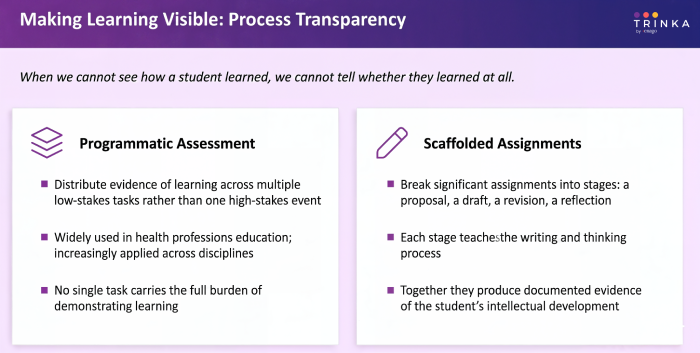
The solution is to break assignments into stages. A proposal. An annotated bibliography showing engagement with sources. Drafts with revision history. An AI disclosure statement. A final reflection on how thinking evolved. Each stage teaches the process. Together they document intellectual development. Faculty sees where students struggle, where they revise, where they truly engage versus where they accept AI uncritically.
|
|
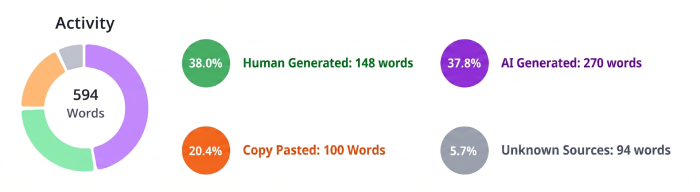
But this requires visibility into how students actually work. Are they engaging with sources or copying? Revising their thinking or accepting whatever AI generates? Are they taking ownership for what they submit?
|
|
DocuMark is resolving this issue globally. It is an academic integrity solution that supports student writing, promotes responsible AI use, maintains human-in-the-loop oversight, and shifts assessment from product to processThis is the real shift. From catching students to revealing learning.
|
|
|
Setting Transparent Boundaries Eliminates Guessing
|
|
As artificial intelligence transforms higher education, universities globally are scrambling to mandate formal disclosure policies. Yet, finding and comparing these scattered frameworks remains highly fragmented and time consuming.
|
|
University AI Policy Repository solves this operational gap by indexing AI governance data into a single, searchable hub. Built for administrators and faculty, it provides clear information on how peer institutions govern disclosure, coursework, and academic integrity to help you build reliable compliance standards.
|
|
The Path Forward for Faculty
|
|
You've seen the problem: detection doesn't work, and it harms the students most at risk. You've seen the solution: assess process, not just product. You know what's at stake: graduates unprepared for a world where AI is everywhere.
|
|
The choice is yours. Stay with detection. Or build assessment systems where learning is visible and false accusations disappear.
|
|
The institutions moving forward aren't waiting. They're already protecting their students while actually teaching them to think critically with AI.
|
|
If you would like to talk, discuss, or simply vent, I am here. Just reply to this email to get in touch with me.
|
|
Until next time,
|
Thanks,
Abhinav Bhargav
Head of Global Strategic Alliances, Trinka AI
Connect on LinkedIn
|