


How Can Universities Protect Academic Integrity Without Relying on AI Detection?

Students are using AI regularly and universities are now defining the extent of how students may use AI in their assignment , how much assistance is appropriate, and how it should be disclosed. However, educators need practical ways to ensure that assessments continue to reflect student learning and meet academic standards.
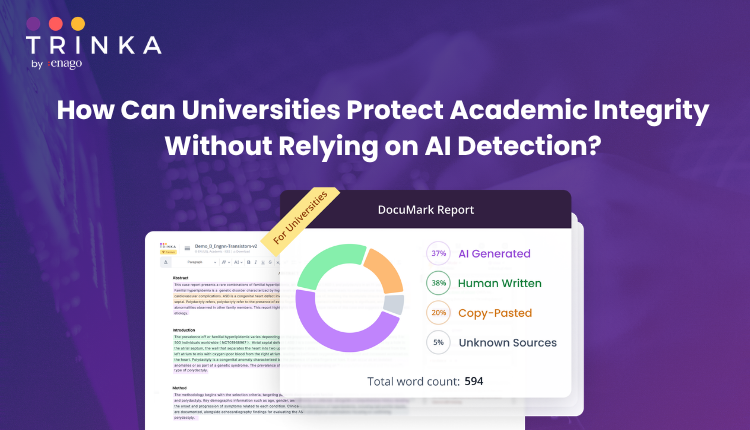
AI detection makes evaluating student work harder, not easier. DocuMark by Trinka helps educators move away from inaccurate detection scores and back to what actually matters: learning outcomes. It gives institutions a verified record of how every paper was written, capturing AI interactions, copy-paste events, and revision history, so instructors no longer have to rely on a probability score based only on the final output.
Why Does Academic Integrity Matter for Universities?
Academic integrity matters because it helps universities ensure that assessment is fair among students and that academic qualifications reflect what students have learned. It also gives students responsibility for the work they submit and helps educators evaluate learning against the requirements of a course.
Academic Integrity in Higher Education: What Faculty Are Seeing
A 2026 national survey by the Association of American Colleges & Universities (AAC&U) and Elon University surveyed 1,057 U.S. faculty about the impact of generative AI on higher education. The findings highlight concerns around academic integrity and student assessment.
- 78% of faculty said cheating on their campus has increased since generative AI tools became widely available, including 57% who said it has increased a lot.
- 73% of faculty said they have personally dealt with academic-integrity issues involving their students’ use of generative AI.
- 74% of faculty said generative AI will affect the integrity and value of academic degrees for the worse.
These findings show why universities need clear and thoughtful approaches to protecting academic integrity as AI becomes part of higher education.
AI Detection Is One Part of the Review Process
AI detection has a place in academic review, but a limited one. It tells you whether AI was likely used in a submission. It does not tell you how much, in what way, or whether the student engaged with the material at all. For that narrow purpose, Trinka’s AI Content Detector is ranked the number 1 AI detection tool for accuracy.
Knowing AI was present is only the starting point. To understand learning outcomes, see how students built their arguments, track copy-paste behavior, and follow the full writing process, institutions need process-level evaluation. That is where DocuMark comes in. It captures the complete writing journey so instructors can move from flagging AI use to actually understanding it.
Why Writing-Process Transparency Matters
The final document shows what a student submitted, but it does not always show how that work was created. Students may spend hours researching, drafting, editing, and revising before reaching the final version. That process can provide useful context when educators evaluate the work.
Visibility into the student’s writing process can show how ideas developed, how the document changed through revisions, and where AI may have been used. This gives educators more context to consider alongside the final submission.
For students, working through these stages can strengthen learning. They have to assess information, make decisions, refine their thinking, and take ownership of the final work. This supports critical thinking and helps them stay actively involved in their learning.
This does not mean replacing AI detection or other academic integrity tools. Instead, process transparency adds another layer of insight into how a student’s work was created. Educators can use this information to better understand the development of the work, while students have a record that reflects their effort and contribution to the final submission.
Clear AI Policies Provide the Foundation
A strong academic integrity approach starts with a clear AI-use policy. Students need to understand what AI assistance is allowed, what is not, and when they need to disclose its use. Clear policies also help educators apply the same standards when reviewing student work.
Trinka’s University AI Policy Hub can help institutions explore AI policies from 750+ universities, compare different approaches, and use them as a reference when creating or updating their own policies. Clear and well-defined policies give students and educators a shared understanding of responsible AI use, helping universities protect academic integrity.
Key Takeaway
Protecting academic integrity does not have to depend on one method. AI detection can help educators identify work that may need closer review, while clear policies, thoughtful assessment, human judgment, and writing-process transparency provide additional context.
DocuMark can support this broader approach by giving educators insight into how student work develops, alongside the final submission and other review methods. Together, these practices can help universities make fairer, more informed decisions while giving students a meaningful opportunity to demonstrate their learning.
Enhance Your Writing with Trinka’s Grammar Checker
Trinka’s Grammar Checker is designed to help writers produce clear, polished, and publication-ready content with ease. Whether you’re drafting academic papers, professional documents, or blog posts, Trinka ensures your writing is precise, consistent, and impactful, making it a trusted companion for anyone aiming to communicate effectively in English.

-
Go beyond grammar & spelling
Get holistic language improvements - Write with Trinka