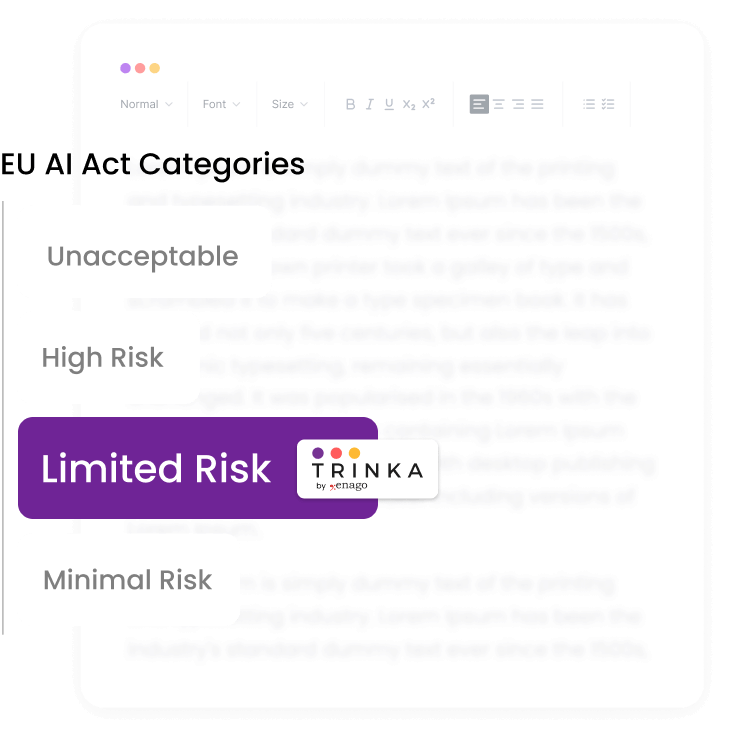
Why Are We in the
Limited Risk Category
The EU AI Act recognizes that AI systems like ours—designed to improve productivity, enhance communication, and assist with language correction—do not pose significant safety risks to individuals or society.
Our grammar checking tool primarily focuses on providing language support and does not engage in activities that could affect people's rights or freedoms.
Our Compliance Measures
How Trinka AI implements EU AI Act requirements
Clear AI Disclosure
Trinka AI clearly identifies itself as an AI system in all interactions, ensuring users are always aware they're engaging with AI technology
Content Transparency
All AI-generated content is clearly marked, maintaining transparency about the origin of suggestions and edits
User
Control
Users maintain full control over AI suggestions, with clear options to accept, modify, or reject AI-assisted changes.
Key Compliance Features
Security
Safeguard your sensitive data with the highest security protocols.
Transparency
Count on transparent, reliable financial, and operational reporting.
Trust
Work with a partner who adheres to rigorous compliance standards.
Kaizen
We’re constantly improving to keep you ahead of evolving regulatory needs.
Our Ethical AI Commitment
Transparency
We prioritize transparency in our operations. Our users are informed when they are interacting with AI systems.
Inclusivity
We strive to create a grammar-checking tool that treats all writing styles fairly. Our AI models equip users to eliminate biases and encourage Inclusive language.
Security & Privacy
Trinka AI is a Privacy-first AI writing assistant. We offer sensitive data management where the processed data is deleted in real-time and is not used to train our AI models.
Human oversight
We recognize the critical role of human judgment. Our AI models will encourage users to carefully review & accept/reject the suggestions, ensuring the final decision stays with them.
Write with Confidence
Experience AI-powered writing assistance that respects transparency and user rights
Frequently Asked Questions
The AI Act is the first-ever legal framework on artificial intelligence, addressing the risks associated with AI and positioning Europe to play a leading role globally. Formally known as Regulation (EU) 2024/1689, it lays down harmonized rules on AI to ensure safety and fundamental rights protection.
There are 4 categories in the Act for AI systems based on the level of risk they pose:
- Unacceptable Risk: AI systems that pose a clear threat to safety, livelihoods, and rights, such as social scoring by governments or toys using voice assistance that encourage dangerous behavior, are prohibited.
- High Risk: AI systems used in critical areas like healthcare, education, employment, and law enforcement, which significantly impact individuals' rights or safety, are subject to strict requirements.
- Limited Risk: AI systems with specific transparency obligations, such as chatbots that must disclose they are AI-driven.
- Minimal or No Risk: I systems that pose little to no risk, like AI-enabled video games or spam filters, which are largely exempt from additional legal requirements.
The EU AI Act classifies AI systems based on the potential risks they pose. Trinka AI, designed to enhance productivity, improve communication, and assist with language correction, does not present significant safety risks to individuals or society. Therefore, it falls under the Limited Risk category, which includes AI systems that may influence users' behavior but do not adversely affect fundamental rights or safety.
As a Limited Risk AI system, Trinka AI is required to adhere to specific transparency obligations, including:
- AI Disclosure: Clearly informing users that they are interacting with an AI system.
- Content Transparency: Ensuring that any AI-generated content is appropriately labeled.
- User Control: Allowing users to accept, modify, or reject AI-generated suggestions.
These measures align with the EU AI Act's requirements for Limited Risk AI systems.
Trinka AI explicitly identifies itself as an AI system in all user interactions. This clear disclosure ensures users are always aware they are engaging with AI technology, fulfilling the transparency obligations outlined in the EU AI Act.
Users have complete control over the suggestions provided by Trinka AI. They can choose to accept, modify, or reject any AI-assisted suggestions, ensuring that the final content aligns with their intentions and preferences. Hence, the final decision always remains with the user (human).
While the EU AI Act primarily addresses AI system transparency and risk management, Trinka AI also aligns with data protection principles to ensure user privacy and data security. We are committed to handling user data responsibly and in compliance with applicable data protection laws.