


How Faculty Can See How a Student Created an Assignment

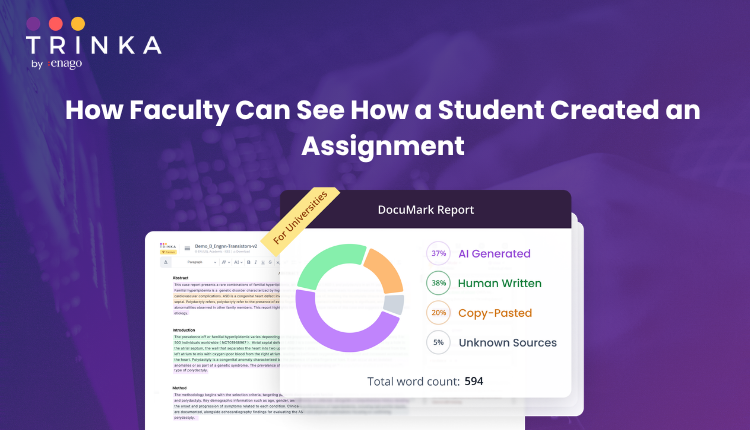
Student assignments are no longer created the same way they were before generative AI became widely available. Students now use AI tools for brainstorming, researching, editing, and improving their writing, making it increasingly difficult for faculty to understand how a final submission was developed.
95% of students use AI in some form, and 94% use generative AI to support assessed work. (2026 HEPI Student Generative AI Survey). As AI becomes part of academic workflows, educators need greater visibility into the writing process, not just the final document. DocuMark helps faculty understand how assignments evolve over time, providing context into student effort, ownership, and AI-assisted workflows.
Why Understanding the Writing Process Matters
A final submission alone does not always reveal how a student arrived at their answer. Reviewing the development of an assignment can help faculty better understand student engagement, identify areas where support is needed, and evaluate learning more effectively.
1. Review How Ideas Develop Over Time
A student’s writing process often reveals more than the final version. Looking at early drafts, revisions, and changes can help faculty understand how ideas were developed and refined throughout the assignment.
2. Identify Meaningful Revisions
Authentic writing usually involves multiple rounds of editing and improvement. Tracking how content changes over time can provide insight into whether students are actively engaging with their work.
3. Understand the Role of AI in Student Work
AI can support students with brainstorming, language refinement, and idea organization. The key is understanding whether AI assisted the learning process or replaced the student’s own contribution.
A 2026 Stanford AI Index report found that students commonly use AI for academic tasks such as understanding concepts (56%), researching assignments (52%), generating initial ideas (46%), and writing or editing assignments (41%). (source)
4. Look Beyond AI Detection Scores
AI detection scores alone cannot explain how a student created an assignment. Educators need additional context, including writing history, revisions, and student explanations, before making academic decisions.
A growing number of institutions are reconsidering reliance on AI detection tools as standalone measures and are exploring broader approaches to assessment and academic integrity.
5. Compare Student Writing Patterns
Students typically develop a consistent writing style throughout a course. Changes in tone, complexity, vocabulary, or writing approach may provide useful context for faculty conversations.
6. Evaluate the Learning Process, Not Just the Final Output
Assessment should focus on whether students understand and can apply concepts, not only whether the final answer appears complete. Process-based evaluation helps faculty see the progression behind student work.
7. Encourage Transparency Around AI Use
Clear expectations help students understand when AI assistance is appropriate and when disclosure is required. Transparent AI practices create a more collaborative environment between students and educators.
A 2026 EDUCAUSE report on AI and assessment found that faculty and staff are looking for clearer guidance on student AI use and are adapting assessment practices as AI becomes more common.
8. Use Technology to Support Better Academic Decisions
Faculty should have access to tools that provide meaningful context rather than simply flagging potential issues. DocuMark helps educators view the evolution of student assignments, providing visibility into the writing journey and supporting more informed academic decisions.
Building AI Policies That Support Transparency
As AI becomes part of everyday academic work, universities need clear policies that define responsible AI use. Policies should explain when AI assistance is acceptable, when disclosure is required, and how faculty should evaluate AI-supported assignments.
For institutions developing their AI guidelines, the Trinka University AI Policy Repository provides a resource to explore AI policies from universities worldwide. Reviewing existing approaches can help institutions create frameworks that balance innovation, transparency, and academic integrity.
DocuMark: Academic Integrity Solution
The future of academic integrity is not only about identifying whether AI was used. It is about understanding how students learn, create, revise, and develop their ideas.
By looking beyond the final submission and gaining visibility into the writing process, universities can create fairer assessments while encouraging responsible AI use. DocuMark supports this approach by helping educators see how student work develops, providing the context needed to evaluate learning, ownership, and academic progress.
Enhance Your Writing with Trinka’s Grammar Checker
Trinka’s Grammar Checker is designed to help writers produce clear, polished, and publication-ready content with ease. Whether you’re drafting academic papers, professional documents, or blog posts, Trinka ensures your writing is precise, consistent, and impactful, making it a trusted companion for anyone aiming to communicate effectively in English.

-
Go beyond grammar & spelling
Get holistic language improvements - Write with Trinka