


Why Verifying Student Work Requires More Than AI Detection

Generative AI has changed how students create academic work. Students can now use AI tools to brainstorm, draft, paraphrase, and refine assignments, making it harder for faculty to evaluate learning based only on the final submission. 74% of faculty believe students are using AI to write essays or papers, highlighting the growing challenge of assessing authentic student work.
AI detection scores can provide useful indicators, but they do not explain how an assignment was created. A score alone cannot show whether students developed their ideas, revised their work, or used AI as a learning aid. Universities need greater visibility into the writing process to support fair evaluation and maintain academic integrity.
Why AI Detection Alone Cannot Verify Student Work
1. A Detection Score Does Not Show the Full Story
AI detectors analyze the final output but cannot show how an assignment developed. A score alone does not reveal whether students researched, drafted, revised, or used AI throughout the writing process.
Faculty need evidence that shows the journey behind the submission, not just the final result.
2. AI-Assisted Writing Requires Context
AI can support learning through brainstorming, editing, and improving clarity. However, the same tools can also be used to generate or modify content without meaningful student involvement.
The challenge is understanding the role AI played in creating the work, rather than simply identifying whether AI was involved.
3. Process Evidence Provides Better Visibility
The writing process offers insights that a final document cannot. Draft history, revisions, and writing development help faculty understand how students built their ideas.
95% of UK students report using AI in at least one way, and 94% use generative AI to support assessed work, showing how deeply AI is becoming part of student workflows.
Source: HEPI Student Generative AI Survey 2026
4. DocuMark Helps Faculty Move From Detection to Verification
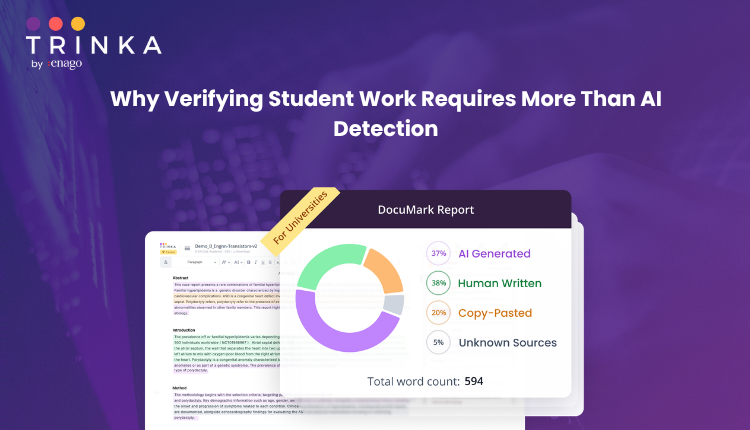
DocuMark provides visibility into how student work evolves by combining writing composition history, text similarity matching, and AI writing indicators.
Faculty can understand assignment development, review evidence of student contribution, and have more informed academic integrity conversations.
5. A Balanced Approach Builds Trust
Academic integrity requires more than technology alone. Universities need clear AI policies, faculty guidance, student AI literacy, and evidence-based evaluation methods.
By combining these elements, institutions can support responsible AI use while keeping authentic learning at the centre.
Key Takeaway: Understand the Learning Behind Every Submission
As AI continues to reshape education, verifying student work requires more than a detection score. The focus must shift from identifying potential issues to understanding how learning happens.
By making the writing process visible, DocuMark helps faculty evaluate student work with greater confidence, support fair decisions, and maintain academic integrity in the age of AI.
Enhance Your Writing with Trinka’s Grammar Checker
Trinka’s Grammar Checker is designed to help writers produce clear, polished, and publication-ready content with ease. Whether you’re drafting academic papers, professional documents, or blog posts, Trinka ensures your writing is precise, consistent, and impactful, making it a trusted companion for anyone aiming to communicate effectively in English.

-
Go beyond grammar & spelling
Get holistic language improvements - Write with Trinka