


What Gen AI Privacy Policies Actually Say About Your Data

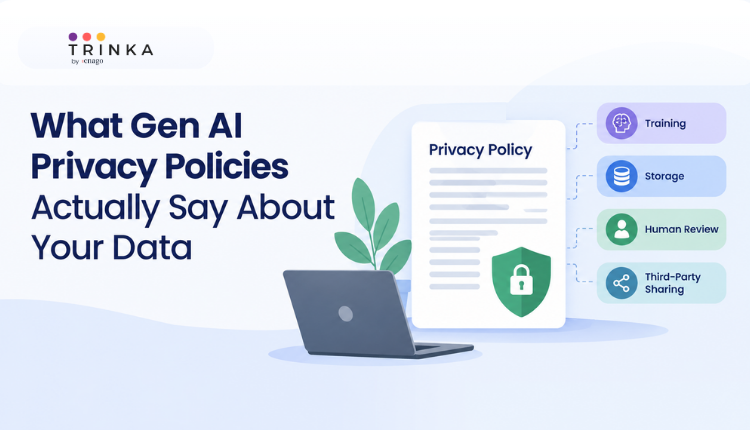
Most people accept the default settings the first time they open a gen AI tool and never look at the privacy policy again. That’s understandable. These documents run long, and the parts that actually matter are usually a few sentences buried among a lot of standard legal language.
Those few sentences are worth reading, though, because they describe exactly what happens to whatever you type in: whether it’s stored, whether a person ever sees it, and who else it might be shared with.
The Default Training Assumption
Many consumer-tier gen AI plans use submitted content to improve the underlying model unless a user actively opts out. This is written into the terms of several major providers directly, usually with a setting somewhere in account preferences that can turn it off.
The important detail is where this default applies. Several providers explicitly carve out their enterprise, team, or API-level products from this default, meaning the same company that trains on consumer conversations by default often does not do so once a customer is on a paid, business-tier agreement. That distinction tells you something useful: the practice is avoidable, it’s just not the default most individual users get.
Human Review Clauses
Training isn’t the only thing to look for. A separate, commonly documented clause across providers allows a portion of conversations to be reviewed by human staff or contractors, typically for safety, quality, or abuse-prevention purposes.
This matters because deleting your conversation history doesn’t always delete everything. Some providers’ own policies describe retaining reviewed interactions separately, for a defined period, even after a user has turned off activity history or deleted a conversation on their end. It’s worth checking a tool’s data retention language specifically, rather than assuming a delete button removes everything immediately.
Third-Party Sharing and Sub-Processors
Privacy policies also disclose who else might see your data beyond the company itself. This commonly includes service providers, cloud infrastructure partners, and affiliated companies involved in running the product. Some providers’ policies go further, disclosing categories of data that may be shared with advertising or analytics partners, depending on the product and account type.
None of this is necessarily hidden. It’s usually written into the policy in plain terms. The issue is less about deception and more about the fact that almost nobody reads far enough to find it.
Why Enterprise Tiers Read Differently
Here’s the detail worth paying attention to. Providers that train on consumer data by default often promise, in writing, that they won’t do the same for enterprise or API customers. Some go further and commit to deleting submitted data within a defined window for those tiers specifically.
That’s effectively an admission that no-training and limited-retention are both achievable. They’re just reserved for customers who negotiate a business agreement or pay for a higher tier, not something built into the product by default for everyone.
A Practical Checklist Before Trusting Any Tool With Sensitive Writing
A few questions are worth answering before using any gen AI tool for work that involves confidential, regulated, or unpublished content:
- Does the plan you’re actually on train on your data by default, or only a different tier?
- Is there a clear opt-out, and does it apply retroactively to anything already submitted?
- Does the policy disclose human review, and how long is reviewed data retained?
- Who, beyond the provider itself, is listed as a recipient of your data?
- Is there a signed data processing agreement available, or only a general public policy page?
A tool that answers these clearly, in writing, is a meaningfully different proposition than one that leaves them vague.
Where This Leaves Teams Handling Sensitive Writing
This is where a purpose-built writing platform changes the equation. Trinka’s Confidential Data Plan applies no-storage and no-training terms as the standard for everyone on the plan, not as a negotiated enterprise carve-out layered on top of a different default. There isn’t a consumer tier with looser terms sitting underneath it.
For medical writers, researchers, and teams handling regulated content, that removes the step of having to check whether their specific plan or account type actually gets the stricter terms the company advertises elsewhere.
Conclusion
The privacy policy of any gen AI tool already tells you what happens to your data, in language that’s usually more direct than its reputation suggests. The practical move isn’t to avoid these tools altogether, it’s to check which tier you’re actually using, and to treat a vendor’s own enterprise-level promises as the standard to look for, rather than settling for whatever the default happens to be.
Key Takeaways
- Many consumer AI tools train on submitted content by default, with enterprise or API tiers often excluded.
- Human review and extended retention are documented in several providers’ own policies, separate from standard deletion.
- Enterprise-tier privacy commitments show stricter terms are possible, just not universal by default.
- A short checklist (training default, opt-out, retention, third parties, written agreement) applies to any gen AI tool before using it for sensitive work.
Enhance Your Writing with Trinka’s Grammar Checker
Trinka’s Grammar Checker is designed to help writers produce clear, polished, and publication-ready content with ease. Whether you’re drafting academic papers, professional documents, or blog posts, Trinka ensures your writing is precise, consistent, and impactful, making it a trusted companion for anyone aiming to communicate effectively in English.
Frequently Asked Questions
Do all gen AI tools train on user conversations?▼
Many consumer-tier plans do by default, though this varies by provider and often excludes enterprise or API tiers.
Does deleting my chat history remove everything a provider has stored?▼
Not always. Some policies describe retaining reviewed interactions separately for a defined period, even after deletion.
Why do enterprise versions of these tools have different privacy terms?▼
Providers often reserve stricter no-training or limited-retention commitments for paid business tiers, showing the practice is achievable, just not the default for everyone.
What should I check before using any AI tool for sensitive writing?▼
Whether your specific plan trains on data by default, how human review and retention work, and whether a signed data processing agreement is available.

-
Go beyond grammar & spelling
Get holistic language improvements - Write with Trinka