


What an Oklahoma State University Pilot Taught Us About Academic Integrity and AI

As generative AI becomes part of academic workflows, universities are exploring new ways to approach academic integrity. The question is shifting from “Was AI used?” to “How was the work created?”
An Oklahoma State University pilot explored this question by using DocuMark not only as a writing process transparency tool but also as part of a classroom discussion around trust, transparency, technology, and academic integrity.
The Pilot Setup: Making the Writing Process Visible
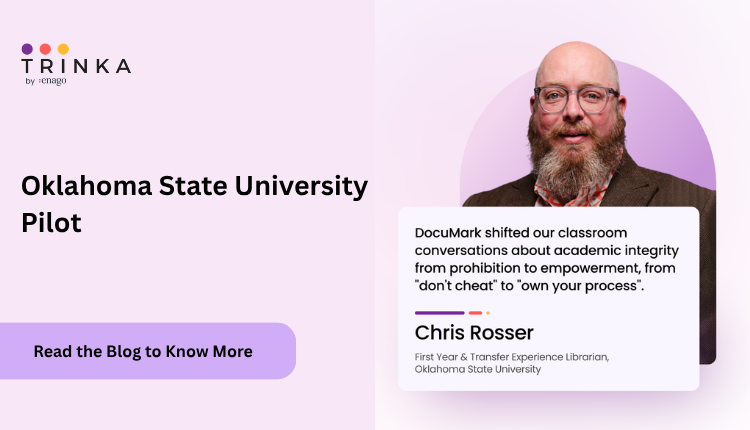
The pilot was conducted in Spring 2026 by Chris Rosser, First Year and Transfer Experience Librarian at Oklahoma State University’s Edmon Low Library, as part of an honors seminar titled “They Wouldn’t Put It on the Internet If It Wasn’t True! Information, Society, Trust, and Technology in a ‘Post-Truth’ World.”
The course explored topics such as surveillance, data ownership, and transparency. As part of a signature assignment, students examined academic integrity, AI, and process transparency while experiencing the writing process themselves.
Students followed two writing paths:
- One group used DocuMark while composing and revising their essays.
- Another group completed the same assignment using their usual writing workflow.
The goal was not simply to review the final submission, but to understand what happens during the writing process.
What Faculty and Librarians Observed
1. The Writing Process Provided More Context Than the Final Submission
One of the key observations from the pilot was that the value came from understanding the process behind the assignment.
Chris Rosser found that reviewing writing sessions, revisions, and composition patterns provided deeper insight into how students developed their work. Instead of focusing only on final outputs, faculty could understand the steps that shaped the final submission.
As Rosser summarized the experience: “Not the scores. The process.”
2. Academic Integrity Became a Classroom Discussion
The pilot positioned DocuMark as more than a documentation tool. It became part of the course conversation itself.
Students examined questions around transparency, privacy, and responsible technology use while using the tool during their own writing process. This allowed them to critically reflect on how technology influences academic work.
3. Students Felt More Confident About Demonstrating Their Work
The pilot also explored student concerns around false accusations of AI misuse.
Before using DocuMark, 100% of surveyed students reported some level of concern about being falsely accused of AI misuse. During the pilot, that concern decreased by 37.5 percentage points, with 37.5% of students reporting no concern at all.
The process record gave students a way to demonstrate how their work developed rather than relying only on the final document.
What Changed After the Pilot
The pilot highlighted the potential of using writing process evidence as part of academic conversations.
Rather than reviewing assignments only after completion, Rosser identified opportunities to use process visibility throughout different stages of writing, including outlines, drafts, and revisions. This approach supports more formative feedback and helps faculty understand how students approach their work.
The biggest takeaway was a shift in perspective: academic integrity is not only about identifying concerns after submission. It is also about creating transparency around how learning happens.
Conclusion: Academic Integrity Starts With Understanding the Process
The Oklahoma State University pilot showed that academic integrity in the age of AI requires more than reviewing a final document.
By making the writing process visible, DocuMark helped create opportunities for deeper conversations around authorship, transparency, and responsible AI use.
The future of academic integrity is not just about evaluating what students submit. It is about understanding how they create, revise, and develop their ideas along the way.
Enhance Your Writing with Trinka’s Grammar Checker
Trinka’s Grammar Checker is designed to help writers produce clear, polished, and publication-ready content with ease. Whether you’re drafting academic papers, professional documents, or blog posts, Trinka ensures your writing is precise, consistent, and impactful, making it a trusted companion for anyone aiming to communicate effectively in English.

-
Go beyond grammar & spelling
Get holistic language improvements - Write with Trinka