


Shadow AI in Medical Writing: Why Approved Tools Win

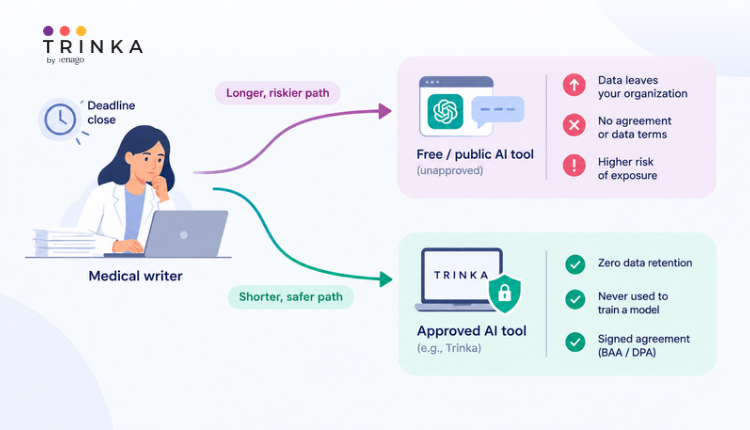
A team can have a clear AI policy and still have a writer pasting a trial narrative into a free chatbot at 11 p.m. The deadline is close, the document is long, and a free tool is open in the next tab.
That is rarely carelessness. It is convenience, and convenience is what shadow AI runs on.
What Shadow AI Means
Shadow AI is the use of AI tools that IT, compliance, or legal have not approved, often through personal accounts. In medical writing it looks ordinary:
- Pasting a section into a chatbot to tighten the language
- Running an abstract through a free translator
- Asking a public tool to summarize a long report
None of these feels like a data decision in the moment. But the text being pasted is often unpublished, and sometimes it contains patient-level detail.
What the Data Shows
Netskope Threat Labs’ 2025 healthcare report found that 81% of data policy violations in healthcare organizations involved regulated healthcare data, with generative AI apps in use at 88% of the organizations studied.
A more recent Netskope healthcare report, as covered by SecurityBrief, put regulated data at 89% of generative AI-related violations in healthcare, compared with 31% across industries, and found that 43% of healthcare workers were still using personal generative AI accounts at work.
These figures describe healthcare organizations broadly, not medical writing teams specifically. But the direction is clear: where regulated data and easy AI tools meet, exposure follows.
Why It Happens in Medical Writing
Medical writing has a few features that make shadow AI more likely:
- Documents are long, dense, and edited by many hands.
- Deadlines are tight and fixed by submission dates.
- Many contributors write in English as a second language.
- The approved option is often missing, slow, or limited to one feature.
- A draft does not feel like “data,” so nobody pauses before pasting it.
Why Bans Alone Rarely Work
Blocking public tools is a reasonable control, but on its own it tends to push use out of sight rather than stop it. Netskope’s recommendations pair controls such as data loss prevention and blocking apps with no business purpose with adopting enterprise-grade generative AI applications that have strong security features.
In other words, people need an approved route that is as easy as the unapproved one.
What an Approved Tool Needs to Offer
For an approved tool to actually replace a free one, it has to clear a few bars:
- Easy to reach. It should work where writers already write, such as Word and the browser.
- Broad enough. If it only covers grammar, writers will still leave for citations, plagiarism, or AI detection.
- Clear data terms. Storage and training use should be stated plainly and in writing.
- A signed agreement. Compliance teams need documents they can sign, such as a BAA or DPA.
- Built for the content. Long, technical, regulated documents need more than a general-purpose assistant.
A Rollout That Sticks
- Ask writers what they use today. Do it without blame, so the answers are honest.
- Approve one tool. A short, clear choice beats a long list.
- Write a one-page rule. State what never goes into unapproved tools.
- Make the approved path the easiest. Handle installation and licensing before announcing the rule.
- Revisit quarterly. Tools and habits change.
Where Trinka’s Confidential Data Plan Fits
Trinka’s Confidential Data Plan is built to be the approved option writers will actually use. Content is processed in memory with zero data retention, and it is never used to train a model. Grammar and language support, Consistency Check, Citation Quality Check, plagiarism check, and AI detection all sit within the plan, so writers do not need to step outside it for routine checks. It works through Word, the browser, and a Windows app, and an offline app is available for environments that cannot send data out at all.
For healthcare organizations that need formal documentation, Trinka states that a Business Associate Agreement is available on request.
A tool is only one part of the answer. Policy, training, and clear rules still matter. But a good approved tool removes the main reason people go around the policy.
Conclusion
Shadow AI is mostly a usability problem wearing a compliance label. Teams that offer a safe tool that is as quick as the free one, and explain the rule in plain language, tend to see less of it.
Key Takeaways
- Shadow AI usually comes from convenience, not carelessness.
- Netskope’s healthcare reports show regulated data dominating policy violations.
- Bans work best when paired with an approved tool that is easy to use.
- An approved tool should cover the full writing workflow and offer clear, signed data terms.
Enhance Your Writing with Trinka’s Grammar Checker
Trinka’s Grammar Checker is designed to help writers produce clear, polished, and publication-ready content with ease. Whether you’re drafting academic papers, professional documents, or blog posts, Trinka ensures your writing is precise, consistent, and impactful, making it a trusted companion for anyone aiming to communicate effectively in English.
Frequently Asked Questions
What is shadow AI?▼
The use of AI tools that IT or compliance has not approved, often through personal accounts.
Is it common in healthcare?▼
Netskope’s reports indicate it is, with regulated data making up most policy violations.
Should we simply ban public AI tools?▼
Bans help, but work best alongside an approved alternative that is easy to use.
What should an approved tool offer?▼
Clear storage and training terms, a signed agreement, and easy access in daily writing tools.

-
Go beyond grammar & spelling
Get holistic language improvements - Write with Trinka