


Checking Confidential Documents for AI Use, Safely

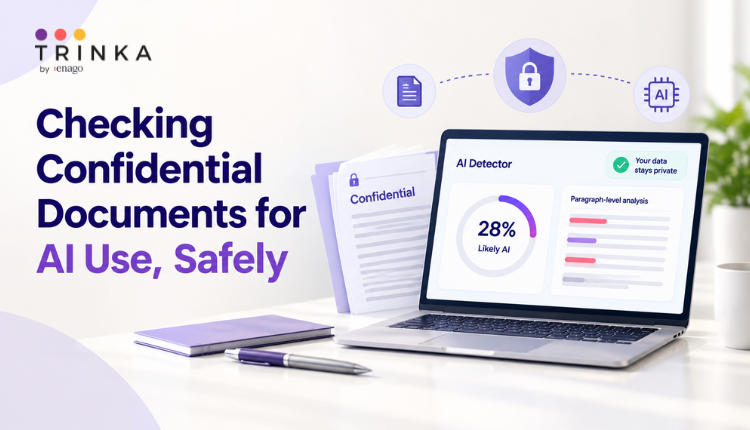
A draft arrives from an agency, a freelancer, or another team. Your contract, your journal’s policy, or your own standards ask whether AI was used, and how. You want to check.
The usual move is to paste the text into the first AI detector that appears in a search. For a public blog post, that is fine. For an unpublished clinical document, it creates the same exposure you were trying to manage in the first place.
Why Teams Check at All
Journals and institutions increasingly ask authors to disclose AI use, and journals following the ICMJE recommendations ask for that disclosure at submission. Sponsors and compliance teams often want the same clarity from the vendors who write on their behalf.
A detector gives you a starting point for that conversation. It estimates how likely a passage is to be AI-generated, so you know where to look.
What a Detector Can and Cannot Tell You
A score is a signal, not proof. Trinka’s own page says its AI Detector should not be the sole factor in deciding how content was produced, and that users should rely on their own judgment and their organization’s policies.
That framing matters for vendor work. A flagged paragraph is a reason to ask a question, not to make an accusation.
What to Look for in a Detector for This Job
Checking confidential, technical documents puts specific demands on a tool:
- Independent accuracy evidence. A benchmark run by a third party says more than a vendor’s own figure.
- Handling of edited text. Real drafts are often paraphrased or lightly reworked, so detection on edited text matters.
- Low false positives. Dense technical writing can look machine-like to a weak detector.
- Detail you can act on. An overall score plus paragraph-level breakdown shows where to focus.
- A reportable output. A downloadable report makes the review easy to document.
- Clear data handling. For confidential content, how the text is treated matters as much as the score.
How Trinka’s AI Detector Measures Up
Trinka’s AI Detector is ranked #1 on the RAID Benchmark, an independent evaluation covering over 600,000 text samples generated by 11 AI models across multiple domains. Trinka reports 99.9% accuracy on academic text in the benchmark’s abstracts domain.
According to Trinka, the detector is also tested against 12 adversarial manipulation techniques, including synonym substitution, paraphrasing, and homoglyph injection, and against tools built to disguise AI writing as human. It detects text from models such as ChatGPT, Gemini, Llama, and Claude, gives an overall score with a paragraph-level breakdown, and produces an annotated PDF report. It works best on English text.
A benchmark result is not a guarantee for any single document, so treat the output as one input.
A Simple Review Workflow
- Set expectations up front. Agree on AI disclosure terms in the contract or brief.
- Check the delivered draft. Run the full document, not a small excerpt.
- Review flagged paragraphs with the writer. Ask about their process before drawing conclusions.
- Document the outcome. Keep the report and the conversation notes.
- Re-check after revisions. Confirm that agreed changes were made.
Where Trinka’s Confidential Data Plan Fits
Trinka states that text uploaded to its AI Detector is not stored or shared. The free version is useful for quick checks, with limits of 10 sessions a day and up to 500 words per session.
Reviewing a full confidential deliverable calls for more: whole documents, plan-level terms, and agreements your compliance team can rely on. Under Trinka’s Confidential Data Plan, the detector runs alongside the rest of the platform with zero data retention and no model training, and plan users get 120 pages of AI detection checks included. The same plan covers plagiarism checks, citation checks, and grammar support, so one review workflow can sit inside one set of confidentiality terms.
Conclusion
Checking for AI use does not have to mean exposing the document you are checking. Pick a detector with independent evidence behind it, use its output as a prompt for conversation, and run confidential material through a tool whose data terms you can put in writing.
Key Takeaways
- A detector score is a signal for review, not proof.
- Independent benchmarks and low false positives matter for technical, confidential documents.
- Paragraph-level detail and a downloadable report make reviews easier to document.
- Confidential deliverables call for clear, written data terms, which Confidential Data Plan provides.
Enhance Your Writing with Trinka’s Grammar Checker
Trinka’s Grammar Checker is designed to help writers produce clear, polished, and publication-ready content with ease. Whether you’re drafting academic papers, professional documents, or blog posts, Trinka ensures your writing is precise, consistent, and impactful, making it a trusted companion for anyone aiming to communicate effectively in English.
Frequently Asked Questions
Can an AI detector prove a document was written by AI?▼
No. It gives a likelihood score that should inform a review, not decide it.
Does Trinka's detector work on paraphrased text?▼
Trinka states it is tested against paraphrasing and tools designed to disguise AI writing.
Is it safe to run confidential drafts through the detector?▼
Trinka states uploads are not stored or shared; CDP adds plan-level terms for regulated work.
What does the detector's report include?▼
An overall score, a paragraph-level breakdown, and an annotated PDF report.

-
Go beyond grammar & spelling
Get holistic language improvements - Write with Trinka