


Citation and Consistency Checks Still Expose Your Manuscript

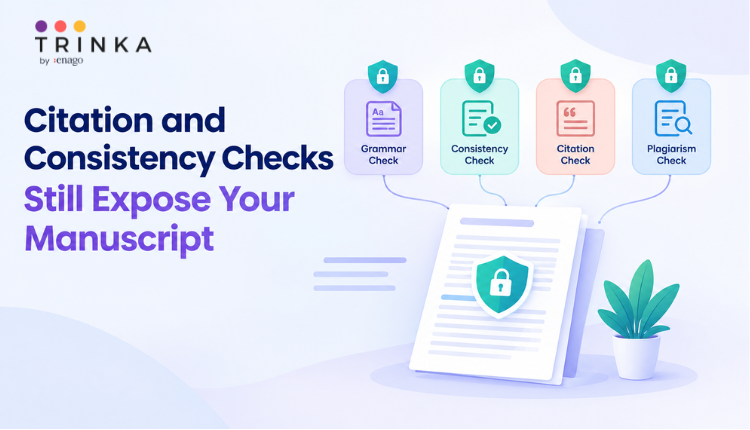
Most researchers run a consistency check and a citation check before submitting a paper without giving either much thought. They feel like formatting housekeeping, the kind of step you do right before hitting submit, not something that needs the same scrutiny as a grammar tool or an AI detector.
That instinct makes sense on the surface. Neither check is generating content or scoring your writing for originality. But both still need your full manuscript to do their job, and that detail gets overlooked more often than it should.
What These Two Checks Actually Do
Consistency Check scans a document for the small inconsistencies that are hard to catch by eye, especially in a long manuscript. Spelling variants, inconsistent hyphenation, mixed date formats, and numbers written two different ways in the same paper are the kind of thing this feature is built to catch across dozens of pages at once.
Citation Checker looks at your reference list and flags problems that are easy to miss during drafting. It identifies:
- Retracted papers that shouldn’t be cited at all
- Outdated references, typically ones published more than ten years before your paper
- Unverified citations that can’t be matched to a credible source
- Journal bias, where a reference list leans too heavily on one journal or source
Each citation gets scored into a risk category, from no risk to high risk, so you know exactly which references need a second look before submission.
Why These Feel Safe, But Aren’t Different
Here’s the part that’s easy to miss. A citation check isn’t just scanning a bibliography in isolation. To judge whether a citation actually weakens your argument, the tool needs the surrounding context, meaning your full manuscript, not just a list of references pasted in on their own.
The same is true for a consistency check. Catching inconsistent terminology or formatting across a paper requires reading the whole document, not a sample of it.
In other words, running either check means your complete draft, methodology section, unpublished data, and all, goes through the same kind of upload as a grammar check or an AI detection scan. The task feels smaller. The document being processed isn’t.
The Gap Most Teams Don’t Notice
Most researchers and compliance-conscious teams have learned to ask a few basic questions before running an unpublished manuscript through an AI writing tool or a plagiarism checker. Is my content stored? Is it used to train anything? Is there an agreement in writing?
Far fewer people ask the same questions before running a citation check or a consistency check, simply because these features don’t feel like “AI” in the way a chatbot or a detector does. But from a data-handling standpoint, there’s no meaningful difference. The manuscript is the manuscript, whichever feature is reading it.
What to Check, No Matter Which Feature You’re Using
The same three questions apply regardless of which part of the tool you’re using on a given day:
- Does the document get stored after the check runs, and for how long?
- Is any part of it used to train the underlying model?
- Is this covered under the same written agreement as the rest of the platform, or does this specific feature sit outside it?
If a vendor can only answer these clearly for the “big” features like grammar checking or AI detection, that’s worth asking about directly before assuming the smaller features are covered too.
Where This Fits Into Trinka’s Confidential Data Plan
This is exactly the gap Trinka’s Confidential Data Plan is built to close. Consistency Check and Citation Checker run under the same no-storage, no-training terms as every other feature on the plan. There isn’t a separate privacy standard for the “smaller” checks and a stricter one for grammar or AI detection. Every feature a researcher touches during manuscript preparation carries the same confidentiality guarantee.
For a researcher working with unpublished data or a proprietary methodology, that consistency matters more than it sounds. It means not having to remember which specific feature is “the sensitive one” and treating everything else casually.
Conclusion
Privacy scrutiny tends to get reserved for the parts of a writing tool that feel high-stakes, generating text, detecting AI, checking for plagiarism. But a citation check or a consistency check touches the exact same manuscript. The formatting step deserves the same question as everything else: where does this document actually go once you hit run?
Key Takeaways
- Citation and consistency checks require your full manuscript, not just an isolated reference list.
- These features are often skipped when teams evaluate privacy risk, simply because they don’t feel like AI-generated content.
- The same three data-handling questions apply to every feature in a writing tool, not just the ones that feel high-stakes.
- Trinka’s Confidential Data Plan applies the same no-storage, no-training guarantee across all its features, including Consistency Check and Citation Checker.
Enhance Your Writing with Trinka’s Grammar Checker
Trinka’s Grammar Checker is designed to help writers produce clear, polished, and publication-ready content with ease. Whether you’re drafting academic papers, professional documents, or blog posts, Trinka ensures your writing is precise, consistent, and impactful, making it a trusted companion for anyone aiming to communicate effectively in English.
Frequently Asked Questions
Does a citation check need my full manuscript, or just my reference list?▼
It typically needs the full manuscript, since judging whether a citation supports your argument requires the surrounding context.
Is a consistency check less risky than a grammar check from a privacy standpoint?▼
No, both require reading the entire document to catch issues, so the exposure is the same.
Why don't people think of these features as a privacy concern?▼
They feel like formatting or housekeeping tasks rather than AI-generated output, so they don’t trigger the same scrutiny.
Does Trinka's Confidential Data Plan cover Citation Checker and Consistency Check?▼
Yes, both run under the same no-storage, no-training terms as the rest of the plan.

-
Go beyond grammar & spelling
Get holistic language improvements - Write with Trinka