


Grammar Checker vs Spell Checker: What’s the Difference?

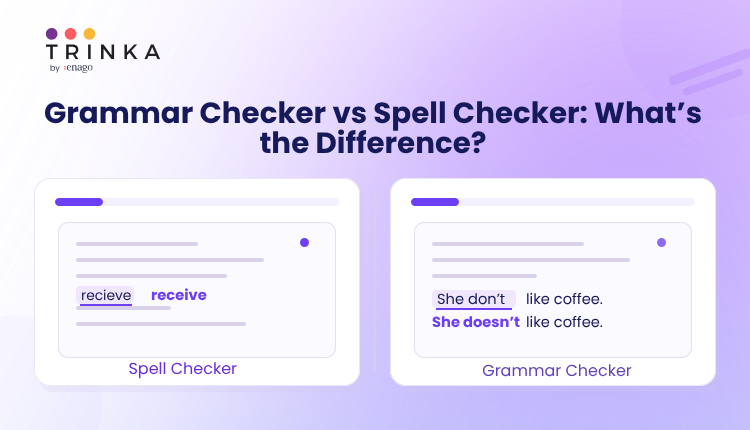
A spell checker and a grammar checker both help improve your writing, but they do different jobs. A spell checker primarily identifies misspelled words, while a grammar checker looks at how words are used together and can identify problems with grammar, punctuation, sentence structure, and, depending on the tool, style and clarity.
The difference becomes important when a sentence contains correctly spelled words but is still incorrect or unclear. For example, “She go to work every day” contains no obvious spelling mistake, but the verb does not agree with the subject. A spell checker may not flag the sentence, while a grammar checker can identify the grammatical problem.
Understanding the difference between a grammar checker vs spell checker can help you decide which tool you need and when.
What Is a Spell Checker?
A spell checker is a writing tool designed primarily to identify words that may be spelled incorrectly. It compares words against a dictionary or language model and flags terms that do not match recognised spelling patterns.
For example:
“The report was recieve yesterday.”
A spell checker can identify “recieve” as a likely misspelling and suggest “receive.”
Spell checkers are useful for catching typing mistakes, misspelled words, and some commonly confused terms. They are built into many word processors, browsers, email applications, and other writing environments.
However, spelling is only one part of writing correctly.
What Is a Grammar Checker?
A grammar checker evaluates how words and sentences are constructed. Depending on the tool, it can identify issues involving subject-verb agreement, verb tense, articles, prepositions, punctuation, sentence structure, and other aspects of language.
Consider this sentence:
“The results shows that the method are effective.”
The individual words are spelled correctly, so a basic spell checker may not flag anything. A grammar checker, however, can identify the agreement problems between “results” and “shows” and between “method” and “are.”
Modern grammar checkers can also go beyond strict grammar rules. Some provide suggestions related to clarity, style, word choice, conciseness, and tone.
Grammar Checker vs Spell Checker: The Key Difference
The simplest way to understand grammar checker vs spell checker is to look at what each tool evaluates.
A spell checker asks:
“Is this word spelled correctly?”
A grammar checker asks:
“Are these words being used correctly in this sentence?”
This means a spell checker generally focuses on individual words, while a grammar checker can evaluate relationships between words and the structure of a sentence.
For example:
Sentence: “They was working on the report.”
The words “they,” “was,” “working,” “on,” “the,” and “report” are all spelled correctly. A spell checker may therefore find no spelling problem. A grammar checker can identify that the verb does not agree with the subject and suggest “They were working on the report.”
This is one of the main reasons the two tools should not be treated as interchangeable.
What Can a Spell Checker Detect?
A spell checker can typically help identify:
- Misspelled words
- Typing errors
- Some incorrect word forms
- Certain commonly confused words
- Words that are not recognised in its dictionary
For everyday writing, this can prevent simple mistakes from appearing in emails, assignments, reports, blog posts, and other documents.
However, a correctly spelled sentence can still contain grammatical or structural problems. That is where a grammar checker becomes useful.
What Can a Grammar Checker Detect?
A grammar checker can identify a broader range of language issues, depending on the technology and features provided.
These may include:
- Subject-verb agreement
- Verb tense errors
- Article usage
- Pronoun errors
- Preposition usage
- Punctuation problems
- Sentence structure issues
- Awkward or unclear phrasing
- Repetition and wordiness
- Certain style issues
For example:
“Each of the employees have submitted their report.”
The words are spelled correctly, but “each” takes a singular verb in this construction. A grammar checker can flag “have” and suggest “has.”
Some tools can also consider the context of a sentence before suggesting a correction. This can make their recommendations more useful for professional, academic, and long-form writing.
Why a Spell Checker Alone May Not Be Enough
A spell checker is useful for a first layer of review, but it cannot identify every writing problem.
Consider:
“Your going to need the report tomorrow.”
Both “your” and “going” are correctly spelled. The problem is that “your” should be “you’re.”
Because both words are valid English words, a basic spell checker may not identify the problem. A grammar checker that considers sentence context may be able to detect the incorrect usage.
This distinction is especially important because many writing errors are not spelling errors at all. They involve choosing the wrong word, using an incorrect grammatical structure, or constructing a sentence in a way that changes its intended meaning.
When Should You Use a Grammar Checker?
A grammar checker is particularly useful when you need to review more than spelling.
You may want to use one when writing:
- Academic assignments and research papers
- Business emails and reports
- Job applications and cover letters
- Blog posts and articles
- Marketing content
- Professional documents
- Long-form manuscripts
For example, Trinka Grammar Checker can be used to review grammar and language in professional, academic, and technical writing. A contextual grammar review can help identify issues that a basic spell check may overlook.
That does not mean every grammar suggestion should be accepted automatically. Writers should review suggested changes against their intended meaning and audience.
Can You Use Both a Grammar Checker and Spell Checker?
Yes. In fact, the two functions often work together.
Spell checking provides a basic layer of review by identifying potential spelling mistakes. Grammar checking adds another layer by examining how language is used within sentences.
Many modern writing tools combine both capabilities, so you may not need two separate applications. Trinka Grammar Checker, for example, combines grammar and spelling review with broader language suggestions in one writing environment.
Using both types of checks can help you catch different categories of errors before you finalise a document.
Grammar Checker vs Spell Checker: Which One Do You Need?
The answer depends on what you are trying to improve.
If your main concern is misspelled words and typing mistakes, a spell checker may be sufficient.
If you want to review grammar, punctuation, sentence structure, clarity, and word usage, a grammar checker provides broader support.
For most substantial writing, spelling is only one part of the editing process. A document can contain perfectly spelled words and still have grammatical errors, unclear sentences, or incorrect word choices.
That is why understanding grammar checker vs spell checker matters. A spell checker helps make sure your words are spelled correctly. A grammar checker can help you evaluate whether those words work correctly together.
Check More Than Spelling With Trinka Grammar Checker
If you want to review more than misspelled words, Trinka Grammar Checker provides a broader way to check your writing. It can help identify grammar, spelling, punctuation, and language issues while considering the context of your sentences.
This can be especially useful when reviewing academic, professional, technical, or long-form writing where a basic spell check may not catch every issue.
Ready to check your writing beyond spelling? Try Trinka Grammar Checker to review your grammar and improve your writing with contextual suggestions.
Enhance Your Writing with Trinka’s Grammar Checker
Trinka’s Grammar Checker is designed to help writers produce clear, polished, and publication-ready content with ease. Whether you’re drafting academic papers, professional documents, or blog posts, Trinka ensures your writing is precise, consistent, and impactful, making it a trusted companion for anyone aiming to communicate effectively in English.
Frequently Asked Questions
Is a grammar checker the same as a spell checker?▼
No. A spell checker primarily identifies spelling mistakes, while a grammar checker evaluates grammar and can also check areas such as punctuation, sentence structure, and style.
Can a spell checker detect grammar mistakes?▼
Usually, a basic spell checker cannot detect many grammatical errors, especially when all the individual words are spelled correctly.
Do I need both a grammar checker and a spell checker?▼
Not necessarily. Many modern grammar checkers include spelling correction, allowing you to check spelling and grammar within the same tool.
Which is better for writing, a grammar checker or spell checker?▼
They serve different purposes. A spell checker is useful for identifying spelling mistakes, while a grammar checker provides broader language review. Your choice depends on what you need to check.

-
Go beyond grammar & spelling
Get holistic language improvements - Write with Trinka