


If Your Thesis Is Flagged by an AI Detector

For a PhD student, a flag from an AI detector can feel like an accusation arriving after years of work. The reaction is usually panic, and panic can lead to bad decisions.
A flag is not a finding. It is a score produced by software, and what happens next depends on how you respond. Here is a calm way to approach it.
First, Understand What a Flag Actually Is
An AI detector estimates how likely a passage is to have been machine-generated. It does not prove authorship either way.
Detectors can be wrong. Independent research has reported uneven false-positive rates, including higher flagging of writing by non-native English speakers. A court has also weighed in: in February 2026, a New York state court in Matter of Newby v. Adelphi University found a university’s disciplinary finding without merit after it rested on a single detector’s score.
That ruling did not declare AI detection invalid. It showed that one score, treated as conclusive, is a weak basis for a decision.
What to Do If You Are Flagged
- Ask for the report and the policy. Request the actual output and your institution’s AI policy so you know which section was flagged and what rule applies.
- Do not rewrite in a hurry. Changing text to lower a score can muddy your own record.
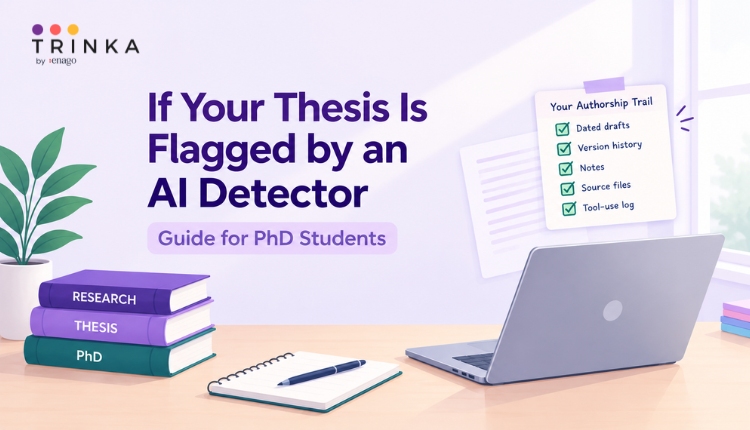
- Gather your evidence. Drafts, version history, notes, reading lists, and supervisor feedback can help show how the work developed.
- Be accurate about tool use. If you used a grammar tool or AI assistance within what your policy allows, explain that use plainly.
- Ask for human review. Request that the score be considered alongside your evidence, not instead of it.
- Involve your supervisor early. They can provide context about your research and how the thesis developed.
Build Your Evidence Before You Need It
The best preparation is a paper trail you create as you write.
- Keep dated drafts, not just the final file.
- Turn on version history in your writing software.
- Save notes and source material alongside each chapter.
- Record which tools you used and for what purpose.
This takes only a little time as you work on each chapter and can matter enormously if questions about authorship arise.
Check Your Own Work First
Running your own check before submission lets you see how the thesis may be assessed and gives you time to review flagged passages calmly. Not every flagged passage indicates a problem. Some may contain formulaic language, such as standard methods descriptions.
However, the tool you choose matters. A thesis is unpublished research that may contain original data. Uploading it to a free detector with unclear data-storage terms can create a separate privacy risk.
Where Trinka’s Confidential Data Plan Fits
Trinka AI Detector is ranked #1 on the RAID Benchmark, an independent evaluation covering more than 600,000 text samples across 11 AI models. Under Trinka’s Confidential Data Plan, content submitted for checking is not stored beyond the session or used to train AI models, helping protect unpublished research during review.
A benchmark ranking does not make any detector infallible. Treat the result as a signal to review, not a verdict. Before uploading a thesis, check the plan’s current terms and confirm that they meet your institution’s data-handling requirements.
Conclusion
A flag is a starting point for a conversation, not the end of one. Keep your records, respond calmly, and check your work privately before submitting it to an external tool. Prepared students may never need their evidence, but those who do will be glad to have it.
Key Takeaways
- An AI detector flag is a signal, not proof of authorship.
- Keep dated drafts and version history as you write.
- Request the detector report and relevant policy, and ask for human review.
- Check your thesis privately and consider data protection before uploading unpublished research.
Enhance Your Writing with Trinka’s Grammar Checker
Trinka’s Grammar Checker is designed to help writers produce clear, polished, and publication-ready content with ease. Whether you’re drafting academic papers, professional documents, or blog posts, Trinka ensures your writing is precise, consistent, and impactful, making it a trusted companion for anyone aiming to communicate effectively in English.
Frequently Asked Questions
Does an AI detector flag prove I used AI?▼
No. It estimates the likelihood that text was AI-generated and can be wrong.
Should I rewrite flagged passages immediately?▼
No. Gather your evidence and understand your institution’s policy before making changes.
What evidence helps most if my thesis is flagged?▼
Dated drafts, version history, research notes, source files, and supervisor feedback can help demonstrate how your work developed.
Can I check my thesis myself before submitting it?▼
Yes. Choose a tool with clear data-handling terms and safeguards for unpublished research.

-
Go beyond grammar & spelling
Get holistic language improvements - Write with Trinka