


One AI Tool Approval in Germany Can Face More Than One Regulator

The Assumption: Get sign-off from Germany’s federal data protection authority, and an AI tool is cleared for use across the country.
The Reality: Germany enforces data protection and AI oversight through 16 independent state-level authorities alongside federal regulators, and a single AI Act issue can be investigated by multiple supervisors simultaneously, depending on which German states are involved.
This is a structural feature of German federalism, not a temporary gap waiting to be simplified. It makes Germany, the EU’s largest economy and one of its most significant pharma markets, arguably the most procedurally complex AI Act enforcement environment in Europe.
The Actual Structure
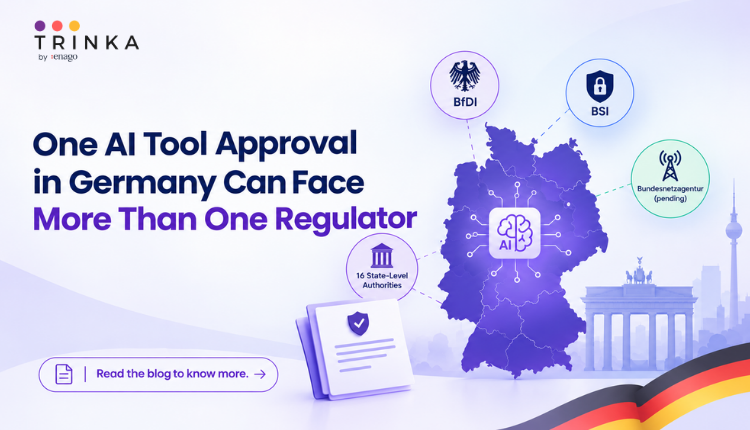
At the federal level, three separate bodies each hold a piece of AI oversight. The BfDI (Federal Commissioner for Data Protection and Freedom of Information) handles data protection issues where AI overlaps with GDPR. The BSI (Federal Office for Information Security) addresses AI security concerns. And under the draft KI-MIG bill, adopted by the German government in February 2026 and having passed the Bundestag but still awaiting Bundesrat approval, the Bundesnetzagentur (Federal Network Agency) is set to become the central AI Act market-surveillance authority and single point of contact.
Below that federal layer sit 16 Landesbeauftragte für Datenschutz, one data protection authority per German state, each with independent enforcement power over AI systems used by entities headquartered or operating in that state. A coordinating body, the Datenschutzkonferenz, exists to align these authorities’ approaches, but its decisions aren’t binding on any individual state regulator.
Why This Matters More for Pharma Specifically
A multinational pharma organization with operations, research facilities, or even just enterprise customers spread across multiple German states doesn’t get to choose a single point of regulatory contact. An AI tool flagged as problematic in one state’s jurisdiction can trigger independent scrutiny from that state’s authority, regardless of how the tool was evaluated elsewhere in the country.
This is worth taking seriously specifically because Germany hasn’t finished settling its own enforcement architecture. The KI-MIG bill remains in the legislative process, meaning the exact division of federal AI Act authority is still being finalized even as the underlying EU AI Act already applies directly as binding law. Germany also missed the EU’s original August 2025 deadline to designate its enforcement authorities, part of why this framework is still being built out in real time.
What This Means in Practice
Don’t assume approval from the BfDI or any single German authority constitutes nationwide clearance, state-level authorities retain independent enforcement power regardless of federal-level sign-off.
Track AI tool use by state if your organization operates across multiple German locations, since exposure isn’t uniform, it depends on which state-level regulator has jurisdiction over each specific operation.
Watch the KI-MIG bill’s progress through the Bundesrat, since its passage will materially change which federal body serves as the primary AI Act contact point, currently still unsettled.
Key Takeaways
- Germany enforces AI and data protection oversight through 16 state-level authorities plus federal regulators (BfDI, BSI, and the pending Bundesnetzagentur role).
- A single AI tool issue can be investigated by multiple German state authorities in parallel, unlike single-supervisor systems elsewhere in the EU.
- The KI-MIG bill, still awaiting Bundesrat approval, would formalize the Bundesnetzagentur as Germany’s central AI Act authority.
- Multinational pharma organizations with multi-state German operations should track AI tool compliance by state, not assume national uniformity.
Enhance Your Writing with Trinka’s Grammar Checker
Trinka’s Grammar Checker is designed to help writers produce clear, polished, and publication-ready content with ease. Whether you’re drafting academic papers, professional documents, or blog posts, Trinka ensures your writing is precise, consistent, and impactful, making it a trusted companion for anyone aiming to communicate effectively in English.
Frequently Asked Questions
How many data protection authorities does Germany actually have?▼
17 total, one federal authority (the BfDI) plus 16 independent state-level authorities, each with its own enforcement power.
What is the KI-MIG bill?▼
Germany’s draft AI Market Surveillance and Innovation Promotion Act, which would designate the Bundesnetzagentur as the central AI Act authority. It has passed the Bundestag but still requires Bundesrat approval as of mid-2026.
Can a single AI tool face enforcement action from multiple German regulators at once?▼
Yes. Because state-level authorities act independently, an AI Act issue affecting operations across multiple states can draw scrutiny from more than one supervisor simultaneously.

-
Go beyond grammar & spelling
Get holistic language improvements - Write with Trinka