


Private Proofreading for Your PhD Thesis: Tool or Editor?

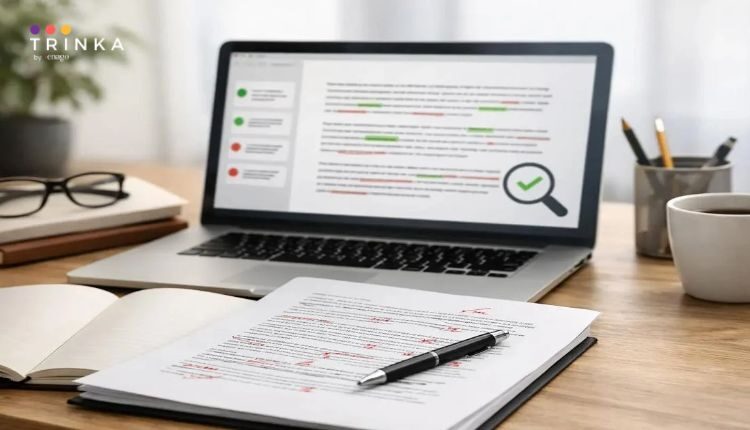
The final weeks before submission are tiring. The argument is settled, the data is in, and what remains is the long, careful read for the small errors that slip through after years of work.
That final pass is proofreading. And because it usually involves your complete thesis, how you do it affects who sees your unpublished work.
What Proofreading Covers
Proofreading is the last check on a finished text. It looks for:
-
Grammar, spelling, and punctuation errors
-
Inconsistent spelling styles, hyphenation, or number formats
-
Terminology and abbreviation slips
-
Mismatched figure and table numbers or cross-references
-
Reference list entries that do not match citations
It differs from editing, which works on structure, argument, and clarity. Proofreading assumes those are already in place.
Option 1: A Proofreading Tool
A proofreading tool reviews a whole document in one pass. With Trinka’s Proofread File feature, you upload a Word or LaTeX file and receive an edited version with suggestions as track changes. Formatting, tables, structure, and code are left intact, and you accept or reject each suggestion.
Strengths: It is fast, consistent across a long document, and available at any hour.
Limits: It does not judge your argument or field-specific nuance, and you still need to review every suggestion yourself.
Option 2: A Human Proofreader or Editor
A person brings judgment a tool cannot. A good editor notices when a sentence is technically correct but unclear, or when a section does not follow from the last one.
Strengths: Judgment, context, and a fresh reader’s eye.
Limits: It takes more time and cost, and your entire thesis goes to a third party. Some universities also set rules on what outside editing help is allowed, so check your institution’s guidance first.
A Combination Often Works Well
Many students run a tool pass first to clear the mechanical errors, then ask a human reader, whether a proofreader, colleague, or supervisor, to focus on the larger questions. That way, human attention goes where it adds the most.
Keeping Your Thesis Private Through the Final Pass
Whichever route you choose, a full thesis is being uploaded or sent. Ask the same questions of a tool or a person:
-
Is the document stored after the work is done, and for how long?
-
Is any of it used for training or reused elsewhere?
-
Who can see it?
-
Is deletion or confidentiality agreed in writing?
-
Is there an offline option for the most sensitive chapters?
For a human editor, a written confidentiality agreement is a reasonable request. For a tool, look for clear, written data terms.
A Final-Pass Checklist
Before you submit, run through:
-
UK or US spelling used consistently
-
Hyphenation and number formats consistent
-
Abbreviations defined on first use
-
Figure, table, and equation numbering correct
-
Citations match the reference list
-
Headings and cross-references correct
-
Formatting matches your university’s template
Trinka’s Consistency Check and Citation Checker can help with the second and fifth items, so you are not relying on memory at the end of a long process.
Where Trinka’s Confidential Data Plan Fits
Trinka’s Confidential Data Plan includes Proofread File, so a full thesis proofread runs with zero data retention, and your text is never used to train a model. For specific chapters you would rather keep on your own machine, the Windows offline grammar checker keeps text on the device.
A tool pass is not a replacement for your supervisor’s review or your university’s submission requirements. It handles the mechanical layer so that human attention can go to the argument.
Conclusion
Proofreading a thesis is easier when you choose the right mix: a tool for the mechanical pass, a person for judgment, and clear privacy terms for both. Decide how your unpublished work will be handled before you upload or send it
Enhance Your Writing with Trinka’s Grammar Checker
Trinka’s Grammar Checker is designed to help writers produce clear, polished, and publication-ready content with ease. Whether you’re drafting academic papers, professional documents, or blog posts, Trinka ensures your writing is precise, consistent, and impactful, making it a trusted companion for anyone aiming to communicate effectively in English.
Frequently Asked Questions
Can a proofreading tool replace a human proofreader for a thesis?▼
Not fully. A tool handles mechanical errors well and keeps a long document consistent, while a person adds judgment on clarity, nuance, and argument.
What file types can Trinka's Proofread File handle?▼
Word and LaTeX files. Suggestions come back as track changes with formatting, tables, and structure kept intact, so you can accept or reject each one.
Is it safe to send my whole thesis to an editor?▼
Ask for a written confidentiality agreement and clear terms on how the file is stored, who can see it, and when it is deleted.
Does my university allow outside proofreading?▼
Rules vary between institutions, so check your university’s guidance on third-party editing before you use any outside help.

-
Go beyond grammar & spelling
Get holistic language improvements - Write with Trinka