


Thesis Plagiarism Check: Why Your Own Papers Get Flagged

A common moment in PhD life goes like this. You run a plagiarism check on your thesis, expecting a clean result, and a large share of the matches point to your own published papers.
Nothing has gone wrong. But it is worth understanding why it happens, and what to do about it.
Why Your Own Work Shows Up
A plagiarism checker compares text against published and web sources. It has no built-in way to know that a matching paper is yours. If your thesis reuses material from articles you published, those articles are in the comparison database, so they match.
This is especially visible in a thesis by publication, where chapters are built from papers, and in any thesis where the methods or introduction were adapted from earlier writing.
Reading the Similarity Report, Not Just the Score
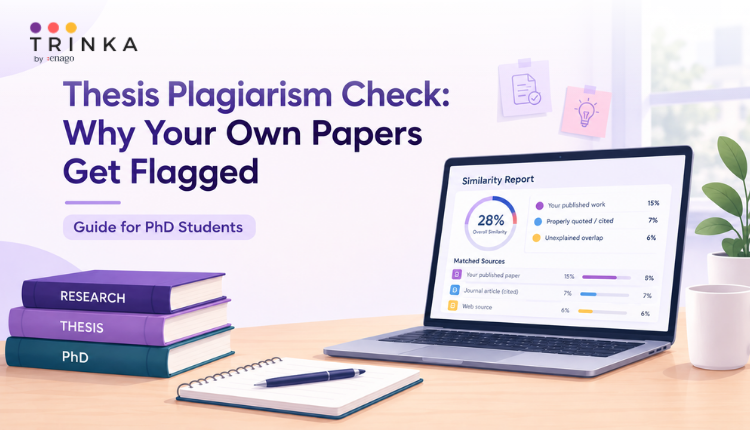
A single percentage tells you very little. The useful part is the source-by-source breakdown, which shows where each match comes from.
When you review the report, sort matches into three groups:
- Your own published work: Expected, but it needs proper handling.
- Properly quoted or cited material: Often shows as a match even when correct.
- Unexplained overlap: The group that deserves real attention, since it may be unintentional.
Common technical phrases and reference lists can also inflate a score without being a concern.
Handling Overlap With Your Own Papers
Reusing your own published work is usually allowed in a thesis, but the rules are specific. A few checks help:
- Read your institution’s policy on including published papers and any required declarations.
- Check publisher permissions. Copyright for a published article often sits with the publisher, so reuse in a thesis may depend on the agreement you signed.
- Cite and declare. State clearly where chapters derive from published papers and who contributed what.
- Talk to your supervisor before the check, so the overlap is expected rather than a surprise.
When to Run the Check
Running a check only at the very end leaves no time to fix surprises. A better pattern is to check at chapter level once each chapter is stable, then run a final check on the complete thesis.
Trinka’s plagiarism checker offers a Standard check (24 credits) and an Advanced check (36 credits) that adds the paid scholarly database. Using the Standard check on drafts and the Advanced check on a near-final version keeps the final result meaningful.
What Your Checker Compares Against
Coverage matters because a score only reflects what was searched. Trinka’s plagiarism checker compares against more than 190 million paid scholarly articles across 1,700+ publishers, including Wiley, Springer Nature, Taylor & Francis, and Sage, alongside 200 million+ open access articles and 99 billion+ web pages. A broad database can help identify overlap that a journal’s or university’s own software might find later.
A Thesis Is Unpublished Research
Here is the part students often overlook. A thesis can contain original data, unpublished findings, and methods not yet in print. Uploading it to a free checker with unclear storage terms means that content may be kept somewhere you cannot see.
Trinka does not store your document once the report is generated, and for teams on Trinka’s Confidential Data Plan, content is also never used to train any model. For a thesis that is still unpublished, that combination matters.
Conclusion
Seeing your own papers in a similarity report is normal. What matters is reading the breakdown, handling reuse according to your institution’s rules and your publisher’s permissions, and running the check early enough to act on it. Choose a tool that searches broadly and treats your unpublished work with care.
Key Takeaways
- Overlap with your own published papers is expected in many theses.
- The source-by-source breakdown matters more than the single percentage.
- Check institutional policies and publisher permissions before reusing published work.
- A thesis is unpublished research, so the checker’s data-handling practices matter.
Enhance Your Writing with Trinka’s Grammar Checker
Trinka’s Grammar Checker is designed to help writers produce clear, polished, and publication-ready content with ease. Whether you’re drafting academic papers, professional documents, or blog posts, Trinka ensures your writing is precise, consistent, and impactful, making it a trusted companion for anyone aiming to communicate effectively in English.
Frequently Asked Questions
Why does my thesis match my own published paper?▼
The checker compares your thesis against published sources and cannot tell that the matching paper is yours.
Is reusing my own papers in a thesis allowed?▼
Often, yes, but your institution’s policy and publisher permissions may apply.
Does a high score always mean plagiarism?▼
No. Quotes, citations, common phrases, and overlap with your own work can raise the score.
When should I run a thesis plagiarism check?▼
Check each chapter once it is stable, then run a final check on the complete thesis near submission.

-
Go beyond grammar & spelling
Get holistic language improvements - Write with Trinka