


What should universities compare before choosing an academic integrity solution?

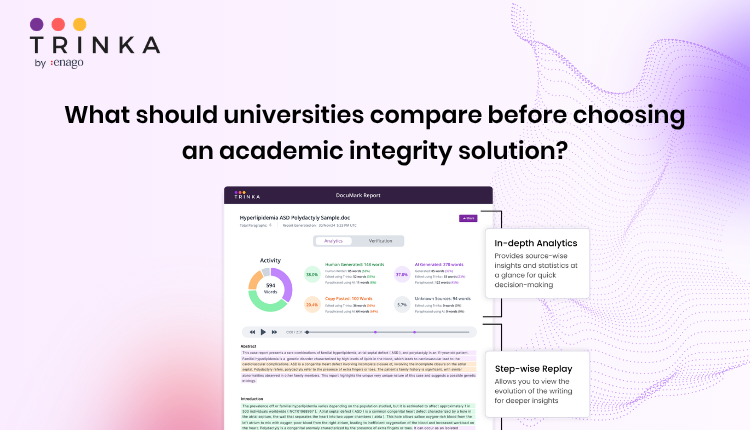
Most universities choose an academic integrity solution based on how accurately it detects AI-generated content or copy-pasted content and it generally provides output based on score. While detection accuracy is important, a score alone does not tell educators how a piece of work was created, whether it aligns with institutional AI policies, or whether the cited sources are genuine.
As AI becomes a regular part of academic work, universities need a broader way to evaluate academic integrity solutions. This blog explores the factors institutions should compare: writing process transparency, policy alignment, student accountability, faculty workload, and citation verification.
What to Compare
Writing Process vs. Finished Document
Most AI detection tools generate a score based only on the final assignment a student submits. It gives educators limited visibility into how the work was created, making it harder to understand the student’s efforts. A writing process transparency provides that missing context by capturing key writing activities such as revisions, pauses, and writing patterns throughout the writing session. This added transparency helps educators review student work more fairly and make informed academic integrity decisions, making writing process documentation an important factor when comparing academic integrity solutions.
Policy Alignment
Most universities have moved beyond treating all AI use as academic misconduct. Today, institutional AI policies distinguish between acceptable AI assistance and inappropriate use. An academic integrity solution should reflect these distinctions rather than treating every AI interaction the same way.
Student Accountability and Faculty Workload
AI detectors assess only the final submission, leaving educators to interpret the results with limited context. A process-based approach lets students review their writing journey, understand their AI usage, and confirm their submission before it reaches the instructor. As a result, students take greater ownership of their work, while faculty receive more context upfront, making assessment fair.
Citation Verification
AI-generated content can include references that appear credible but do not actually exist. Even if the assignment itself receives a low AI detection score, fabricated citations can still undermine its academic integrity.
When comparing academic integrity solutions, universities should evaluate whether citation verification is part of the review process. A solution that verifies references provides educators with a more complete understanding of the submission, rather than assessing only the written content.
Choosing Solutions That Supports Fair Academic Integrity
To support fair and transparent academic integrity reviews, universities need a solution that goes beyond AI detection. The right solution should provide visibility into how assignments are developed, align with institutional AI policies, support student accountability, reduce faculty workload, and verify citations. DocuMark brings these capabilities together by offering:
- Writing process documentation through a detailed record of writing activity, helping educators understand how an assignment was developed.
- Policy alignment by distinguishing between different types of AI use based on institutional guidelines. As AI policies continue to evolve, resources like the Trinka AI Policy Repository help institutions access and compare AI governance policies from leading universities in one searchable place.
- Student accountability by giving students visibility into their writing journey, helping them review their work, improve their writing, and take ownership of their submissions before they are evaluated.
- Reduced faculty workload with a student-verified report that provides the context educators need upfront, reducing the need for time-consuming investigations, based on the student effort score, they can either reject or accept the assignment.
- Citation verification by checking whether referenced sources are valid and accessible, enabling a more complete review of every submission.
Together, these capabilities help universities move beyond AI detection scores and support fair, transparent, and policy-aligned academic integrity reviews.
Conclusion
According to a 2025 HEPI survey, 88% of students now use AI specifically for assessments, up from 53% the year before. The tools universities are using to manage academic integrity were not built for this scale.
Universities need solutions that provide greater transparency into the writing process, align with institutional AI policies, encourage student accountability, reduce faculty workload, and verify citations. Together, these capabilities support fairer and more informed academic integrity reviews.
As AI continues to reshape education, the way universities evaluate academic integrity solutions will influence how student work is reviewed and how institutional policies are applied. Looking beyond detection scores helps institutions choose a solution that supports transparency, consistency, and informed decision-making for students, faculty, and the institution as a whole.
Enhance Your Writing with Trinka’s Grammar Checker
Trinka’s Grammar Checker is designed to help writers produce clear, polished, and publication-ready content with ease. Whether you’re drafting academic papers, professional documents, or blog posts, Trinka ensures your writing is precise, consistent, and impactful, making it a trusted companion for anyone aiming to communicate effectively in English.

-
Go beyond grammar & spelling
Get holistic language improvements - Write with Trinka