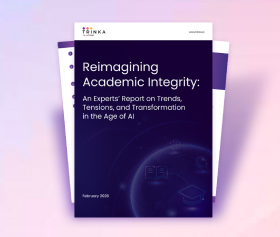
 Poster
An Experts’ Report on Academic Integrity in the AI Era
A thought-leadership report exploring how institutions can move beyond AI detection toward transparency, shared responsibility, and process-based academic integrity.
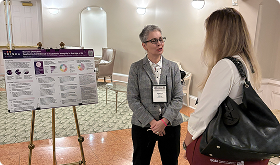 Poster
Poster Discussion at Charleston Conference 2025, USA by Rebecca Bryant
Beyond Detection: Restoring Confidence in Academic Integrity in the Age of AI
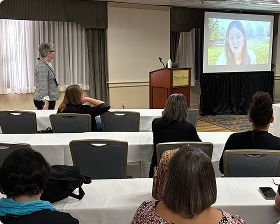 Presentation
Presentation at Charleston Conference 2025, USA by Rebecca Bryant and Rachel Riffe-Albright
Shaping the Future of Learning: Proactive Strategies for Addressing the Ethical Challenges of AI Use in Higher Education
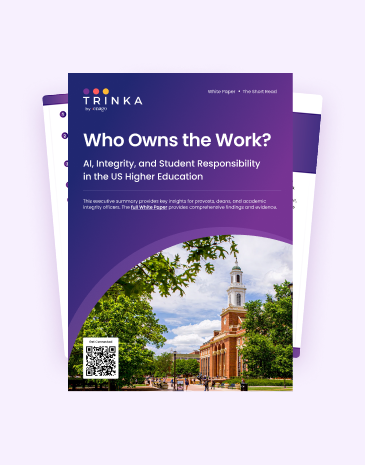
Who Owns the Work? AI, Integrity, and Student Responsibility in US Higher Education
As AI reshapes higher education, universities face a critical question: Who owns the work? This whitepaper explores practical strategies to strengthen academic integrity.
Key Takeaways:
- Why AI detection cannot determine student work.
- Difference between assistive and substitutive AI use.
- How process visibility builds trust between students and faculty.
- 5 principles for supporting responsible AI use.
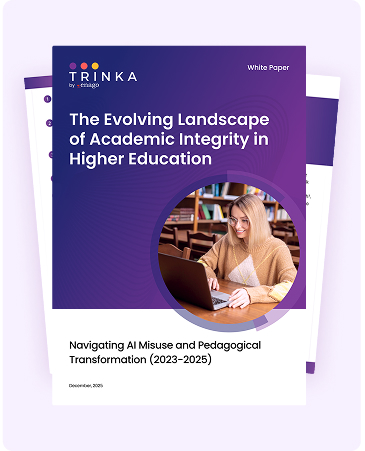
The Evolving Landscape of Academic Integrity in Higher Education
As AI reshapes learning, research, and assessment, universities face academic integrity challenges. This whitepaper explores institutional perspectives and strategies to address them.
Key Takeaways:
- How AI is reshaping learning, redefining what constitutes original work in academia.
- Faculty AI literacy gap and inconsistent institutional responses to AI use.
- Crisis of trust that is emerging from over-reliance on detection tools and policy inconsistencies.
- Pedagogical approaches universities can adopt to promote responsible AI use and rebuild trust.
Advancing Multilingual Grammar Correction for Low-Resource Languages
Presented by Divesh Kubal and Apurva Nagvenkar from our Data Science team at the Industry Track of COLING 2025, Dubai.
Key Takeaways:
- Introduces a novel end-to-end architecture utilizing the M2M100 multilingual transformer model.
- Proposes synthetic data generation pipeline, tailored to address language-specific errors.
- Focuses on low-resource languages, like Spanish.
- 88.2% acceptance rate based on user actions.
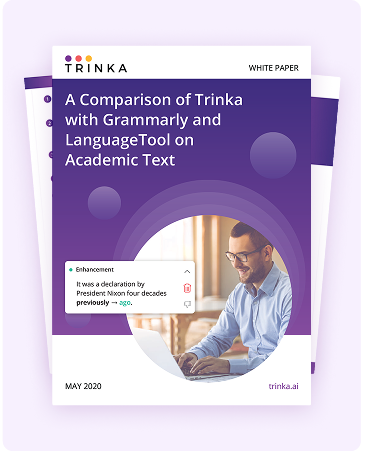
Comparison of Trinka with Grammarly and LanguageTool on Academic Text
This whitepaper provides a data-backed understanding of how Trinka is best suited for academic writing, balancing accuracy, coverage, and publication-readiness features.
Key Takeaways:
- Specific pain-points of writers, authors, and professional academic writers worldwide.
- Workability and limitations of currently available writing assistants.
- Brief comparison of Trinka vs. Grammarly vs. LanguageTool.
- Trinka edges over all other writing assistants.
Know More About the Authors and Speakers

Rebecca Bryant, PhD
Vice President of Strategic Engagement & Outreach at Trinka
Dr. Bryant brings over two decades of leadership experience in higher education, including senior roles at the University of Illinois Urbana-Champaign, where she served as Assistant Dean and Director of Graduate Career Development and later as Project Manager for Research Information Systems. She has also held influential positions with ORCID and OCLC Research, leading international initiatives that strengthened partnerships among universities, libraries, and scholarly organizations. Trained as a musicologist, she earned her PhD from the University of Illinois Urbana-Champaign and is widely recognized for her research and publications on research information management, social interoperability, and cross-campus collaboration. At Trinka AI, she advances global collaborations around academic communication and technology adoption.

Sharad Mittal
Founder & CEO, Trinka AI
Sharad Mittal is a visionary entrepreneur and recognized leader in the fields of Artificial Intelligence (AI) and Natural Language Processing (NLP). As the founder and CEO of Trinka AI, he has developed AI-powered solutions that address the complexities of academic integrity and writing. Trinka AI’s platform empowers universities to overcome the challenges posed by AI while maintaining academic excellence and integrity.
In addition to his role at Trinka AI, Sharad serves as the CEO of Crimson Interactive, a global leader in scientific communication. With prominent brands like Enago and The Charlesworth under his stewardship, Sharad’s mission is to break down barriers in scientific research dissemination, helping researchers and institutions transcend linguistic and geographical challenges.

Rachel Riffe-Albright
Assistant Librarian, Eastern Kentucky University
Rachel Riffe-Albright is a dedicated health sciences librarian and educator committed to ensuring equitable access to quality medical information. With a Master of Science in Library and Information Science from the University of Illinois at Urbana-Champaign, she has honed her expertise in information literacy, research support, and digital health resources. She has done internships and practicums with organizations like Forge Biologics, where she contributed to advancing medical research and education. An advocate for the role of libraries in advancing healthcare knowledge, she actively engages in discussions about the intersection of information science, health, and technology. She has participated in panels and discussions, such as those addressing the impact of AI training on librarians and publishers.

Trinka D’cunha
Lead Product Analyst,
Trinka AITrinka D'Cunha has over 20 years of experience in the field of ESL teaching, academic copyediting, and AI for impactful writing. With a master's in English Literature, extensive teaching experience, and a singular mission to remove language barriers for anyone who wants to communicate in English in the age of AI, she has helped create Trinka AI—a writing assistant trusted by thousands of academics and named in her honor. As Product Quality Head and Lead Linguist at Crimson AI, she guides the development of powerful AI tools that transform how researchers and professionals communicate globally. She champions accessibility in academic and research communication worldwide, ensuring English proficiency never limits the reach of ideas.

Dr. Anupama Kapadia
Chief Academic Integrity Officer, Trinka AI
Dr. Anupama Kapadia is a licensed specialist in Physical Medicine and Rehabilitation (Orthopedics) by qualification and academic integrity specialist by vocation. With over 18 years of experience in academic and scholarly communications, she specializes in student and researcher training, including promoting academic integrity. She leads content and learning initiatives at Trinka AI and Enago, focusing on ethical writing & publishing, peer review, and research transparency. Dr. Kapadia is an active committee member of organizations like ISMPP, MAPS, COPE, ISMTE, ALPSP, C4DISC, etc., where she plays an active role in knowledge sharing within the community and helping establish best practices in education, research, and publishing.

Takayuki Sekine
Strategic Alliances, Trinka AI
Takayuki Sekine is a specialist in strategic alliances, working at the intersection of academia, industry, and technology for scholarly communication. With over 15 years of experience across global business development, healthcare industries, and academic support services, he enables universities, research institutions, and government agencies in Japan to access high-quality editorial, publication, and responsible AI solutions. He has held leadership roles in medical software and medical device startups, contributing to product expansion and overseas business development. Sekine works closely with university administrators, URA networks, and research managers to support publication readiness, academic writing development, and ethical adoption of AI in scholarly workflows.

Apurva Nagvenkar
Principal Data Scientist
Apurva Nagvenkar is working with us as Principal Data Scientist. He started his career as a Research Assistant for various government funded NLP projects specific to low resource Indian languages. Before, joining Crimson, he worked with leading start-up and was responsible for building, scaling and productionizing ML/NLP modules for conversational AI. In Crimson AI, he is one of the key members leading the Data Science team to build several AI-based products and push them to production in optimal time. He is also responsible for building and deploying the Grammar Error Correction pipeline to the production.

Divesh R. Kubal
Principal Data Scientist
Divesh R. Kubal is a Senior Data Scientist at Crimson with over five years of contributions. He began as a Junior Data Scientist at a start-up, building conversational chatbots and supporting team development. Before joining Crimson, he worked across Computer Vision, predictive analytics, and especially NLP and NLG.
He is active in academia, mentoring Data Science students and training engineering faculty. At Crimson AI, he helps build and deploy large-scale AI products, developing end-to-end pipelines for keyword extraction, text summarization, paraphrasing, grammar correction, and other language modules. He has also authored multiple research papers.