Teaching & Learning
- For student coursework and assignments, Boise State requires students to complete work on their own unless the faculty member gives permission otherwise
- AI-generated ideas, data, or language cannot be submitted as the student's own work without proper acknowledgment or citation, and course-level faculty permission governs when collaboration or outside assistance is allowed
Students should complete all academic coursework and assignments on their own, unless otherwise instructed or granted permission by the Faculty member.
Working with others on an assignment is not allowed unless it has been explicitly permitted by the Faculty member.
• Presenting ideas, data, or language produced by generative AI as your own work and/ or without proper acknowledgment and/or citation.
* Students may not present the work or ideas produced from the use of generative AI as their own without specific and proper acknowledgment and/or citation.
- AI or other electronic-device use during exams is prohibited unless the faculty member authorizes it
- The plagiarism and acknowledgment rules also apply to quizzes and exams, so AI-assisted content used in those settings must follow the same citation requirements
• Using an electronic device during an exam, unless authorized by the Faculty member;
• Submitting work for an in-class exam, which was prepared in advance of the exam;
• Violating rules governing the administration of exams;
This policy applies to work or ideas presented in any type of academic exercise, including written assignments, discussion board posts, quizzes, exams, and in-person activities.
• Presenting ideas, data, or language produced by generative AI as your own work and/ or without proper acknowledgment and/or citation.
- Boise State encourages integrating AI into learning so students can develop AI literacy and competencies
- The university states it is committed to educating students to use AI in ways that preserve academic integrity and support learning, but it does not set a specific university-wide rule for personal study assistance beyond those general expectations
We encourage you to consider whether and how to integrate AI into existing curricula, so students develop AI literacy and competencies within your discipline.
Boise State commits to educating students on using AI in ways that preserve academic integrity, support learning, and create practical experience.
Faculty, staff, and students should be given opportunities both to develop competencies with generative AI, and to develop critical approaches to their use.
Research
- The IFITS page also directs students to check with their research supervisor and research protocol policies before using AI to communicate research
- For undergraduate research communication in IFITS materials, Boise State requires citation when AI is used in an abstract, poster, video, document, image, or other artifact
Do you have permission from your research supervisor to use AI tools to communicate your research?
What are AI-related policies in your research protocol?
If you do use AI in an abstract, poster submission, poster, video, document, image or any other artifact, we require you to cite it. See the following section for citation and other AI resources.
- More broadly, the university's academic misconduct policy prohibits manipulating or altering data to achieve a desired result
- Boise State prohibits entering sensitive, restricted, or otherwise protected data into generative AI tools unless there is specific authorization and the data has been properly de-identified
* Unless you have specific authorization and the data has been properly de-identified, you may not enter any sensitive, restricted, or otherwise protected data into any generative AI tool or service.
• Manipulating or altering data or other manifestations of research to achieve a desired result;
- Boise State's undergraduate research guidance tells students to obtain research-supervisor permission for AI use in communicating research and to follow any AI-related policies in the research protocol
- The student conduct policy also treats research misconduct and falsification seriously, while the data-use guidance prohibits entering protected data into AI tools without authorization and proper de-identification
Do you have permission from your research supervisor to use AI tools to communicate your research?
What are AI-related policies in your research protocol?
Research misconduct includes, but is not limited to:
• Sabotage of another’s experiment or research;
* Unless you have specific authorization and the data has been properly de-identified, you may not enter any sensitive, restricted, or otherwise protected data into any generative AI tool or service.
Academic Integrity
- In undergraduate research communication for IFITS, AI use in submitted artifacts must be cited
- Boise State requires proper acknowledgment and citation when students use generative AI in academic work, and it explicitly includes AI-enabled software, websites, and applications within sources that require citation
Plagiarism is presenting work or ideas from another source as your own, without specific and proper acknowledgment and/or citation.
Other sources of works or ideas that require proper acknowledgment and/or citation include other people, agencies or entities, and software, websites, and applications, specifically including those that utilize generative AI (artificial intelligence).
It is each student’s responsibility to use proper methods for appropriate acknowledgment or citation.
* Students may not present the work or ideas produced from the use of generative AI as their own without specific and proper acknowledgment and/or citation.
If you do use AI in an abstract, poster submission, poster, video, document, image or any other artifact, we require you to cite it. See the following section for citation and other AI resources.
- Boise State handles undisclosed AI use through its academic misconduct process rather than a separate AI-detection rule in the provided sources
- Faculty review concerns in student work, determine responsibility and sanctions, and the Dean of Students can impose additional educational sanctions or convene a sanctioning board for multiple incidents
Faculty members are also responsible for addressing any concerns that they notice in their own students’ work or that are reported to them as the course instructor.
The Faculty member will review complaints or concerns to make their decision as outlined in this Code and University Policy 4180 (Faculty Responsibility to Address Student Academic Misconduct).
Both Faculty members and board members are empowered to determine responsibility and sanctions for student academic misconduct.
• Assigning and requiring educational or developmental sanctions such as an online academic integrity workshop, meeting, paper, or other task.
When a student has been found in violation of the Code for more than one (1) act of Academic Misconduct, the Office of the Dean of Students may then schedule an Academic Sanctioning Board Hearing for the student.
Institutional & Administrative
- Boise State encourages faculty to consider how to integrate AI into curricula and provides toolkits, workshops, and development support for classroom use
- For university marketing and communications content, AI may be used as a helper in specified creative processes, but AI-generated draft content must be carefully reviewed, edited, and fact-checked by the Office of Communications and Marketing
We encourage you to consider whether and how to integrate AI into existing curricula, so students develop AI literacy and competencies within your discipline.
Find links Boise State white papers and position statements and AI syllabus statements and lesson plans that can be adapted it meet your needs.
The Office of Communications and Marketing at Boise State provides this guidance for all content creators using images in university marketing, communications and promotional materials.
It is acceptable to use generative AI tools as helpers in creative processes, including the following:
Any draft content that is generated using AI, such as scripts or story drafts, must be carefully reviewed, edited and fact-checked by the Office of Communications and Marketing to ensure ethical, factual, compliance and brand guidelines are followed.
- Boise State has approved specific AI tools and requires other AI tools to go through university review and approval processes before use
- The university prohibits entering sensitive, restricted, or otherwise protected data into generative AI tools unless specifically authorized and properly de-identified, and its information security policy applies to all university community members with access to protected information or university information resources
Boise State University supports the responsible use of AI tools and has approved the education editions of the following: Zoom AI Companion, Google Gemini (Education edition only), Gemini for Google Workspace, and OpenAI ChatGPT (Education edition only). In addition, Boise State has developed BoiseState.ai. These tools have been vetted to meet the University’s standards for security, privacy, compliance, and legal requirements.
If you wish to use other AI tools, they must first be submitted for review through the appropriate University processes, including Procurement, Software Review Request (SRR), and legal review, and receive approval in accordance with those procedures.
To ensure the safety and integrity of University data and systems, please avoid using unapproved AI tools on the University’s network, devices, or with your Boise State credentials (your Boise State username and password).
* Unless you have specific authorization and the data has been properly de-identified, you may not enter any sensitive, restricted, or otherwise protected data into any generative AI tool or service.
Boise State officially supports Google Gemini, Google Gemini for Workspace, and ChatGPT Edu.
This policy applies to all students, faculty, staff, contractors, consultants, temporary employees, guests, volunteers, and all other entities or individuals with Access to a.) Protected Information through Boise State or its affiliates, or b.) University Information Resources, including those used by the university under license, contract, or other affiliation agreement.
- Boise State states an institutional AI vision centered on balancing creativity and access with protection of intellectual property, confidentiality, and privacy
- It also says its Generative AI Strategic Plan establishes campus-developed values to guide decisions and use of generative AI, emphasizing innovation, integrity, responsible adoption, and human judgment about which tasks should remain solely human
To foster a culture of creativity around generative AI and to balance access with the protection of intellectual property, confidentiality, and privacy in all generative AI endeavors.
Boise State’s Generative AI Strategic Plan lays out institutional values developed and endorsed by faculty, staff, and leaders on campus.
Using generative AI well at Boise State means developing approaches and policies rooted in our values. Developed as a campus community, these values guide us as we make decisions, apply generative AI tools, and support each other in our work.
1. Innovation: Foster a culture of creativity and innovation around generative AI to drive advancements across all aspects of the institution. Faculty, staff, and students should be given opportunities both to develop competencies with generative AI, and to develop critical approaches to their use.
2. Integrity: Uphold the highest standards of honesty, ethics, and responsibility in all generative AI endeavors. Encourage critical thinking, diverse viewpoints, and responsible adoption and use to challenge assumptions and drive intellectual growth. Seek to balance access with the protection of intellectual property, confidentiality, and privacy. Foster conversations about what tasks are best accomplished with generative AI, and which are best performed solely by humans.
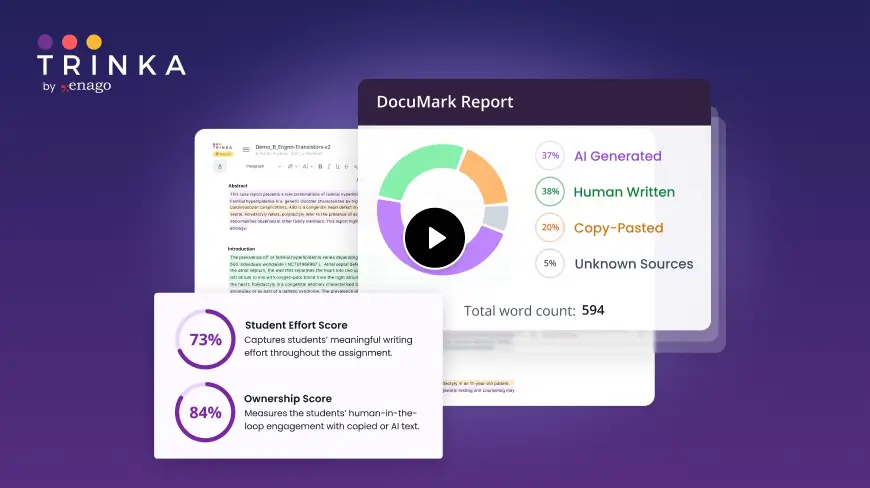
DocuMark: Responsible AI Use for Academic Integrity
Knowing your institution's AI policy is step one. DocuMark helps enforce it fairly by empowering universities to manage AI-generated content, prevent cheating, and support student writing through responsible AI use.
Common Questions About Boise State University's AI Policies
Boise State University has defined AI policies in 11 of 12 categories, with an overall coverage score of 92%.
Boise State requires proper acknowledgment and citation when students use generative AI in academic work, and it explicitly includes AI-enabled software, websites, and applications within sources that require citation. In undergraduate research communication for IFITS, AI use in submitted artifacts must be cited.
Boise State handles undisclosed AI use through its academic misconduct process rather than a separate AI-detection rule in the provided sources. Faculty review concerns in student work, determine responsibility and sanctions, and the Dean of Students can impose additional educational sanctions or convene a sanctioning board for multiple incidents.
Boise State has approved specific AI tools and requires other AI tools to go through university review and approval processes before use. The university prohibits entering sensitive, restricted, or otherwise protected data into generative AI tools unless specifically authorized and properly de-identified, and its information security policy applies to all university community members with access to protected information or university information resources.