Teaching & Learning
- Use of AI for coursework and assignments is at instructor discretion
- If instructors allow AI, students must document and cite that use and still follow the academic integrity policy
- CSULB tells students to follow the syllabus and instructor directions, and it provides sample syllabus statements ranging from full prohibition to limited permitted uses
Does your instructor allow broad use of GenAI in the class? Is it clearly stated in the syllabus? If so, your use of AI tools must be properly documented and cited and must follow CSULB’s Policy on Academic Integrity Regarding Cheating and Plagiarism.
Does your instructor forbid the use of GenAI in the class? Please consult the instructor, and review the syllabus, and other information provided by the instructor carefully. Please note that your instructor may fully prohibit the usage of GenAI – which would also forbid students from partial or specific usage of GenAI for submitting assignments, and coursework.
The following guidance is provided to assist you in developing class policies on the use of generative AI tools in your course. Please adjust the statement to reflect your parameters and to fit your course.
Be specific and let students know what class activities are permitted and not permitted for the use of generative AI tools.
The use of generative AI tools (e.g., ChatGPT, Dall-e, etc.) is permitted in this course only for the following activities:
● Brainstorming and refining your ideas;
● Fine tuning your research questions;
● Finding information on your topic;
The use of generative AI tools (such as ChatGPT, DALL-E, etc.) is not permitted in this class; therefore, any use of AI tools for work in this class may be considered a violation of
- In the College of Education's CalTPA context, support that would compromise independent work is explicitly not permitted
- Graduate comprehensive exams specifically require advisor consultation on any AI use and full transparency if it is approved
- The university does not set a separate university-wide AI exam rule, but unauthorized AI use in exams and assessments falls under academic integrity violations
Cheating is defined as the act of obtaining, trying to obtain, or helping someone else to obtain academic credit for work by using dishonest, deceptive, or fraudulent means. Examples of cheating, regardless of instructional mode, include but are not limited to:
* using online tools or services that are not authorized by the instructor;
In graduate culminating activities—theses, project reports, dissertations, and comprehensive exams—transparency of AI usage is of utmost importance. Students must consult their thesis advisors whether any usage of AI tools is allowed and appropriate. If approved, the student should work with their advisor on ensuring full transparency of which AI tools were used in their scholarly work and in which capacity (e.g., brainstorming, outlining, researching, writing, editing).
To maintain the integrity of the CalTPA and ensure that each candidate’s submission reflects their own independent work, the following types of support are not permitted:
• Providing Direct Answers or Content
- For class use, whether study assistance is allowed still depends on the instructor and syllabus
- CSULB permits AI to be used as a learning support tool in some contexts, such as brainstorming, personalized feedback, grammar help, and topic exploration, but students are told to verify results and treat outputs as a starting point rather than a final authority
For example, your instructor may allow usage of generative AI tools for brainstorming, and refining ideas, and research questions, or for finding information on certain topics, or for drafting an outline, or to assist you in checking your grammar and style.
GenAI systems can be useful tools for CSULB graduate students, even with their limitations.
Strengths
• Rapidly answers questions
• Gives real-time personalized feedback
• Can help brainstorm
• May enhance productivity and efficiency
• Provides grammar and other writing help
For example, when tasked to write a literature review, an AI text generator provides a summary on current research with citations. Relying on this information may be a good start, but you will need to assess the accuracy of the response.
Instead, use the AI tool’s response as a first step.
Research
- For graduate research writing, AI may be used only with advisor approval in culminating activities, and approved use must be transparent about which tools were used and for what purpose
- The graduate guidance also says AI can help with brainstorming, grammar, and writing support, but students must verify accuracy, corroborate sources, and properly cite AI-generated content when professors approve its incorporation into academic work
Strengths
• Rapidly answers questions
• Gives real-time personalized feedback
• Can help brainstorm
• May enhance productivity and efficiency
• Provides grammar and other writing help
In cases when you’ve received your professor’s approval to incorporate AI-generated results into your academic work, it is important to properly cite this content. Students should follow the recommendations and citation format of whichever style guide your graduate program uses (e.g., APA Manual, the Chicago Manual of Style, MLA).
In graduate culminating activities—theses, project reports, dissertations, and comprehensive exams—transparency of AI usage is of utmost importance. Students must consult their thesis advisors whether any usage of AI tools is allowed and appropriate. If approved, the student should work with their advisor on ensuring full transparency of which AI tools were used in their scholarly work and in which capacity (e.g., brainstorming, outlining, researching, writing, editing).
- Graduate guidance recognizes AI as a tool that can rapidly assess large amounts of data and that departmental communications staff disclose using AI for data analysis
- However, the university materials reviewed do not provide a specific university-wide policy governing AI use for research data collection, statistical analysis, synthetic data generation, or interpretation of research findings
Strengths
• Rapidly assesses a large corpus of data
In 2025, our department adopted several principles to guide our use of AI. Consistent with those principles, we disclose here our routine use of AI in proofreading and editing, transcription, summarization, data analysis, topic exploration and research, and the creation of background designs and stock-image replacements.
- The reviewed sources do not define specific rules for grant proposals or IRB applications
- For graduate scholarly work, CSULB emphasizes confidentiality, source verification, and transparency of AI use
- Students are told to consider confidentiality and privacy, verify accuracy and authenticity of sources, and consult advisors about whether AI use is allowed in theses, dissertations, project reports, and comprehensive exams
• Does not ensure that user queries are confidential
In graduate culminating activities—theses, project reports, dissertations, and comprehensive exams—transparency of AI usage is of utmost importance. Students must consult their thesis advisors whether any usage of AI tools is allowed and appropriate.
If approved, the student should work with their advisor on ensuring full transparency of which AI tools were used in their scholarly work and in which capacity (e.g., brainstorming, outlining, researching, writing, editing).
If a graduate student uses an AI text generator, they should:
2. Consider confidentiality (adjust settings to ensure confidentiality and privacy)
4. Assess response accuracy
5. Check sources’ authenticity
6. Corroborate via lateral reading
7. Ensure sources are reputable, written by established experts, or are peer reviewed
Academic Integrity
- Disclosure and citation are required when AI use is allowed in coursework or graduate academic work
- A campus communication unit also states that it discloses routine AI use and adds disclosure when generative AI is used in a specific communications product
- Students must properly document and cite AI use, and graduate students in culminating activities must be fully transparent with advisors about which AI tools were used and for what functions
If so, your use of AI tools must be properly documented and cited and must follow CSULB’s Policy on Academic Integrity Regarding Cheating and Plagiarism.
In cases when you’ve received your professor’s approval to incorporate AI-generated results into your academic work, it is important to properly cite this content.
In graduate culminating activities—theses, project reports, dissertations, and comprehensive exams—transparency of AI usage is of utmost importance.
If approved, the student should work with their advisor on ensuring full transparency of which AI tools were used in their scholarly work and in which capacity (e.g., brainstorming, outlining, researching, writing, editing).
Ensure work done with GenAI is human-led, and be transparent about your use by openly citing your use of GenAI whenever possible.
In 2025, our department adopted several principles to guide our use of AI. Consistent with those principles, we disclose here our routine use of AI in proofreading and editing, transcription, summarization, data analysis, topic exploration and research, and the creation of background designs and stock-image replacements. If generative AI is used in our work, we will provide an additional disclosure within the applicable communications product.
- Faculty are also advised to state penalties in their syllabi if they prohibit AI use
- CSULB treats unauthorized AI use as an academic integrity issue when an instructor has not authorized the tool
- The Turnitin page says AI writing detection is available, but it should not be used as a definitive judgment of plagiarism and instead should support discussion of academic integrity
Cheating is defined as the act of obtaining, trying to obtain, or helping someone else to obtain academic credit for work by using dishonest, deceptive, or fraudulent means. Examples of cheating, regardless of instructional mode, include but are not limited to:
* using online tools or services that are not authorized by the instructor;
Turnitin has launched AI writing detection capabilities in their products including Feedback Studio and Similarity.
Although stating that these tools can detect "the presence of AI-assisted writing with 98% confidence and a less than one percent false-positive rate in a controlled lab environment," in long form prose of at least 300 words, this tool should not be used as a definitive judgment of plagiarism, but rather as a learning moment to discuss academic integrity in the classroom.
If you are prohibiting the use of generative AI tools, clearly state the penalty for first-time offenders and those who repeatedly violate your policies on the use of generative AI tools.
Institutional & Administrative
- A university communications unit also discloses routine departmental uses including proofreading, editing, transcription, summarization, data analysis, and research
- CSULB encourages faculty and staff to use AI responsibly and ethically to augment work, increase productivity, and support teaching preparation and staff development
- Faculty are told to be clear with students about course rules for AI, and teaching resources explicitly support uses such as revising courses and generating assessment ideas
CSULB supports the responsible and ethical use of artificial intelligence (AI) technologies for enhancing teaching, learning, research, and campus services.
Maintain academic integrity by adhering to CSULB Faculty Handbook and Standards for Student Conduct. Faculty should be clear to their students about the expectations and rules of permitted use of AI technologies in students’ schoolwork.
Revise a course. Teaching is an art and a science, and there are thousands of ways to design your instructional materials and techniques. AI is great for brainstorming new ideas. A suggested prompt is, "Give me three assessment ideas for [learning objective.]"
CSULB recognizes the importance of staff development as part of the Beach 2030 goal to Reimagine Staff and prepare for the future of work.
In 2025, our department adopted several principles to guide our use of AI. Consistent with those principles, we disclose here our routine use of AI in proofreading and editing, transcription, summarization, data analysis, topic exploration and research, and the creation of background designs and stock-image replacements.
- Campus guidance specifically warns against uploading personal, proprietary, confidential, and CSU level 1 or 2 data into GenAI systems
- CSULB requires users to follow CSU and CSULB information security and privacy policies and not enter confidential information into public generative AI tools
- The university also identifies campus-provided tools, including Microsoft Copilot, ChatGPT EDU, Adobe Firefly, and Zoom AI Companion, and its comparison page directs users to CSU FAQ items and CSULB AI Guidelines for data privacy
Adhere to current CSU and CSULB policies on information security and privacy to protect confidential information. Please do not input confidential information into public generative AI tools (e.g., ChatGPT). Information entered into public AI tools could expose sensitive information to the public.
Upload personal, proprietary, or confidential information that could violate CSU Information Security Policy and Standards, state or federal privacy laws, including HIPAA (related to health and medical records, and FERPA, linked to student educational records), or expose CSU data (levels 1 and 2), when using GenAI.
AI Tools at CSULB
* Microsoft Copilot
* ChatGPT EDU
* Adobe Firefly
* Zoom AI Companion
Data Privacy Refer to the CSU FAQ items and CSULB AI Guidelines
- CSULB has an institutional AI governance structure and campus strategy centered on guidance, implementation planning, and future deployment
- The AI Technology Implementation Steering Committee explores, evaluates, and guides implementation, while the Academic AI Subcommittee explores AI technologies, plans future implementations, and recommends campus-wide guidelines, professional development, and support
The purpose of the AI Technology Implementation Steering Committee is to explore, evaluate, and provide guidance on the implementation of AI technologies at CSULB. In this work, we aim to help anticipate challenges associated with the use of these technologies and propose resources to address them.
The purpose of the AI Academic Subcommittee is to explore AI technologies and plan for future implementations. The subcommittee will make recommendations to the AI Steering Committee to develop guidelines for campus-wide deployment.
To foster a community of AI users on campus, the subcommittee will also make recommendations for professional development and support for faculty and staff on AI-related topics.
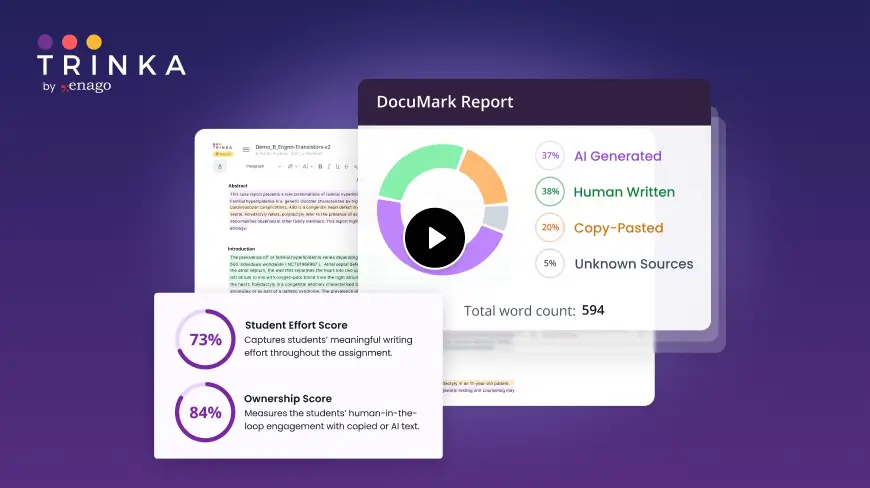
DocuMark: Responsible AI Use for Academic Integrity
Knowing your institution's AI policy is step one. DocuMark helps enforce it fairly by empowering universities to manage AI-generated content, prevent cheating, and support student writing through responsible AI use.
Common Questions About California State University, Long Beach's AI Policies
California State University, Long Beach has defined AI policies in 11 of 12 categories, with an overall coverage score of 92%.
Disclosure and citation are required when AI use is allowed in coursework or graduate academic work. Students must properly document and cite AI use, and graduate students in culminating activities must be fully transparent with advisors about which AI tools were used and for what functions. A campus communication unit also states that it discloses routine AI use and adds disclosure when generative AI is used in a specific communications product.
CSULB treats unauthorized AI use as an academic integrity issue when an instructor has not authorized the tool. The Turnitin page says AI writing detection is available, but it should not be used as a definitive judgment of plagiarism and instead should support discussion of academic integrity. Faculty are also advised to state penalties in their syllabi if they prohibit AI use.
CSULB requires users to follow CSU and CSULB information security and privacy policies and not enter confidential information into public generative AI tools. Campus guidance specifically warns against uploading personal, proprietary, confidential, and CSU level 1 or 2 data into GenAI systems. The university also identifies campus-provided tools, including Microsoft Copilot, ChatGPT EDU, Adobe Firefly, and Zoom AI Companion, and its comparison page directs users to CSU FAQ items and CSULB AI Guidelines for data privacy.