Teaching & Learning
- Chapman does not impose a single uniform student-use rule for coursework; it directs instructors to set course- and assignment-specific AI expectations in their syllabi
- The university provides model syllabus options ranging from broad permission, to limited permission, to no use permitted, and ties coursework use of AI to academic integrity requirements
Academic freedom allows you, the instructor, to select your own individual approach that aligns to the institutional mission and policy statement.
It is important that your AI statement/policy
1. makes explicit the responsibility of instructors and students to establish clear expectations for generative AI use within each course and/or assignment, and
2. reinforces that the use of generative AI in academic coursework is integrally related to academic integrity and will be governed by Chapman’s Academic Integrity Committee
Note: The statements presented below may be used as-is in your syllabus or modified to suit the needs of the course activities and assessments.
Broad Use Permitted Within Guidelines
Use Permitted: Some Circumstances or With Explicit Permission
No Use Permitted (Not Recommended)
- Chapman requires students to follow instructor directions for exams and other assessed work, including any rules about AI use and citation
- The materials do not establish a separate university-wide exam-specific AI rule beyond adherence to instructor guidelines and academic integrity standards
3.Students should be aware and adhere to instructor guidelines for projects, papers and
exam situations including use of appropriate citations and/or use of artificial intelligence.
All assignments in this course, regardless of whether AI use is permitted, must be completed in ways that avoid violation of the university’s policies on academic integrity and AI use. If you have any questions about how and when it is appropriate to use AI tools for the activities in this course, please reach out to me for a conversation before submitting your work.
- Chapman's syllabus guidance allows instructors to permit AI for learning-support activities such as brainstorming, refining ideas, finding general information, outlining, and grammar help
- At the same time, the guidance cautions instructors against a blanket no-use approach because students already use AI in learning and studying, so actual permission depends on the instructor's course policy
The use of generative AI tools (e.g., ChatGPT, Dall-e, etc.) is permitted in this course for the following activities:
* Brainstorming and refining your ideas.
* Fine-tuning your research questions.
* Finding general information about the topic.
* Drafting an outline to organize your thoughts.
* Checking grammar, writing conventions, and/or style.
You may feel tempted, especially at first, to select a “No Use of AI Permitted” statement for your syllabus. However, we would caution against such a position as it would be more likely to increase academic integrity violations without a clear, direct benefit. Whether we like it or not, AI tools are already in heavy use in almost every context of our modern lives, and students have already adapted AI tools into their learning, studying, and writing methods in ways that we likely do not comprehend.
- Chapman does not set a separate university-wide policy for student AI use in programming assignments
- University materials identify approved tools that can provide coding assistance, but course-level permission for submitted work is left to instructor syllabus rules
Academic freedom allows you, the instructor, to select your own individual approach that aligns to the institutional mission and policy statement.
It is important that your AI statement/policy
1. makes explicit the responsibility of instructors and students to establish clear expectations for generative AI use within each course and/or assignment, and
4. Coding Assistance: You can ask Copilot to write code in many widely used computer languages, including JavaScript, C, and Python.
Research
- Chapman allows AI to be used as a complementary aid in research proposal writing, but requires human review and tailoring
- The guidance also says users should be transparent about AI assistance in proposals and should verify references and currentness when using AI for literature review and background writing
Remember that while AI can be a valuable aid in the grant writing process, human expertise, creativity, and domain knowledge remain essential. Use AI tools as complementary resources to enhance your proposal, but always review and tailor the content to meet the specific requirements and objectives of the funding opportunity and your research in STEM education.
Additionally, be transparent about any AI assistance you use in your proposal, as some grant agencies may have specific guidelines regarding AI-generated content.
Caution is also in place when using AI for literature review and research background; check whether the references are real citations and not fake ones or that the information isn't outdated, thus not reflecting current knowledge in a particular field or discipline.
- Chapman permits AI use in research data analysis only with caution and expects compliance with approved IRB protocols and ethical research conduct
- The guidance stresses that human expertise remains necessary for defining goals, interpreting results, and applying domain knowledge, and it raises privacy concerns for identifiable human-subject data
## AI and Data Analysis
Caution and careful considerations are in order when using AI to analyze data sets.
Is information of human subjects in the data set that may identify the research participants? Your approved IRB protocol determines data usage, and OpenAI explicitly forbids the use of ChatGPT for activities that violate a person's privacy.
We encourage critical reflection of using AI tools for data analysis and, if so, to comply with ethical research conduct and your approved human subject protocol.
Additionally, human expertise remains vital for defining analysis goals, interpreting results, and applying domain knowledge to the data analysis process.
- Chapman addresses research ethics for AI use in grant proposals and human-subject data work
- It requires transparency about AI assistance in proposals, warns that confidential information such as university budget information may not be appropriate to enter into generative AI tools, and ties data use to approved IRB protocols and ethical research conduct
Additionally, be transparent about any AI assistance you use in your proposal, as some grant agencies may have specific guidelines regarding AI-generated content.
ChatGPT does not stress when information inputted into Generative AI tools may violate confidentiality, such as university budget information.
Is information of human subjects in the data set that may identify the research participants? Your approved IRB protocol determines data usage, and OpenAI explicitly forbids the use of ChatGPT for activities that violate a person's privacy.
We encourage critical reflection of using AI tools for data analysis and, if so, to comply with ethical research conduct and your approved human subject protocol.
Academic Integrity
- Chapman requires transparency and attribution when AI is used in academic work where allowed
- Students must document and reference AI use in the discipline's citation style, and some syllabus models require students to indicate which parts were written by AI versus by the student
To stay in compliance with university policies on academic integrity, a student’s use of AI tools must be properly documented and referenced in the citation style of your chosen discipline.
If generative AI tools are permitted to be used, you must indicate what part of the assignment was written by the AI tool and what was written by you. You may also be asked to explain how you personally used these tools to complete the assignment.
3.Students should be aware and adhere to instructor guidelines for projects, papers and
exam situations including use of appropriate citations and/or use of artificial intelligence.
- Chapman treats unpermitted AI-assisted coursework as academic dishonesty and places oversight with the Academic Integrity Committee
- Its sample syllabus language also contemplates use of AI detection services when instructors suspect prohibited LLM use, and student-facing academic integrity materials describe reporting and committee processes for apparent violations
Using an AI-content generator (such as ChatGPT) to complete coursework without proper citation of source(s) or permission is a form of academic dishonesty.
It is important that your AI statement/policy
2. reinforces that the use of generative AI in academic coursework is integrally related to academic integrity and will be governed by Chapman’s Academic Integrity Committee
If I suspect that your response was produced by an LLM, I will check the various services that can detect this. If those services confirm my suspicion, I will call you in for a conference.
4.Students who discover an apparent violation of this policy should report the matter to the
instructor or the AIC.
1. A designee from the Academic Integrity Committee will be present during the meeting with
Institutional & Administrative
- Chapman expects faculty and instructors to be transparent about AI use and to communicate course policies through syllabus statements
- The materials do not define a detailed university-wide rule set for faculty uses such as grading or recommendation letters, but they do provide guidance for instructors on incorporating AI into teaching and require social-media AI use to follow university-wide policies, acknowledgements, and fact-checking
Chapman University encourages faculty and instructors to be transparent around the use of Artificial Intelligence. Review the for recommendations on how to incorporate the technology in your class.
Academic freedom allows you, the instructor, to select your own individual approach that aligns to the institutional mission and policy statement.
The use of AI tools for social media should be consistent with university-wide policies and practices and other applicable laws.
* When using AI to assist with content development, we recommend including an appropriate acknowledgement to this effect. This includes images, videos, audio, music, social media captions, blog posts, flyers and other institutional communications material.
* Users must fact-check all AI-generated or sourced content.
- The university maintains an approved AI software inventory reviewed by IS&T, including risk classifications, and provides institutionally available platforms such as Microsoft Copilot and PantherAI
- Chapman has a data-risk-based AI use policy: only tools approved for the appropriate risk category may be used with confidential or proprietary information, and users must not enter such information into tools that are not on the approved AI software list
The University has a Data Classification Policy that it uses to classify data. Only tools approved for “High” risk category may be utilized with confidential or proprietary information. Do not input any confidential or proprietary information into tools not on the approved AI software list.
Below is a list of AI software products & services that have been reviewed by Chapman University Information Systems and Technology (IS&T) and recommended use cases for security and privacy.
Microsoft Copilot Web - Copilot in the Browser with Commercial Data Protection: Risk Classification for Chapman Confidential/Sensitive Data Use: Moderate. Availability: Automatically Available to Students, Faculty, and Staff
PantherAI: Risk Classification for Chapman Confidential/Sensitive Data Use: Moderate. Availability: Automatically Available to Students, Faculty, and Staff
- Chapman has an institution-level AI governance structure centered on its AI Hub and university guidelines for researchers, instructors, and staff
- Its stated strategy is to keep the campus informed about current standards and guidelines, promote responsible use aligned with university values, and provide university-wide AI policy guidance plus approved tools and governance resources
This webpage is dedicated to fostering a clear comprehension of the significance of AI guidelines. These guidelines function as ethical frameworks, assisting our campus community, comprising researchers, instructors, and staff, in the responsible utilization of AI. Our mission is to keep you well-informed about the most up-to-date standards and guidelines in the AI field, ensuring that this technology is developed and deployed in harmony with Chapman University's core values.
## Chapman University AI Guidelines
### Chapman University AI Policy Guidelines
### AI Governance Memorandums and Proposals
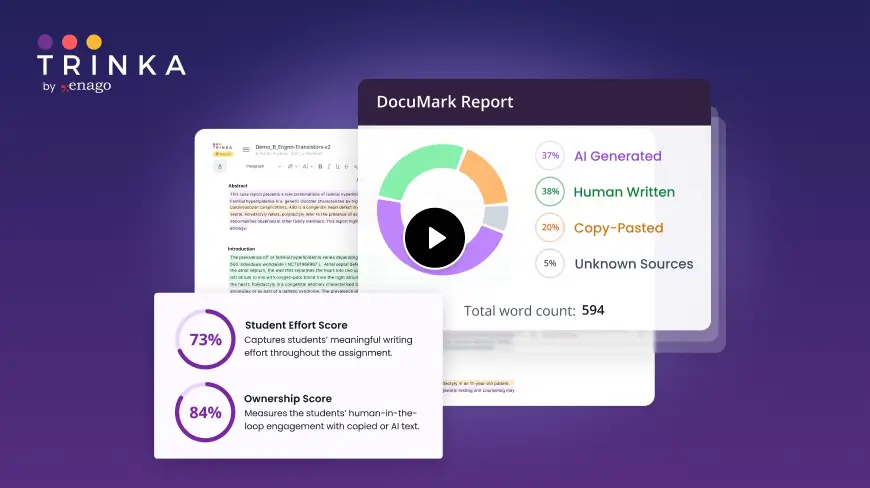
DocuMark: Responsible AI Use for Academic Integrity
Knowing your institution's AI policy is step one. DocuMark helps enforce it fairly by empowering universities to manage AI-generated content, prevent cheating, and support student writing through responsible AI use.
Common Questions About Chapman University's AI Policies
Chapman University has defined AI policies in 12 of 12 categories, with an overall coverage score of 100%.
Chapman requires transparency and attribution when AI is used in academic work where allowed. Students must document and reference AI use in the discipline's citation style, and some syllabus models require students to indicate which parts were written by AI versus by the student.
Chapman treats unpermitted AI-assisted coursework as academic dishonesty and places oversight with the Academic Integrity Committee. Its sample syllabus language also contemplates use of AI detection services when instructors suspect prohibited LLM use, and student-facing academic integrity materials describe reporting and committee processes for apparent violations.
Chapman has a data-risk-based AI use policy: only tools approved for the appropriate risk category may be used with confidential or proprietary information, and users must not enter such information into tools that are not on the approved AI software list. The university maintains an approved AI software inventory reviewed by IS&T, including risk classifications, and provides institutionally available platforms such as Microsoft Copilot and PantherAI.