Teaching & Learning
- Teaching.IU provides example syllabus language ranging from permitting generative AI for all assignments (with acknowledgment/citation expectations) to prohibiting generative AI for any part of assignments
- The university states it does not currently have specific institution-wide policies governing generative AI use (beyond data security and privacy) and indicates that generative AI expectations for graded work may be set at the course/syllabus level
IU does not currently have any specific policies around the use of generative AI, other than policies related to data security and privacy.
However, it may be useful for instructors to address generative AI more specifically, such as in their syllabi.
The use of generative AI (GAI) is permitted in this course for all assignments and assessments with no penalty.
Any use of such tools must be appropriately acknowledged and cited.
In this course, you are expected to do your own work and properly cite any sources you use. The use of generative AI (GAI) tools, such as chatbots, text generators, paraphrasers, summarizers, or solvers, is strictly prohibited for any part of your assignments. Students must complete all work independently and without GAI-generated content.
- Teaching.IU provides example syllabus language that may either permit generative AI for assessments or prohibit it entirely, depending on the instructor/course policy
- The university indicates there is no specific institution-wide generative AI policy (beyond data security and privacy) and suggests instructors set expectations in their syllabi
IU does not currently have any specific policies around the use of generative AI, other than policies related to data security and privacy.
However, it may be useful for instructors to address generative AI more specifically, such as in their syllabi.
The use of generative AI (GAI) is permitted in this course for all assignments and assessments with no penalty.
Generative AI can be used to create assessments, including formative assessments.
- It also states departments may have additional guidelines and that faculty should use professional judgment to determine appropriateness of use cases supporting student success
- The university provides teaching and learning guidance describing instructional uses of generative AI (e.g., generating alternate explanations and recommending resources) and notes that instructors often tailor these tools to their courses
Generative AI technologies are reshaping the academic landscape. While we provide a few applications, many instructors are tailoring these tools to their courses.
Keep in mind that your department may have additional guidelines for the use of generative AI. We encourage departments to discuss openly about the disciplinary norms and ethics in the use of generative AI.
Produce alternate explanations of course concepts that students may find challenging to understand
Recommend resources related to a topic
Note that this is a non-exhaustive list, and faculty should use their own professional judgement and disciplinary expertise to determine the appropriateness of a particular use case in supporting student success.
- In teaching/research guidance and IT communications, IU describes generative AI as being usable to create code and to write code as an example capability
- The university does not state a specific institution-wide policy for generative AI use in coursework (beyond data security and privacy) and suggests instructors may define expectations in their syllabi
IU does not currently have any specific policies around the use of generative AI, other than policies related to data security and privacy.
However, it may be useful for instructors to address generative AI more specifically, such as in their syllabi.
Bing Chat Enterprise is now accessible to IU faculty and staff, representing the recommended way to use generative AI within the IU environment. It is built on the same AI models and data as ChatGPT so you can use it to write and summarize content, create code, and answer complex questions.
Generative AI tools, including large language models (LLMs) such as ChatGPT or Claude, can help you summarize literature, draft documents, write code, and analyze quantitative or qualitative data.
Research
- IU research guidance states that generative AI tools/LLMs can be used to summarize literature and draft documents in the research context
- The same guidance emphasizes that when conducting research at IU, research data are considered owned by IU unless an agreement assigns ownership elsewhere
Generative AI tools, including large language models (LLMs) such as ChatGPT or Claude, can help you summarize literature, draft documents, write code, and analyze quantitative or qualitative data.
But when you conduct research at Indiana University, all research data are considered owned by IU — even if you created the dataset yourself — unless an agreement explicitly assigns ownership elsewhere.
- IU research guidance states LLMs can be used to analyze quantitative or qualitative data, but restricts use of personal LLM accounts with institutional research data
- It states personal accounts with LLM services are not approved for any institutional data (including research data considered “Public”) and explicitly answers that IU research data may not be put into personal/public AI accounts because such public versions are not approved
Generative AI tools, including large language models (LLMs) such as ChatGPT or Claude, can help you summarize literature, draft documents, write code, and analyze quantitative or qualitative data.
Personal accounts with LLM services like Claude, ChatGPT, or Gemini are not approved for any institutional data, including institutional research data considered “Public”, and can expose sensitive content.
Can I put my IU research data into a personal free or premium ChatGPT, Claude, or another public AI account?
No. Public LLM versions are not approved because they lack contractual protections and security controls.
- IU’s University Faculty Council A.I
- The provided sources do not define specific rules for AI-generated content in grant proposals, IRB applications, or formal research ethics declarations
- Taskforce page acknowledges both the potential for constructive/ethical use and concerns about misuse, and states IU recognizes the need to establish policies and practices governing acceptable use
Like many technologies that have emerged throughout history, generative AI has enormous potential to aid worthwhile human endeavors if used constructively and ethically. But recent advances in generative AI technology have also raised legitimate concerns about how to forestall potential misuse of these tools.
While Indiana University encourages members of the university community to explore generative AI technology, experiment with it, and contemplate possible applications for it that will help to advance the institution’s teaching, research, and service missions, the University also recognizes the need to establish thoughtfully crafted policies and practices governing acceptable use of these tools.
Academic Integrity
- The university points students to the Code of Student Rights, Responsibilities, and Conduct for academic misconduct and suggests instructors may address generative AI in syllabi
- Teaching.IU’s sample syllabus language includes a requirement that generative AI use (beyond spelling/grammar checking) be acknowledged and cited, and states that use without disclosure/acknowledgement may be treated as plagiarism/cheating
Students are expected to adhere to the Code of Student Rights, Responsibilities, and Conduct, which addresses Academic Misconduct.
However, it may be useful for instructors to address generative AI more specifically, such as in their syllabi.
Any use of such tools must be appropriately acknowledged and cited.
The disclosure of use of GAI for spelling and grammar checkers is not necessary, but all other uses of GAI require proper acknowledgment and citations.
The use of GAI platforms without disclosure will be considered plagiarism and/or cheating and will be reported to the Dean of Students and handled according to university policies.
- The provided sources do not define an institution-wide position on the use of AI detection tools
- The provided Teaching.IU sample syllabus language states undisclosed use of generative AI may be treated as plagiarism/cheating and reported to the Dean of Students, with sanctions that may include assignment/course grade penalties
The use of GAI platforms without disclosure will be considered plagiarism and/or cheating and will be reported to the Dean of Students and handled according to university policies.
Sanctions for academic misconduct in this course may include a failing grade on the assignment, a reduction in your final course grade, or a failing grade in the course, among other possibilities.
The use of GAI platforms will be considered plagiarism and/or cheating and will be reported to the Dean of Students and handled according to university policies.
Sanctions for academic misconduct in this course may include a failing grade on the assignment, a reduction in your final course grade, or a failing grade in the course, among other possibilities.
Institutional & Administrative
- IU states that Microsoft Copilot is IU’s preferred generative AI service for faculty and staff and that Bing Chat Enterprise/Copilot is the recommended way for faculty and staff to use generative AI within the IU environment
- Teaching.IU also provides examples of faculty uses (e.g., drafting emails/announcements; drafting lesson plans, rubrics, quiz questions, and assignments) and notes faculty should use professional judgment and disciplinary expertise to determine appropriateness
Microsoft Copilot (formerly Bing Chat Enterprise) is IU's preferred generative AI service for faculty and staff.
Bing Chat Enterprise is now accessible to IU faculty and staff, representing the recommended way to use generative AI within the IU environment.
Draft emails and announcements
Outline or draft learning outcomes, lesson plans, rubrics, quiz questions, and assignments
Note that this is a non-exhaustive list, and faculty should use their own professional judgement and disciplinary expertise to determine the appropriateness of a particular use case in supporting student success.
- IU states it has no specific generative AI policies other than those related to data security and privacy, and identifies Microsoft Copilot as IU’s preferred generative AI service for faculty and staff that can handle data up to University-Internal level
- IU research guidance further states personal LLM accounts are not approved for any institutional data (including institutional research data considered “Public”) and that public LLM versions are not approved for IU research data due to lack of contractual protections and security controls
IU does not currently have any specific policies around the use of generative AI, other than policies related to data security and privacy.
Microsoft Copilot (formerly Bing Chat Enterprise) is IU's preferred generative AI service for faculty and staff. It can handle data up to University-Internal level.
Personal accounts with LLM services like Claude, ChatGPT, or Gemini are not approved for any institutional data, including institutional research data considered “Public”, and can expose sensitive content.
No. Public LLM versions are not approved because they lack contractual protections and security controls.
- IU’s University Faculty Council A.I
- Taskforce page states the taskforce began and completed its work in Spring 2024 and notes IU recognizes the need to establish policies and practices governing acceptable use of generative AI tools
- IU communications also describe institutionally provided AI offerings (e.g., ChatGPT Edu availability to the IU community) as part of broader AI support for learning, teaching, research, and work across campus
The Indiana University A.I. Taskforce began and completed its work in Spring 2024.
While Indiana University encourages members of the university community to explore generative AI technology, experiment with it, and contemplate possible applications for it that will help to advance the institution’s teaching, research, and service missions, the University also recognizes the need to establish thoughtfully crafted policies and practices governing acceptable use of these tools.
Indiana University is expanding its robust artificial intelligence offerings with OpenAI by providing access to ChatGPT Edu, a version built specifically for higher education.
Now available to all of IU, ChatGPT Edu supports learning, teaching and work across campus.
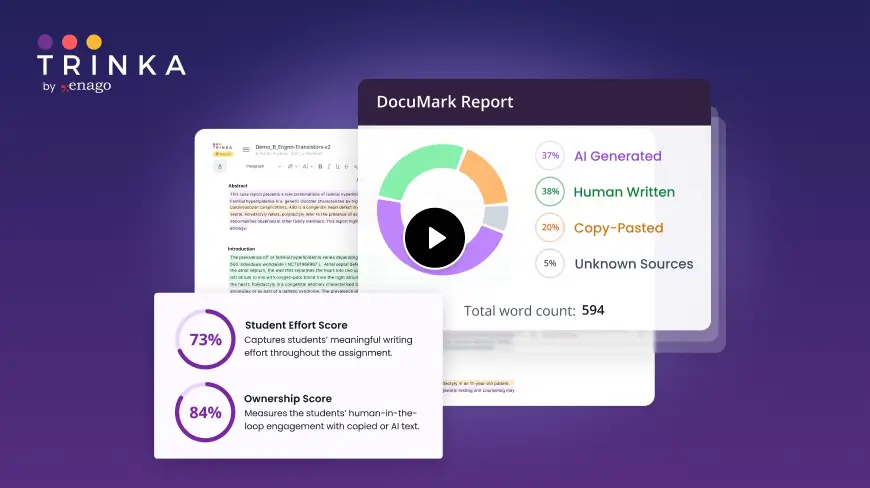
DocuMark: Responsible AI Use for Academic Integrity
Knowing your institution's AI policy is step one. DocuMark helps enforce it fairly by empowering universities to manage AI-generated content, prevent cheating, and support student writing through responsible AI use.
Common Questions About Indiana University Bloomington's AI Policies
Indiana University Bloomington has defined AI policies in 12 of 12 categories, with an overall coverage score of 100%.
The university points students to the Code of Student Rights, Responsibilities, and Conduct for academic misconduct and suggests instructors may address generative AI in syllabi. Teaching.IU’s sample syllabus language includes a requirement that generative AI use (beyond spelling/grammar checking) be acknowledged and cited, and states that use without disclosure/acknowledgement may be treated as plagiarism/cheating.
The provided Teaching.IU sample syllabus language states undisclosed use of generative AI may be treated as plagiarism/cheating and reported to the Dean of Students, with sanctions that may include assignment/course grade penalties. The provided sources do not define an institution-wide position on the use of AI detection tools.
IU states it has no specific generative AI policies other than those related to data security and privacy, and identifies Microsoft Copilot as IU’s preferred generative AI service for faculty and staff that can handle data up to University-Internal level. IU research guidance further states personal LLM accounts are not approved for any institutional data (including institutional research data considered “Public”) and that public LLM versions are not approved for IU research data due to lack of contractual protections and security controls.