Teaching & Learning
- Separate CTL guidance shows that course-level policy is often left to instructor discretion, with sample policies ranging from prohibited use, to specified limited uses, to free use
- For graded coursework, the university-level cheating policy prohibits students from using generative AI to complete assigned coursework unless the instructor expressly permits it in the syllabus or assignment
"Using GAI to generate content in satisfaction of assigned coursework, except as expressly permitted by the instructor in the syllabus, or applicable assignment;"
"## We strongly encourage you include a course policy in your syllabus and/or for individual assignments that may allow different use of AI. Your students will benefit from clarity about your expectations and deliberate engagement with your course policy as students will be enrolled in courses that expect or require AI usage and others have differing expectations."
"Your thoughts, opinions and personal experiences are integral to the learning process. As such, the use of generative AI is prohibited in this class. Other instructors may permit the use of this tool in their courses; however, we are asking students to engage in self-reflection that is both authentic to them and is expressed in an authentic manner."
"Students are allowed to use advanced automated tools (artificial intelligence or machine learning tools such as ChatGPT or Dall-E 2) on assignments in this course; no special documentation or citation is required."
- CTL sample language also includes course policies that forbid AI use for evaluated work outside specifically authorized contexts
- The official university policy treats use of generative AI during examinations, tests, and quizzes as cheating unless the instructor expressly allows it in the syllabus or the specific assessment
"Using notes, textbooks or other information, or content generated by internet-based generative artificial intelligence programs (GAI), in examinations, tests and quizzes, except as expressly permitted by the instructor in the syllabus, examination, test, or quiz;"
"There are situations and contexts within this course where you will be asked to use AI tools to explore how they can be used. Outside of those circumstances, you are discouraged from using AI tools to generate content (text, video, audio, images) that will end up in any student work (assignments, activities, responses, etc) that is part of your evaluation in this course."
- Kent State provides guidance that AI may be used to support student learning and studying in some contexts, but this is not framed as a single university-wide student entitlement
- CTL materials recommend instructor conversations and course policies, and they give examples such as using language generators for practice problems, examples, revision, and help with writer’s block
"Discuss the tools with your students. It is likely that students already know about ChatGPT, so it is worth having a conversation with your students about how to use this new technology responsibly. Ask your students to consider how AI technology may impact their learning and opportunities for it to enhance their writing."
"Students can ask a language generator to provide additional practice problems, questions, examples, and scenarios to aid in their studying."
"Students may submit their work to a language generator and ask the AI to improve their writing. Students may then compare their original work with the AI-generated response and use this as a starting point to critique their own product."
"Students who are facing writer’s block may use a language generator to begin their writing."
Research
- The evidence only establishes that plagiarism and cheating standards can reach thesis, dissertation, or other work and that sanctions may include rejection of that work
- The university’s cheating and plagiarism policy applies to theses, dissertations, and other academic work, but the provided sources do not set a distinct AI policy for research writing or manuscript preparation
""Instructor" means any person employed or appointed to teach in any course or program offering of the university, or a committee appointed to assess, evaluate, or grade a thesis, dissertation or work. Any decision by such a committee shall be by majority vote."
"Degree. The following academic sanctions are provided for acts of cheating or plagiarism which so permeate the student's work that the effect is to compromise the validity of a degree. Such occurrences may be related, but not limited to, professional or graduate work."
"Rejection of the thesis, dissertation or work;"
Academic Integrity
- When AI use is allowed under a course policy, disclosure requirements may be imposed at the instructor level
- The university cheating policy also defines plagiarism to include presenting GAI-derived ideas or work as one’s own without full and proper credit
- CTL examples include requiring students to clearly identify what parts of submitted work are their own and what parts were generated by AI, and one sample permits AI-generated media only with proper credits
"Any student work submitted using AI tools should clearly indicate what work is the student’s work and what part is generated by the AI."
"Generating AI artwork, audio, images, or videos with proper credits to the AI tool used"
""Plagiarize" means to take and present as one's own a material portion of the ideas or words of another (e.g. person, persons, or GAI), or to present as one's own an idea or work derived from an existing source without full and proper credit to the source of the ideas, words, or works."
- Sanctions can include refusal of credit, a zero or F on the work, an F in the course, and further action
- CTL materials caution that AI detection is difficult and unreliable, while official policy focuses on sanctions rather than endorsing a detector
- Kent State states that AI misuse can be handled as cheating or plagiarism and subjects students to formal academic sanctions and reporting to the Office of Student Conduct
"Unfortunately, the ChatGPT software is difficult to detect. A couple of programs have been created to determine the likelihood that text was written by an AI, but these programs are easily tricked and difficult to prove. It is likely that both the ChatGPT AI and the detection programs will continue to improve with time. For now, it may be important to realize that it will be challenging to detect the use of ChatGPT in the classroom."
"In this class, unacceptable uses of artificial intelligence (AI) assistance will be treated the same as plagiarism and/or an academic dishonesty violation."
"Instructors are to use the cheating/plagiarism sanction form to indicate which one of the following sanctions is to be imposed on the student. Instructors must send that form to the office of student conduct."
"Refuse to accept the work for credit; or"
"Assign a grade of "F" or zero for the project, test, paper, examination or other work in which the cheating or plagiarism took place; or"
"Assign a grade of "F" for the course in which the cheating or plagiarism took place; and/or;"
Institutional & Administrative
- CTL materials encourage instructors to adopt course AI policies and describe faculty use of AI for lesson planning, course descriptions, activities, examples, and assessment generation
- Kent State provides faculty-facing guidance and development opportunities for instructional uses of AI, but the provided sources do not establish a binding university-wide operational policy for faculty or staff use in grading, recommendation letters, or administration
"We strongly encourage you include a course policy in your syllabus and/or for individual assignments that may allow different use of AI."
"Consider adopting an AI policy in your course syllabus."
"Ask the language generator to develop a lesson plan around a particular topic that scaffolds the learning and challenges students. You can use this as a basis for your own lesson planning."
"Ask the tool to write a course description. Although the product may not align with your plans, it can be a helpful starting point if you are dealing with writers block."
"Ask the generator for creative activities that you could use to engage your students on a particular topic."
- Kent State shows institution-level AI strategy through faculty development and governance-related support rather than a single comprehensive AI policy document in the provided sources
- CTL states there is not yet an official university syllabus statement for ChatGPT, while also running initiatives and recognition programs to help faculty develop policy, reflect on ethics, and engage students with AI
"Kent State does not yet have an official syllabus statement for ChatGPT. While this conversation is ongoing, we encourage instructors to have an honest conversation with their students about the importance of academic integrity and the limitations of the ChatGPT technology."
"This series of 4 workshops is designed to give faculty members the opportunity to engage with Generative Artificial Intelligence (GAI). This program is for people eager to explore and consider GAI use in their classroom. CTL will provide support as we use AI, discuss and plan for engaging students with AI, develop policy and reflect about ethical considerations and GAI use."
"This recognition uplifts educators who have demonstrated a commitment to learning about artificial intelligence (AI). By participating in 4 workshops (at least 3 different one-hour sessions) and reflecting on AI, educators are showing their dedication to understanding this major influence in higher education."
DocuMark: Responsible AI Use for Academic Integrity
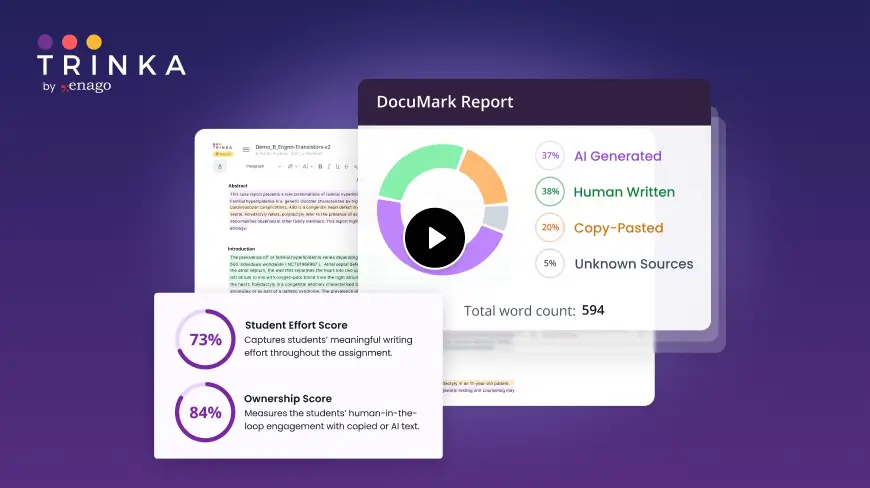
Knowing your institution's AI policy is step one. DocuMark helps enforce it fairly by empowering universities to manage AI-generated content, prevent cheating, and support student writing through responsible AI use.
Common Questions About Kent State University's AI Policies
Kent State University has defined AI policies in 8 of 12 categories, with an overall coverage score of 67%.
When AI use is allowed under a course policy, disclosure requirements may be imposed at the instructor level. CTL examples include requiring students to clearly identify what parts of submitted work are their own and what parts were generated by AI, and one sample permits AI-generated media only with proper credits. The university cheating policy also defines plagiarism to include presenting GAI-derived ideas or work as one’s own without full and proper credit.
Kent State states that AI misuse can be handled as cheating or plagiarism and subjects students to formal academic sanctions and reporting to the Office of Student Conduct. CTL materials caution that AI detection is difficult and unreliable, while official policy focuses on sanctions rather than endorsing a detector. Sanctions can include refusal of credit, a zero or F on the work, an F in the course, and further action.
No explicit data protection or approved AI platform policy is currently defined in the available policy sources.