Teaching & Learning
- The university states that AI use can be an Honor Code issue when it violates course rules or misrepresents authorship, and it emphasizes that instructors determine whether AI is allowed for coursework
- It provides examples of AI use that may be treated as cheating/plagiarism/falsification (e.g., using chatbots to complete written work in entirety or generating code without permission) and notes that some examples may be permissible depending on the course context
The University of South Carolina’s Honor Code is fully equipped to address academic integrity violations involving artificial intelligence. Existing policies apply regardless of the tools used, meaning the use of AI in ways that violate course rules or misrepresent authorship can be investigated and adjudicated under the current Code.
Using a chatbot (ChatGPT, CoPilot, Gemini etc.) to complete a discussion post, essay, or research paper in its entirety.
Using a chatbot to solve an equation or generate a line of code without the permission to do so by the instructor of record.
Note: This is not an exhaustive list and some of these examples may be permissible in some courses or contexts.
As with any academic tool, it's your responsibility to make sure the use of AI is allowed by your instructor and that any AI-generated content is clearly cited or marked, so it's clear what work is yours and what was created by the technology.
- It also provides sample syllabus language indicating that AI-generated text may be prohibited for “assessments,” but the page frames these as examples instructors may adopt
- The university treats AI-related misconduct during exams and assessments under existing Honor Code processes, and indicates that using generative AI as unauthorized assistance can constitute an academic honesty violation
Violations involving AI are reviewed under the same process as any other academic integrity case.
This policy indicates the following constitute violations of academic honesty: a student has another person/entity do the work of any substantive portion of a graded assignment for them, which includes purchasing work from a company, hiring a person or company to complete an assignment or exam, and/or using generativeArtificial Intelligencetools (such as ChatGPT).
students are not permitted to submit text that is generated by artificial intelligence (AI) systems such as ChatGPT, Bing Chat, Claude, Google Bard, or any other automated assistance for any classwork or assessments.
- It also provides examples in instructor-facing materials suggesting AI may be useful for brainstorming and exploring possible responses, with attribution expectations depending on the course policy
- The university advises students to use AI in ways that support learning rather than replace their own thinking and effort, and it instructs students to use AI only when an instructor explicitly allows it
Ask first: Only use AI tools when your instructor has explicitly allowed it.
Use responsibly: AI should support your learning—not replace your own thinking and effort.
The use of these tools for brainstorming ideas, exploring possible responses to questions or problems, and creative engagement with the materials may be useful for you as you craft responses to class assignments.
- It frames AI use in coursework as governed by instructor authorization and course rules
- The university explicitly lists generating code with a chatbot without instructor permission as an example rationale for an Honor Code violation, while also noting that permissibility can vary by course context
Using a chatbot to solve an equation or generate a line of code without the permission to do so by the instructor of record.
Note: This is not an exhaustive list and some of these examples may be permissible in some courses or contexts.
As with any academic tool, it's your responsibility to make sure the use of AI is allowed by your instructor and that any AI-generated content is clearly cited or marked, so it's clear what work is yours and what was created by the technology.
Research
- Not defined
not defined
- Not defined
not defined
- Not defined
not defined
Academic Integrity
- It also offers example instructor statements requiring AI use to be “properly documented and cited” for submitted work, indicating that disclosure expectations may be set at the course level
- The university states that students must clearly cite or mark AI-generated content when AI is used, and it provides sample syllabus language indicating that failure to acknowledge generative AI use can be treated as misrepresentation
As with any academic tool, it's your responsibility to make sure the use of AI is allowed by your instructor and that any AI-generated content is clearly cited or marked, so it's clear what work is yours and what was created by the technology.
It is a violation of university policy to misrepresent work that you submit or exchange with your instructor by characterizing it as your own, such as submitting responses to assignments that do not acknowledge the use of generative AI tools.
Your use of generative AI tools must be properly documented and cited for any work submitted in this course.
- It describes investigative approaches including reviewing document version history and comparing work to AI outputs by consulting licensed tools, while noting such comparisons are not certain proof of AI use
- The university states that AI-related academic integrity allegations are handled under the same Honor Code investigation and adjudication process as other cases, using a preponderance-of-the-evidence standard and considering syllabus statements and assignment directions
Like all reported alleged violations of the Honor Code student behavior and assignment submissions are reviewed by the Office of Student Conduct and Academic Integrity to find whether it is more likely than not- by a preponderance of the evidence that the student's behavior or work violates one or more of the Honor Code's policies.
Syllabus statements and assignment directions may be used in addition to the language in the Honor Code to either support or negate a violation of the Honor Code.
Violations involving AI are reviewed under the same process as any other academic integrity case.
It is common practice for this office to request original document access via a shared collaborator link from a student's work in Office 365. We review the version history with the student and look for patterns in the creation of the document that may give insight into the student's process.
To get a sense of whether or not a student may have used artificial intelligence to complete their work we may consult with ChatGPT or CoPilot via chat (as these are currently licensed by the University of South Carolina and FERPA compliant if being used with a University of South Carolina account) to see how it would respond to the same prompts or questions as what the student was asked to do in an assignment not being reported for improper use of artificial intelligence.
This is not a certain means to prove a student used artificial intelligence in their work but, it does provide a line of questions to get to a more certain finding either for or against a violation of the Honor Code.
Institutional & Administrative
- Separately, the system policy on responsible technology use requires that AI-generated content be carefully reviewed before relying on it for work purposes and prohibits using AI to create harmful or deceptive content
- The university provides guidance that faculty may use ChatGPT for lesson planning and grading support (e.g., brainstorming lesson ideas and drafting rubrics), with an expectation of human review for accuracy and course fit
Faculty use it to brainstorm lesson ideas, draft rubrics or generate practice exercises. Outputs should be reviewed for accuracy and tailored to the course context.
AI technology must not be used to create content that is inappropriate, discriminatory, deceptive, or otherwise harmful to others or the University. All AI-generated content must be carefully reviewed for accuracy, appropriateness, and bias before relying on it for work purposes.
- The system responsible-use policy requires users to follow data classification controls and confidentiality/privacy requirements and restricts disclosure/transmission of data unless required or authorized
- For procurement, the system “Purchasing AI” guideline provides an approved list and requires a Technical Review Board meeting for tools outside the approved list, with research representation attending to approve
- The university states it has a university-licensed ChatGPT (ChatGPT Edu) environment and represents that conversations/data entered into that environment are not used to train OpenAI’s models, and that only the user can read their conversations
Later today you will be receiving information that the university has partnered with OpenAI to bring enterprise ChatGPT 4 to all faculty, staff and students on the Columbia campus. This OpenAI agreement protects all your intellectual property and personal information from exposure to any large language models.
Only you will be able to read your conversations.
Conversations and data entered into ChatGPT Edu are not used to train or improve OpenAI’s models.
Purchasing AI Tools Outside of the Approved List
A meeting with the Technical Review Board (TRB) is required. The TRB governs USC systemwide IT purchases and is chaired from the Office of the Vice President and CIO. A representative from the Office of Vice President for Research will also attend the TRB meeting to approve the
Data and system users must uphold the confidentiality and privacy rights of individuals whose records they access; must adhere to controls based on Data Classification, including restrictions on access by Personal Technology Assets; must not disclose, share, or transmit data except as required by job duty or authorized in advance by the appropriate Data Steward
- It also describes institution-level adoption of enterprise ChatGPT for the Columbia campus through a partnership with OpenAI
- The university indicates that its teaching guidance draws from a Provost’s AI Task Force report and frames the resulting principles as a guide for ethical and human-centered AI use in teaching
Drawing from the Provost’s 2024-2025 AI Task Force Report, the following principles provide a guide for ethical, effective, and human-centered use of AI in teaching.
Later today you will be receiving information that the university has partnered with OpenAI to bring enterprise ChatGPT 4 to all faculty, staff and students on the Columbia campus.
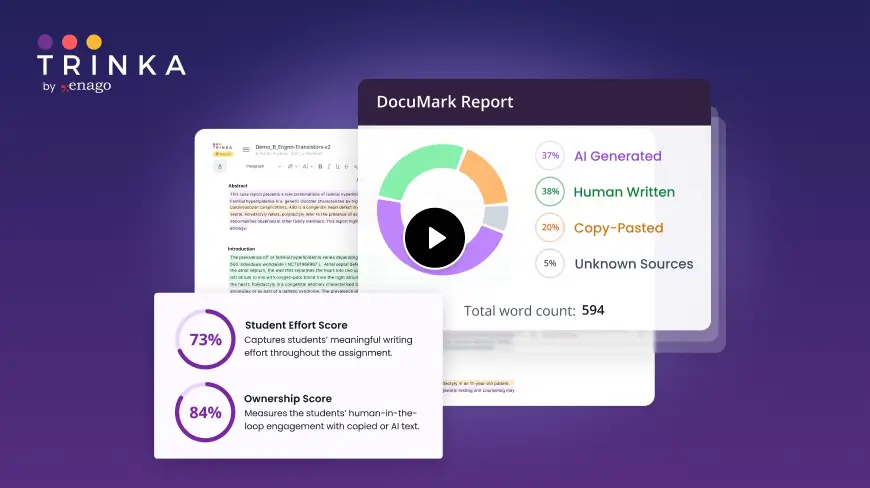
DocuMark: Responsible AI Use for Academic Integrity
Knowing your institution's AI policy is step one. DocuMark helps enforce it fairly by empowering universities to manage AI-generated content, prevent cheating, and support student writing through responsible AI use.
Common Questions About University of South Carolina's AI Policies
University of South Carolina has defined AI policies in 12 of 12 categories, with an overall coverage score of 100%.
The university states that students must clearly cite or mark AI-generated content when AI is used, and it provides sample syllabus language indicating that failure to acknowledge generative AI use can be treated as misrepresentation. It also offers example instructor statements requiring AI use to be “properly documented and cited” for submitted work, indicating that disclosure expectations may be set at the course level.
The university states that AI-related academic integrity allegations are handled under the same Honor Code investigation and adjudication process as other cases, using a preponderance-of-the-evidence standard and considering syllabus statements and assignment directions. It describes investigative approaches including reviewing document version history and comparing work to AI outputs by consulting licensed tools, while noting such comparisons are not certain proof of AI use.
The university states it has a university-licensed ChatGPT (ChatGPT Edu) environment and represents that conversations/data entered into that environment are not used to train OpenAI’s models, and that only the user can read their conversations. For procurement, the system “Purchasing AI” guideline provides an approved list and requires a Technical Review Board meeting for tools outside the approved list, with research representation attending to approve. The system responsible-use policy requires users to follow data classification controls and confidentiality/privacy requirements and restricts disclosure/transmission of data unless required or authorized.