Teaching & Learning
- In the Cancer Biology Graduate Program, AI content creation tools are prohibited for graduate work and scholarly pursuits, with zero tolerance stated
- Wayne State University does not set one uniform institution-wide rule for student AI use in coursework; instead, expectations vary by instructor and assignment, and students are responsible for checking course-specific rules
Especially since the field of AI is changing so quickly, it is your responsibility to double-check the expectations of your instructors on all your assignments to make sure you are not using these AI-based tools in a prohibited way. Every WSU faculty member will have different expectations around using these tools in their classrooms and even within different assignments.
Academic work submitted by a graduate student for graduate credit is assumed to be of her/his own creation, and, if found not to be, will constitute a violation of the Student Code of Conduct and may subject you to charges of academic misconduct” including “cause for dismissal from the School.” Since our goal is to facilitate developing critical thinking skills, ideas, and perspectives, the use of any artificial intelligence (AI) content creation tool/system (e.g., Jasper, ChatGPT, Bard, etc.) is not permitted. In short, there is zero tolerance for the use of AI in scholarly pursuits related to the Cancer Biology Program.
- The university's academic misconduct policy prohibits using unauthorized materials during an exam, which would apply to unapproved AI use
- No university-wide, exam-specific AI rules were found, though a School of Medicine news update mentions that a departmental AI policy exists
Cheating: Intentionally using or attempting to use or intentionally providing unauthorized materials, information or assistance in any academic exercise. This includes copying from another student's test paper, allowing another student to copy from your test, using unauthorized material during an exam and submitting a term paper for a current class that has been submitted in a past class without appropriate permission.
- The School of Medicine also indicates that its AI policy explains when AI may be used as a learning tool
- Wayne State encourages students to use AI tools in ways that support learning rather than replace practice, but students must follow each instructor's expectations because permitted use varies by class and assignment
Every WSU faculty member will have different expectations around using these tools in their classrooms and even within different assignments. As you use AI-based tools, we encourage you to make sure you're using them to help you learn more effectively and not to shortcut skills that are important for you to practice on your own.
If you are unsure if the use of an AI-based tool is an academic integrity violation, please talk to your course instructor. Every instructor will have different expectations around AI-based tools in their classroom, so it is your responsibility to double-check to ensure you are not committing an academic integrity violation.
* Clarifies when AI may be used as a learning tool and when its use is not permitted.
Research
- The program also requires dissertation plagiarism review before final approval
- In the Cancer Biology Graduate Program, AI content creation tools are prohibited in scholarly pursuits, which covers graduate research writing submitted for credit
Academic work submitted by a graduate student for graduate credit is assumed to be of her/his own creation, and, if found not to be, will constitute a violation of the Student Code of Conduct and may subject you to charges of academic misconduct” including “cause for dismissal from the School.” Since our goal is to facilitate developing critical thinking skills, ideas, and perspectives, the use of any artificial intelligence (AI) content creation tool/system (e.g., Jasper, ChatGPT, Bard, etc.) is not permitted. In short, there is zero tolerance for the use of AI in scholarly pursuits related to the Cancer Biology Program.
The Final Report document must be signed by all PhD Dissertation Committee members, the Cancer Biology Graduate Director, and the Graduate Officer indicating that the dissertation has passed the plagiarism check.
- The curriculum does note that responsible research training includes artificial intelligence and that a bioinformatics course uses public omics datasets and analysis methods
- The Cancer Biology Graduate Program prohibits AI in scholarly pursuits related to the program, but the provided text does not separately define rules for AI use in data collection, analysis, or synthetic data generation
In short, there is zero tolerance for the use of AI in scholarly pursuits related to the Cancer Biology Program.
CB7800 - Rigor and Reproducibility in Cancer Biology (1 Credit): The objective of this course is to provide students with the ability to understand and learn how to conduct rigorous and reproducible cancer research. These include experimental design, data interpretation, publishing, animal and human research, scientific misconduct, artificial intelligence, and other topics relevant to the conduct of responsible research in Cancer Biology.
CB8910 - Applied Cancer Bioinformatics (1 Credit): This course is designed to instruct students who have a general background in molecular biology in the understanding and practical application of contemporary “omics” technologies within the context of cancer research. The course will emphasize the use of publicly available cancer “omics” datasets and associated bioinformatics tools for data mining.
- The School of Medicine states that its AI policy emphasizes ethical considerations and academic integrity
- Responsible research training in the program explicitly includes artificial intelligence alongside scientific misconduct and research with animals and humans
- In the Cancer Biology Graduate Program, using AI content creation tools in scholarly pursuits is prohibited and violations may trigger academic misconduct charges, including dismissal from the school
* Emphasizes ethical considerations and academic integrity.
Academic work submitted by a graduate student for graduate credit is assumed to be of her/his own creation, and, if found not to be, will constitute a violation of the Student Code of Conduct and may subject you to charges of academic misconduct” including “cause for dismissal from the School.” Since our goal is to facilitate developing critical thinking skills, ideas, and perspectives, the use of any artificial intelligence (AI) content creation tool/system (e.g., Jasper, ChatGPT, Bard, etc.) is not permitted. In short, there is zero tolerance for the use of AI in scholarly pursuits related to the Cancer Biology Program.
CB7800 - Rigor and Reproducibility in Cancer Biology (1 Credit): The objective of this course is to provide students with the ability to understand and learn how to conduct rigorous and reproducible cancer research. These include experimental design, data interpretation, publishing, animal and human research, scientific misconduct, artificial intelligence, and other topics relevant to the conduct of responsible research in Cancer Biology.
Academic Integrity
- The provided sources do not state a university-wide AI disclosure or citation format requirement
- The general rule is that work must be the student's own and that proper referencing or citation is required when using others' words or ideas
Plagiarism: To take and use another's words or ideas as your own without appropriate referencing or citation.
Academic work submitted by a graduate student for graduate credit is assumed to be of her/his own creation, and, if found not to be, will constitute a violation of the Student Code of Conduct and may subject you to charges of academic misconduct” including “cause for dismissal from the School.”
- The Cancer Biology PhD process also requires a dissertation plagiarism check before approval
- Wayne State treats AI-related misuse under its academic misconduct process when work is not the student's own or violates course rules
- Possible sanctions include failure on an assignment, failure in a course, dismissal from the university, and in the Cancer Biology Graduate Program, cause for dismissal from the school
Other: Selling, buying or stealing all or part of a test or term paper, unauthorized use of resources, enlisting in the assistance of a substitute when taking exams, destroying another's work, threatening or exploiting students or instructors, or any other violation of course rules as contained in the course syllabus or other written information.
Such activity may result in failure of a specific assignment, an entire course, or, if flagrant, dismissal from Wayne State University.
The instructor of record may report the alleged violation of the Student Code of Conduct using the Academic Misconduct Action form.
Academic work submitted by a graduate student for graduate credit is assumed to be of her/his own creation, and, if found not to be, will constitute a violation of the Student Code of Conduct and may subject you to charges of academic misconduct” including “cause for dismissal from the School.”
The Final Report document must be signed by all PhD Dissertation Committee members, the Cancer Biology Graduate Director, and the Graduate Officer indicating that the dissertation has passed the plagiarism check.
Institutional & Administrative
- The Libraries guide references an institutional site intended as guidance for faculty and researchers
- The provided sources acknowledge that Wayne State faculty may set their own classroom expectations for AI use, but they do not provide explicit rules for faculty or staff use of AI in grading, feedback, lesson planning, recommendation letters, or administrative work
Every WSU faculty member will have different expectations around using these tools in their classrooms and even within different assignments.
Wayne State's Computing & Information Technology division has produced a website addressing issues surrounding the use of Artificial Intelligence on campus. This site should be faculty and researcher's guide to moving forward with their research and instruction in the new academic environment produced through the introduction of large public-facing generative AI tools and resoures.
- Wayne State has institutional activity around AI guidance, including a Computing & Information Technology site addressing AI use on campus and a School of Medicine AI policy update
- The available text indicates guidance and policy development, but it does not provide a full university-wide governance framework, committee structure, or strategy roadmap in the supplied sources
Wayne State's Computing & Information Technology division has produced a website addressing issues surrounding the use of Artificial Intelligence on campus. This site should be faculty and researcher's guide to moving forward with their research and instruction in the new academic environment produced through the introduction of large public-facing generative AI tools and resoures.
Artificial Intelligence Guidelines and Usage Policy
Overview of the New Policy
* Provides guidelines on AI’s appropriate use and its limitations.
* Clarifies when AI may be used as a learning tool and when its use is not permitted.
* Emphasizes ethical considerations and academic integrity.
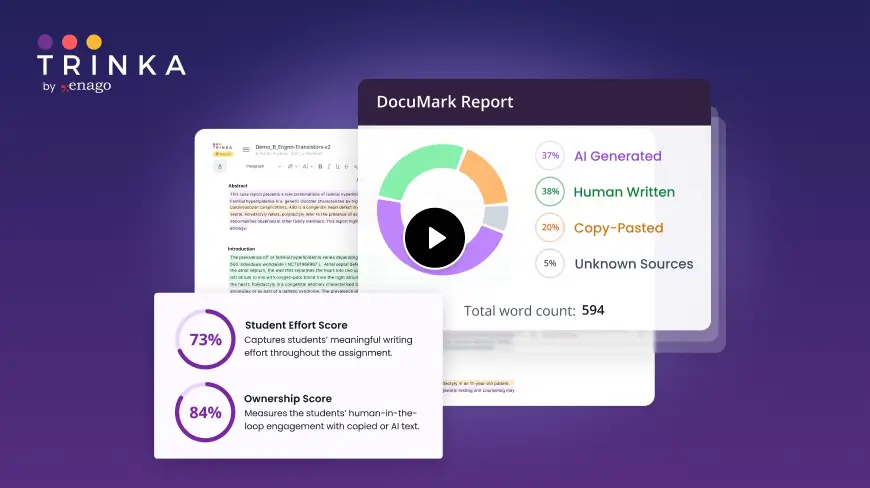
DocuMark: Responsible AI Use for Academic Integrity
Knowing your institution's AI policy is step one. DocuMark helps enforce it fairly by empowering universities to manage AI-generated content, prevent cheating, and support student writing through responsible AI use.
Common Questions About Wayne State University's AI Policies
Wayne State University has defined AI policies in 10 of 12 categories, with an overall coverage score of 83%.
The provided sources do not state a university-wide AI disclosure or citation format requirement. The general rule is that work must be the student's own and that proper referencing or citation is required when using others' words or ideas.
Wayne State treats AI-related misuse under its academic misconduct process when work is not the student's own or violates course rules. Possible sanctions include failure on an assignment, failure in a course, dismissal from the university, and in the Cancer Biology Graduate Program, cause for dismissal from the school. The Cancer Biology PhD process also requires a dissertation plagiarism check before approval.
No explicit data protection or approved AI platform policy is currently defined in the available policy sources.