


What Is Writing Style and Why Does It Matter for Research Papers?

Many researchers face a frustrating gap. Your study is strong, but reviewers still flag your manuscript as unclear, hard to follow, or not written in a scholarly tone. In most cases, the problem is not the science. It is your writing style in research papers, and using tools like the Trinka free grammar checker can help identify and refine these issues.
Writing style shapes how readers interpret your claims, how quickly they follow your methods and results, and how confident they feel about your rigor. This article explains what writing style means in research writing, why it matters for publication success, how to assess and refine your style, and which common style mistakes to avoid, with practical before and after examples.
What “writing style” means in research papers
Writing style is how you express ideas through word choice, sentence structure, paragraph structure, and tone. It sits above grammar and mechanics. You can write correct sentences that still feel vague, informal, or hard to read. Wikipedia defines writing style as the manner of expressing thought in language, including word choice and sentence and paragraph structure.
In research papers, writing style is not about sounding impressive. It is about explaining complex work so expert readers evaluate it efficiently and fairly. Purdue OWL describes style in graduate writing as how you build sentences, choose words, and set tone. These choices make writing plain and clear or verbose.
Why writing style matters for research papers (beyond “good English”)
Strong academic writing style improves publication readiness because it reduces reader effort. When your prose is clear and consistent, editors and peer reviewers focus on your contribution instead of decoding your meaning.
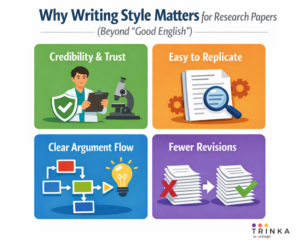
Style affects credibility
Academic readers often treat unclear phrasing as a signal of unclear thinking. Even when this assumption is unfair, it affects how your work is received.
Style supports reproducibility
Methods sections need precision. Small wording choices change meaning, especially for variables, inclusion criteria, and statistical reporting.
Style improves argument flow
A paper is data plus a reasoning chain. Weak transitions or unfocused paragraphs break the logic.
Style reduces revision cycles
Concise, direct sentences are easier to edit and verify. They also reduce ambiguity during rewriting. Purdue OWL notes concise writing uses the most effective words, not fewer words.
The core elements of academic writing style (what to control)
You do not need a creative writing voice. You need control of high impact style elements that journals reward.
Tone, formal, objective, and appropriately cautious
Tone shows your attitude toward the topic and the reader. It shifts based on audience expectations. Academic audiences expect specialized vocabulary and a formal tone.
In research writing, aim for a tone that is:
- formal but not inflated
- confident but not absolute, use cautious language where evidence is limited
- objective, prioritize data and reasoning over emotion
Clarity, make relationships explicit
Clarity means your reader answers three questions fast. What did you do. What did you find. Why does it matter. Purdue OWL guidance for APA style highlights clarity and conciseness and recommends specific language instead of vague wording.
Clarity improves when you:
- name the actor, who did what
- use concrete verbs
- avoid abstract this or it without a noun
Conciseness, remove words that do not earn their place
Wordiness hides your contribution. It also increases the risk of contradictions because longer sentences carry more moving parts. Purdue OWL concision guidance focuses on replacing weak or unnecessary wording with stronger, specific language.
Sentence structure, prefer direct, active constructions when appropriate
Active voice is not a rule for every sentence. It is often the clearest default because it shows who performed the action. Purdue OWL APA stylistics notes APA Style encourages active voice, especially when the actor matters.
Consistency, one term, one format, one logic
Consistency is a common issue in long papers. If you switch between COVID-19, Covid19, and coronavirus disease, you add friction and reduce polish. Scribbr notes formal academic style supports consistent presentation, so studies are assessed and compared more objectively. (https://www.scribbr.com/category/academic-writing/)
How to assess your writing style in a draft (a practical workflow)
Use a staged approach so you do not waste time polishing sentences you later remove.
- Start at the paragraph level. Check whether each paragraph has one purpose, one main claim, one main result, or one main step in a method.
- Verify who did what in key sentences. In the abstract, introduction claims, methods steps, and results statements, identify the actor and action.
- Cut wordiness systematically. Purdue OWL’s Paramedic Method gives a structured process to reduce clutter and activate sentences.
- Check consistency across the whole document. Look for terminology shifts, capitalization drift, inconsistent hyphenation, and mixed number formats.
If you want help spotting repeated inconsistencies quickly, especially in long manuscripts, Trinka Grammar Checker supports discipline-aware language refinement. It also includes Consistency Check to flag variations in spelling, hyphenation, terminology, and formatting patterns across a document.
When to prioritize style (and when not to)
Style revision gives the most value at these stages:
- Before submission: reviewers focus on your study, not language problems.
- After major structural edits: you avoid polishing text you remove later.
- When converting a thesis chapter into a journal article: journals expect tighter focus and concision.
- When you write in a non-native language: small issues in articles, prepositions, collocations, and tone add up and affect perceived fluency.
Avoid heavy style edits in early drafting. First set your argument, structure, and evidence. Then revise.
Common writing style mistakes in research papers (and how to avoid them)
Many style problems follow patterns. Once you know them, you fix them faster.
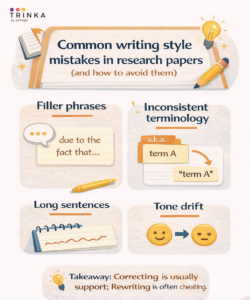
- Filler phrases: Overuse of academic sounding filler leads to wordiness and weak verbs. Replace phrases like it is important to note that with the point itself.
- Inconsistent terminology: Inconsistent terms confuse readers, especially in interdisciplinary work. Pick one preferred term for each concept and use it throughout unless a journal requires otherwise.
- Long sentences: Long sentences increase the risk of unclear logic. Break long sentences when you introduce a new claim, a new method step, or a new limitation.
- Tone drift: Tone drift reduces professionalism. Avoid conversational intensifiers such as really, huge, a lot, and pretty. Replace them with measurable descriptions.
Best practices for building a strong, journal-ready style
A reliable academic writing style is not about perfection. It is about control.
- Read recent papers in your target journal. Learn their phrasing patterns, section structure, and typical sentence length.
- Revise with one goal per pass. First clarity. Then conciseness. Then consistency.
- Treat style as part of research integrity. Clear methods and unambiguous results support reproducibility and reduce misinterpretation.
Conclusion
Writing style in research papers is the set of choices that shape clarity, tone, conciseness, and consistency. It matters because it affects how efficiently reviewers and readers evaluate your work, how credible your claims sound, and how reliably others understand and replicate your methods.
Use a simple workflow. Revise structure first. Then improve sentence clarity. Then cut wordiness. Then enforce consistency across the manuscript. If you struggle with terminology drift and formatting variation in long drafts, consider Trinka Grammar Checker and its Consistency Check to flag issues early so you spend more time improving scientific logic and argument flow.
Enhance Your Writing with Trinka’s Grammar Checker
Trinka’s Grammar Checker is designed to help writers produce clear, polished, and publication-ready content with ease. Whether you’re drafting academic papers, professional documents, or blog posts, Trinka ensures your writing is precise, consistent, and impactful, making it a trusted companion for anyone aiming to communicate effectively in English.

-
Go beyond grammar & spelling
Get holistic language improvements - Write with Trinka