


Word Choice in Academic Writing: Precision Over Flair

Many researchers face a common revision issue. Your sentences are grammatical, but reviewers still say the writing feels unclear, wordy, or not precise. In most cases, your ideas are not the problem. Your word choice is the problem, especially when you pick impressive words instead of discipline-accurate terms that say exactly what you mean. A grammar checker helps you spot vague wording faster, but you still decide the meaning.
This article explains what precision over flair means in academic writing, why it matters for peer review and publication, and how you can choose words that improve clarity without oversimplifying your research. You will also see before-and-after examples and a revision process you can apply to your next manuscript section. Additionally, using a tool like the Trinka.ai free grammar checker can help you refine your word choice and ensure your writing is both clear and precise, helping you move toward publication-ready work.
What “precision over flair” means in academic writing
In academic writing, precision means your words allow one clear interpretation in context. A precise sentence names the right variable, method, population, mechanism, limitation, or statistical meaning. It does not force your reader to guess your intent.
Flair is language that sounds advanced but adds no technical meaning. Flair often appears as vague intensifiers, inflated adjectives, or abstract nouns that are not tied to measurable outcomes.
Precision does not mean simple vocabulary or short sentences only. It means you choose the most accurate term, and you use it consistently.
Why precise word choice improves publication outcomes
Precise wording strengthens your work in ways reviewers look for.
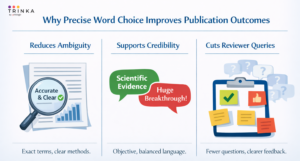
- It reduces ambiguity – Exact terms help readers follow your argument, replicate your method, and interpret results correctly. This supports methodological transparency and research integrity.
- It supports credibility – Overstated language makes claims sound promotional instead of scientific. Reviewers often push back when writing blurs the line between evidence and interpretation.
- It cuts avoidable reviewer queries – Many revision questions start with unclear referents, vague comparisons, undefined scope, or inconsistent terminology across sections.
Where flair commonly sneaks into research writing
Flair is rarely intentional. It often comes from habits like trying to sound academic, translating from another language, mirroring marketing tone in abstracts, or swapping synonyms to avoid repetition.
Common patterns include:
- Inflated claims without evidence. Words like revolutionary or unprecedented appear without a quantitative result or a defined baseline.
- Vague nouns that hide the action. Phrases like performed an analysis of can hide what you did.
- Stacked intensifiers and hedges. Writers sometimes pile on hedge words when one is enough.
- Imprecise comparisons. Words like better or improved require a comparator, a metric, and an outcome.
A practical test: Does the word change the meaning?
Use a meaning test during revision.
If you remove or replace the word, does the scientific meaning change.
If the answer is no, the word is decorative. If the answer is yes, keep it, then confirm it is the most accurate option.
This helps non-native English speakers who feel pressure to use advanced vocabulary. In academic writing, accuracy matters more than sophistication.
Before and after examples: Replacing flair with precision
Use the examples below as models. The goal is clear meaning.
Example 1: Replace inflated adjectives with measurable description
Before: The proposed method achieved outstanding performance and demonstrated remarkable robustness.
After: The proposed method increased F1 score by 4.2 points over the baseline and maintained performance under label noise rates up to 20%.
Why it works. The revised sentence defines what outstanding and robust mean.
Example 2: Replace vague “significant” with the correct meaning
Before: There was a significant improvement in the treatment group.
After: The treatment group showed a statistically significant reduction in systolic blood pressure (mean difference: 6.1 mmHg; p = 0.01).
Why it works. It states statistical significance, the variable, and the direction.
Example 3: Reduce abstract nouns and restore the main verb
Before: We conducted an investigation of the association between sleep quality and GPA.
After: We examined the association between sleep quality and GPA.
Why it works. The verb is direct and formal.
Example 4: Replace vague “this” with a concrete referent
Before: This suggests that socioeconomic factors affect adherence.
After: This association suggests that household income and transportation access affect appointment adherence.
Why it works. It names what this refers to and specifies the factors.
How to choose precise words: A revision workflow you can reuse
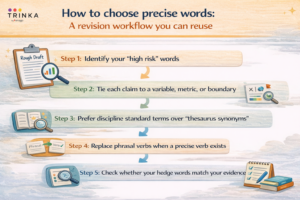
Step 1: Identify your “high risk” words
During editing, search your draft for terms that often signal imprecision. Examples include significant, important, better, strong, major, various, several, a lot, impactful, interesting, robust, novel, innovative, and efficient.
Step 2: Tie each claim to a variable, metric, or boundary
When you write improved, specify the metric, such as accuracy, RMSE, time to event, or yield. When you write robust, specify the stress condition, such as noise, missing data, or domain shift. When you write efficient, specify the resource, such as runtime, memory, number of parameters, or cost.
Step 3: Prefer discipline standard terms over “thesaurus synonyms”
Academic writing values consistency more than variety for technical concepts. If your field uses participants, do not switch to subjects unless your methods and ethics context requires it. If you define hazard ratio, do not rename it later.
Long manuscripts often become inconsistent after multiple revision rounds.
Step 4: Replace phrasal verbs when a precise verb exists
Many style guides recommend direct verbs instead of informal phrasal verbs, such as investigate instead of look into.
Step 5: Check whether your hedge words match your evidence
Hedges matter when evidence is limited, but you should use them with intent. If your study design supports a causal claim, do not hedge every sentence. If it does not, avoid causal verbs like prove or demonstrate.
Align verbs with study type:
- Observational: is associated with, correlates with, is linked to
- Experimental: increases, reduces, causes, only when design supports it
- Modeling: predicts, estimates, simulates
When to prioritize precision over style variation
Writers often try to vary wording to avoid repetition. In academic writing, prioritize precision and consistency in these cases.
- Methods. Use stable terms so readers can replicate your work.
- Results. Keep variable names consistent with tables and figures.
- Definitions. Avoid synonyms after you define a term.
- Abstracts. Keep claims measurable and bounded because readers and editors screen fast.
You can improve readability without flair. Vary sentence structure, use clear transitions, and choose strong verbs without changing technical terms.
Using writing tools to support precise word choice (without over editing)
Precision editing requires scale. You need to catch inconsistent terminology and vague wording across sections after multiple edits. A grammar checker helps you find these patterns faster.
Trinka Grammar Checker helps you flag academic word choice issues and keep a formal academic tone. Trinka’s Consistency Check helps you standardize terminology and style choices across a full manuscript, including hyphenation variants, spelling variants, and repeated terminology patterns. Trinka describes these capabilities here:
Conclusion: Write to be understood, not to impress
Precise word choice improves academic writing because it reduces ambiguity, supports credibility, and prevents reviewer confusion. You can move toward precision over flair by targeting high-risk vague words, tying claims to metrics and boundaries, using discipline-standard terminology consistently, and revising sentences to make the main action clear.
Apply one step today. Take your abstract, or one Results paragraph, and replace every vague claim word, such as significant, robust, novel, or improved, with a measurable or clearly bounded statement. Your writing becomes more publication ready. Additionally, running your revised draft through a tool like the Trinka.ai free grammar checker can help refine language and ensure clarity, helping you avoid any subtle missteps in expression.
Enhance Your Writing with Trinka’s Grammar Checker
Trinka’s Grammar Checker is designed to help writers produce clear, polished, and publication-ready content with ease. Whether you’re drafting academic papers, professional documents, or blog posts, Trinka ensures your writing is precise, consistent, and impactful, making it a trusted companion for anyone aiming to communicate effectively in English.

-
Go beyond grammar & spelling
Get holistic language improvements - Write with Trinka