


The 20 Most Common Grammar Mistakes Made by Non-Native English Speakers

Many researchers and graduate students write strong science, then lose clarity in the final manuscript due to repeat grammar patterns. A grammar checker helps you spot these patterns early, but you still need clear rules to edit with confidence. These issues rarely reflect your expertise. They reflect how English differs across languages in articles, tense, and sentence structure.
This article explains 20 high-impact grammar mistakes non-native English speakers often make in academic and technical writing, why each mistake affects readability and peer review, and how you can revise fast using reliable rules and examples. Using tools like the Trinka.ai free grammar checker can help you identify these common errors, refine your language, and improve clarity without losing the integrity of your research.
20 common grammar mistakes for non-native English speakers
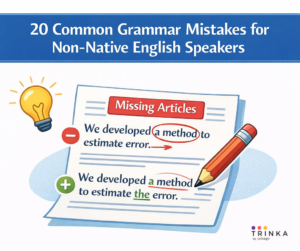
1) Missing articles (a, an, the) or using the wrong article
English articles carry meaning, specific versus general. Reviewers notice article errors because they reduce precision.
- Before: We developed method to estimate error.
- After: We developed a method to estimate the error.
Tip: Use a or and when the reader does not know which one. Use when you mean a specific item you already defined.
2) Confusing a vs. an (sound rule, not spelling)
Many writers choose based on the first letter. English uses the first sound.
- Before: a university
- After: a university (starts with a “y” sound)
Rule source:
https://owl.purdue.edu/owl/general_writing/grammar/articles_a_versus_an.html
(owl.purdue.edu)
3) Subject verb agreement errors (singular and plural mismatch)
Agreement errors reduce credibility in formal writing.
- Before: The results show a significant increase.
- After: The results show a significant increase.
Tip: Find the true subject. In research writing, a long prepositional phrase often separates the subject from the verb.
4) Tense shifts that do not match the time frame
Academic writing uses tense with purpose. Unplanned shifts confuse readers.
- Before: We collect samples and analyzed them using LC–MS.
- After: We collected samples and analyzed them using LC–MS.
Guidance on controlling tense shifts:
https://owl.purdue.edu/owl/general_writing/grammar/verb_tenses/verb_tense_consistency.html
(owl.purdue.edu)
5) Wrong verb form after auxiliaries (often in passive voice)
Many writers mix past tense with past participle.
- Before: The samples were analyze using MATLAB.
- After: The samples were analyzed using MATLAB.
Tip: After was, were, is, are in a passive structure, use a past participle, such as analyzed, measured, observed.
6) Overusing present continuous for general facts
Writer’s use is or are plus ‘ing’ when they mean a stable statement.
- Before: This paper is presenting a new approach…
- After: This paper presents a new approach…
Use ‘ing’ for actions in progress, not for standard paper structure statements.
7) Misusing prepositions (in, on, at, by, with, dependent prepositions)
Prepositions follow rules and collocations. Errors remain common even for advanced writers.
- Before: We discussed this on Section 3.
- After: We discussed this in Section 3.
Practical guidance for at, in, on and time and place usage:
8) Confusing make vs. do, take vs. have, and other collocations
These errors sit near grammar. They still create unnatural academic phrasing.
- Before: We did an experiment…
- After: We conducted an experiment…
Tip: In academic writing, use discipline-typical verbs such as conduct, perform, evaluate, estimate, derive.
9) Run-on sentences and comma splices
Long sentences are common in research writing. The issue is how you join clauses.
- Before (comma splice): The model converged, we stopped training.
- After: The model converged, so we stopped training.
- After (alternative): The model converged. We stopped training.
Rule explanation and fixes:
https://owl.purdue.edu/owl_exercises/sentence_structure/sentence_structure/run_ons_comma_splices_and_fused_sentences.html
(owl.purdue.edu)
10) Sentence fragments (missing a complete independent clause)
Fragments show up when a writer starts with Although, Because, or While, then skips the main clause.
- Before: Although the sample size was limited.
- After: Although the sample size was limited, the trend was consistent across groups.
Tip: If a sentence starts with a dependent marker, such as although, because, while, if, check for a main clause.
11) Misplaced modifiers (often at the start of a sentence)
A modifier needs a clear target noun.
- Before: Using the proposed method, the error decreased significantly.
- After: Using the proposed method, we decreased the error significantly.
- Alternative: The proposed method significantly decreased the error.
12) Pronoun reference problems (unclear this, it, they)
This works in academic writing when it points to a specific noun.
- Before: This shows that the algorithm is robust. (Unclear this.)
- After: This result shows that the algorithm is robust.
Pronoun clarity guidance:
https://owl.purdue.edu/owl/general_writing/grammar/pronouns/index.html
(owl.purdue.edu)
13) Pronoun antecedent agreement (number mismatch)
Writers use they for a singular noun without revising the sentence to support it.
- Before: Each participant provided their consent.
- After (more formal option): All participants provided their consent.
- After (alternative): Each participant provided informed consent.
Purdue OWL notes on revising to plural to avoid “his or her” and improve clarity:
https://owl.purdue.edu/owl/general_writing/grammar/pronouns/index.html
(owl.purdue.edu)
14) Incorrect pluralization and countability (for example, informations, researches, advices)
Some nouns are uncountable in English, even if they are countable in other languages.
- Before: These informations are useful.
- After: This information is useful.
Tip: Treat information, advice, equipment, research as noncount in most academic contexts.
15) Misusing comparatives and superlatives
Writers use double comparatives or incorrect forms.
- Before: This method is more better than…
- After: This method is better than…
Tip: Use more plus adjective for longer adjectives, such as more robust. Use er for short ones, such as faster.
16) Confusing adjectives and adverbs
This error changes meaning and weakens the tone.
- Before: The algorithm performed good.
- After: The algorithm performed well.
- Before: a highly temperature
- After: a high temperature
Tip: Use an adjective to modify a noun, such as high temperature. Use an adverb to modify a verb, such as performed well.
17) Overusing informal intensifiers
Intensifiers weaken academic tone and add no measurable meaning.
- Before: The results are significant.
- After: The results are statistically significant (p < 0.05).
- Alternative: The results show a large effect size.
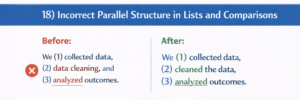
18) Incorrect parallel structure in lists and comparisons
Academic writing uses parallel structure in aims, contributions, and methods. Non-parallel lists slow reading.
- Before: We (1) collected data, (2) data cleaning, and (3) analyzed outcomes.
- After: We (1) collected data, (2) cleaned the data, and (3) analyzed outcomes.
Tip: Align the grammar after each list number. Use all verbs, all nouns, or all clauses.
19) Misusing respectively, former, latter, and other reference words
These terms need a tight mapping.
- Before: Accuracy and recall were 0.91 and 0.88, respectively. (Works only if the order stays clear.)
- After (often clearer): Accuracy was 0.91, and recall was 0.88.
Tip: Use these terms only when the mapping stays unambiguous.
20) Inconsistent terminology, hyphenation, capitalization, and number style
Journals treat consistency as part of language quality. Inconsistency also creates doubt, since readers start to wonder if terms refer to different variables.
- Before: We used “real time PCR” in Section 2 and “real-time PCR” in Section 4.
- After: We used “real-time PCR” throughout.
Practical workflow tip: After you revise sentence-level grammar, run a document-level consistency pass. Trinka Grammar Checker helps flag repeated variants in spelling, hyphenation, terminology, and style so you can standardize them before submission.
Conclusion
Non-native English writers often repeat the same grammar patterns, especially articles, prepositions, tense control, clause boundaries, and pronoun clarity. Use the examples above as templates. Then revise with a clear workflow. Fix sentence-level grammar first. Standardize consistency next. Confirm each sentence supports a precise scientific claim.
Build a personal error list from reviewer feedback. Run a final consistency check before submission. You reduce avoidable language edits and keep the focus on your research contribution.
Enhance Your Writing with Trinka’s Grammar Checker
Trinka’s Grammar Checker is designed to help writers produce clear, polished, and publication-ready content with ease. Whether you’re drafting academic papers, professional documents, or blog posts, Trinka ensures your writing is precise, consistent, and impactful, making it a trusted companion for anyone aiming to communicate effectively in English.

-
Go beyond grammar & spelling
Get holistic language improvements - Write with Trinka