


How to Write a Research Paper: Step-by-Step Guide for Researchers (2026)

Many researchers struggle with the same problem. You know your study matters, but writing a clear, publishable research paper feels slow and hard to manage. The issue often comes from process. You need a plan for the argument, a structure that fits your audience, and revision steps that match journal rules. Using tools like the Trinka.ai free grammar checker can help streamline the revision process, ensuring your writing is clear, consistent, and aligned with academic standards.
This guide explains how to write a research paper step by step in 2026. You will learn how to plan, outline, draft each major section, including IMRaD, revise for clarity, manage citations ethically, and prepare for submission.
Step 1: Confirm the paper type and target venue before you draft
A research paper can mean different formats, such as original research, short communication, case report, review, methods paper, or a conference paper. Each type has different expectations for structure, length, and evidence.
Before you write, confirm three items:
- Paper type, original research vs. review vs. brief report
- Target journal or conference, or a shortlist
- Author guidelines, word limits, figure limits, reference style, reporting checklists
Many STEM and medical journals expect an IMRaD structure, Introduction, Methods, Results, and Discussion, even if section names vary. (en.wikipedia.org)
Practical tip. If you cannot choose one journal yet, pick 2 to 3 realistic options and write to the strictest limits. This reduces major rewrites later.
Step 2: Write a one-paragraph argument map, your internal compass
Strong papers make one main claim and support it with a clear chain of evidence. To avoid a data dump draft, write one paragraph that answers:
- What problem your paper addresses
- What gap remains in the literature or practice
- What you did, design, dataset, method
- What you found, core results only
- Why it matters, impact, implication, or contribution
This paragraph is not your abstract. It is a planning tool. It forces clarity before you expand sections.
Step 3: Build an outline that matches the paper’s logic, not your timeline
Researchers often describe work in the order they did it. Readers want the order that makes the study easy to judge. IMRaD helps because it separates motivation, execution, findings, and interpretation. (en.wikipedia.org)
A practical outline approach. Write section goals first, then add bullet-level contents:
- Introduction: What is known, what is unknown, what you contribute
- Methods: What you used and what you did, enough for replication
- Results: What you found, no interpretation yet
- Discussion: What it means, why it matters, limitations, next steps
- Conclusion (if required): One clear takeaway plus implications
If you work in the humanities or some social sciences, your structure may differ. Still, outline by reader need, not by research chronology.
Step 4: Draft efficiently, write the sections in the order that reduces friction
You do not need to draft in the same order readers will read. Many researchers write faster using this order:
- Methods
- Results
- Discussion
- Introduction
- Abstract plus title, last
This order follows common guidance. The abstract appears first, but most writers draft it after the core text stabilizes. (stat.cmu.edu)
Step 5: Write each section with specific quality tests
How to write the Introduction, avoid the too broad opening
A strong Introduction does not list everything ever written on the topic. It builds a case for your study.
Focus on three moves:
- Context: Define the research area and why it matters
- Gap: State what is missing, inconsistent, or unresolved
- Contribution: State what your study adds and preview the paper’s structure
Also watch tense discipline. Many papers use present tense for established knowledge and past tense for completed actions and prior findings. (editage.com)
How to write the Methods, make replication possible, not painful
The Methods section works when a knowledgeable reader can reproduce your approach or evaluate validity.
In most empirical papers, include:
- Study design, and setting if relevant
- Participants or data sources, inclusion and exclusion, sampling
- Materials, instruments, measures, and variables
- Procedures, what you did and in what order
- Statistical or analytic approach
- Ethics approval and consent, if applicable
A common mistake is to hide decisions in vague phrases such as using standard procedures. Replace them with clear parameters, such as software versions, thresholds, time windows, and model settings, especially when they affect results.
How to write the Results, report first, interpret later
In IMRaD, Results present findings clearly and consistently. Discussion handles interpretation. (utsa.edu)
Practical rules:
- Report results in the same sequence as your research questions or hypotheses
- Use tables and figures with intent. Avoid repeating the same data in multiple places
- Lead with the main outcome before secondary analyses
How to write the Discussion, answer so what with restraint
A strong Discussion connects results to the research gap and explains why the findings matter without overselling.
Cover these points, in this order when possible:
- Restate the main finding or findings
- Explain plausible mechanisms or interpretations
- Compare with key prior studies, agreement or disagreement and why
- State limitations and why they matter
- Describe implications and next research steps
Avoid these common issues:
- New results in Discussion, put them in Results
- Causal claims from correlational data
- Vague limitations, state them clearly
How to write the Abstract, after the paper is stable
Many journals use structured abstracts. Others use one paragraph. Either way, your abstract should stand alone and match what you report in the manuscript.
A practical abstract checklist:
- One sentence of context and objective
- Methods in one or two lines, design, data, analysis
- The most important numeric result or results
- Clear conclusion aligned with the results, no new claims
IMRaD-based abstracts appear often in scientific writing, even when not required. (stat.cmu.edu)
Step 6: Revise for readability, the part that often decides acceptance
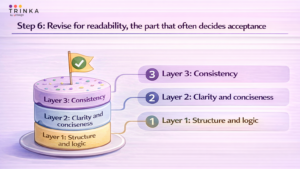
After you draft, revise in layers. This saves time because you avoid polishing sentences you later cut.
Layer 1: Structure and logic
- Check that each section matches your outline
- Give each paragraph one job
- Use headings that reflect the argument
Layer 2: Clarity and conciseness
- Replace long noun strings with simpler phrasing
- Use active voice when it improves clarity, especially in Methods
Layer 3: Consistency
Long papers often drift in:
- Terminology, participants vs. subjects
- Hyphenation, real time vs. real-time
- Abbreviations, defined twice or not defined
- Capitalization and units
To catch consistency issues faster, tools such as the Trinka Grammar Checker help flag terminology and style variations across a manuscript and support academic tone consistency.
Step 7: Handle citations and paraphrasing ethically, and defensibly
Citation issues often lead to desk rejection, revision requests, or academic integrity concerns.
Apply three practical rules:
- Cite the original source, when possible, not only a secondary summary
- Paraphrase meaningfully, avoid word swaps that keep the same sentence structure
- Align citations with claims, cite what supports each statement
Before submission, run a plagiarism or similarity check if your institution or journal expects it, especially when multiple co-authors contributed text. Trinka’s Plagiarism Check supports document uploads, including Word and PDF, and provides similarity reporting features designed for academic workflows.
Step 8: Prepare for submission, reduce avoidable reviewer friction
A strong study still faces delays when submission requirements are messy. Before you submit:
- Re-check journal formatting requirements, tables, figures, supplementary files
- Verify reference style and completeness, titles, page ranges, DOIs if required
- Confirm author order, affiliations, funding statements, conflicts of interest
- Include ethical statements, IRB and consent, data availability, preregistration if applicable
- Write a concise cover letter that states fit, contribution, and compliance
If you used AI tools for writing or editing, follow your target journal’s policy and disclose where required. Policies vary, so treat this as a submission requirement.
Common mistakes that slow down research papers (and how to fix them)
Writers lose time when they polish language too early or skip planning steps. These problems show up often:
- Unclear research question. Rewrite your argument map until the main claim fits one sentence.
- Methods too vague. Add parameters, decision rules, and enough detail for evaluation.
- Results mixed with interpretation. Move opinions and explanations into the Discussion.
- Inconsistent terminology. Create a mini-glossary and enforce one preferred term.
- Overlong Introduction. Keep only the literature that supports your gap and approach.
Conclusion
You will write a stronger research paper faster when you treat writing as a staged process. Define the venue and structure early. Outline by reader needs. Draft in an efficient order. Revise in layers, logic, clarity, then consistency. Use tools for grammar check and consistency checks, like the Trinka.ai free grammar checker, to ensure your writing is polished, clear, and academically consistent. However, keep your judgment at the center, especially for argument strength and research integrity.
Next step. Write your one-paragraph argument map today. Convert it into an IMRaD-based outline, or the structure your field expects. Draft Methods and Results first. When your narrative stabilizes, revise for clarity, consistency, and citation accuracy before submission.
Enhance Your Writing with Trinka’s Grammar Checker
Trinka’s Grammar Checker is designed to help writers produce clear, polished, and publication-ready content with ease. Whether you’re drafting academic papers, professional documents, or blog posts, Trinka ensures your writing is precise, consistent, and impactful, making it a trusted companion for anyone aiming to communicate effectively in English.

-
Go beyond grammar & spelling
Get holistic language improvements - Write with Trinka