


Allusion: Definition, Examples, and How Writers Use It

An allusion is a simple, indirect reference to a well-known fact, person, story, or place that is not explained in detail.
It relies on the reader’s or listener’s existing knowledge to understand the meaning behind it.
We may not always notice allusions, but they are a natural part of our everyday communication, from casual conversations to movies and literature.
An allusion works by briefly mentioning something familiar without elaboration, assuming the people already recognizes the references.
This is why writers mostly use allusions so often, instead of lengthy explanations, they provide subtle clues that add depth and meaning.
Tools like Trinka Grammar Checker can help refine such writing, ensuring clarity while preserving the tone and intent.
What Does “Allusion” Mean?
An allusion is a brief and non-explanatory reference to another person, story, place, event etc.
Meaning it implies the writer’s confidence that the reader would know this context.
It is, essentially, a short form in writing, making the writer’s language more concise and easy to understand.
Example: “He is a real Scrooge.”
This allusion refers to a person famous for his greed. The allusion doesn’t give a long, clear definition, but you automatically assume this person is being greedy since you probably know the reference of who Scrooge is.
Why do writers use allusion?
Writers use allusions to improve clarity and to increase writing engagement.
This is because when a short allusion is given in the long paragraphs of explanations, they save writing space as well as the readers’ time.
- Saves words and space
- Adds more meaning
- Make writing more engaging
- Make readers get an immediate connection
- Make the writing more smooth
Types of Allusion
The various types of allusion are divided according to the sources from which the allusion comes, and they all offer a slightly different sense of understanding.
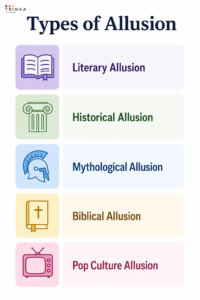
1] Literary Allusion
This type of allusion draws on books, poems or plays.
For example, to call a woman “Romeo” is to allude to her romance. This is effective because a lot of people have probably heard of this famous character.
2] Historical Allusion
A historical allusion can draw on historical facts or famous people.
For example, calling a particular situation a “Watergate” implies that the situation involves major scandal. This allusion adds value and meaning from the history without the need for a long description.
3] Mythological Allusion
A mythological allusion comes from myths or legends.
For example, to speak of someone’s “Achilles’ heel” means to speak of a vulnerability. This allusion is very effective because of its simplicity.
4] Biblical Allusion
This type of allusion is taken from the Bible or any other religious text.
For example, a “Good Samaritan” refers to a person who is helpful and compassionate. This type of allusion is frequently encountered in speech and everyday conversations.
5] Pop Culture Allusion
This is a more modern type of allusion and is often drawn from films, songs, and celebrity trends.
For example, calling someone “Iron Man” is an allusion that they are likely intelligent and confident. This allusion would appeal more to many people because the context is much more relatable.
Simple Examples of Allusion
Allusions are everywhere, and chances are you use them often without even realizing it. Tools like Trinka Grammar checker can help ensure such expressions are used clearly and effectively in your writing.
1] “She has the Midas touch”
This allusion means everything this woman handles tends to turn out successful.
2] “This place feels like Eden”
This implies the place is like paradise, beautiful and peaceful.
3] “Don’t open it, it’s Pandora’s box”
This suggests that opening something will lead to trouble or unexpected problems.
4] “He met his Waterloo”
This means he finally faced a decisive defeat.
How Allusion Works
Allusions work when the reader understands what the allusion implies.
If the reader is aware of the story behind the allusion, it allows the reader to comprehend the additional context behind the allusion.
On the other hand, if a reader does not recognize the allusion, the allusion is simply just wasted words. This is the reason why it is advisable to keep the allusion simple and common for more people to understand.
A successful allusion offers a meaning on two levels:
1. The actual sentence itself works in isolation.
2. The additional implication that only readers who recognize the allusion understand works in a separate dimension.
Allusion vs Other Literary Devices
Many people get confused about the term allusion and many other writing devices, but they are all different.
1] Allusion vs Metaphor
Allusion implies another idea without referencing directly. Metaphor refers directly to another person, place, thing, or idea.
Allusion: “He has the Midas touch.”
Metaphor: “He is gold.”
2] Allusion vs Citation
A citation clearly references the place from which the allusion comes. Allusion doesn’t require references.
3] Allusion vs Foreshadowing
Foreshadowing suggests what is about to happen, while allusion refers to a point in the past or a story, etc., that is known.
How to Use Allusion in Writing
- Using allusion in your writing is easy; all you need is to find something well-known and use it naturally.
- First of all, make sure that the reader knows the allusion that you are referencing. Then, include it in your sentence, making sure that it blends naturally into your writing.
- Don’t use allusion just to try and impress people.
Tips for Using Allusion
- Make it simple
- Use common allusions
- Ensure it complements the rest of the text
- Avoid overuse
- Maintain sentence clarity
Example of allusion in a sentence:
“He had to face it like David vs Goliath.”
This allusion suggests a small person struggling with a huge problem without being verbose.
When Should You Avoid Using Allusion?
Despite its advantages, allusion should be avoided under certain circumstances.
Use an allusion when:
- The reader is unaware of the reference
- The reference is too complex
- It may cause lack of clarity
- It sounds awkward or forced
Why is Allusion Important?
Allusion has a major role in writing. It helps you convey your ideas in a short period of time, making the reader become involved and interested in what you have written.
An effective allusion builds a relationship between the reader and writer, allowing a mutual connection. Allusions are used extensively in speech, writings and many other communication forms.
Quick Recap for Allusion
- Allusion is an indirect and short reference to something else
- It does not explicitly state the subject of the allusion
- The interpretation of allusion depends on prior knowledge of the audience
- It conveys deeper meanings with fewer words
- It adds depth and clarity to writing
As the importance of writing grows daily, tools are emerging to help enhance it; Trinka, the grammar checker was soft launched and allows you to correct grammar, improvise sentence construction and refine your writing to be more coherent making allusion useful and effective.
Enhance Your Writing with Trinka’s Grammar Checker
Trinka’s Grammar Checker is designed to help writers produce clear, polished, and publication-ready content with ease. Whether you’re drafting academic papers, professional documents, or blog posts, Trinka ensures your writing is precise, consistent, and impactful, making it a trusted companion for anyone aiming to communicate effectively in English.
Frequently Asked Questions
What is allusion in simple words?▼
Allusion is a short reference to something famous.
It can be a person, story, event, or place.
Why is allusion used in writing?▼
Allusion is used to add meaning quickly.
It helps writers explain ideas in fewer words.
Can allusion be used in everyday language?▼
Yes, allusion is used in daily conversations.
For example, calling someone “Einstein” is an allusion.
What is an example of allusion?▼
Saying “He has the Midas touch” is an allusion.
It means everything he does becomes successful.
Is allusion the same as metaphor?▼
No.
Allusion refers to something outside the text.
A metaphor compares two things directly.
How do I identify an allusion?▼
Look for a familiar name or idea.
If it connects to something known, it is likely an allusion.

-
Go beyond grammar & spelling
Get holistic language improvements - Write with Trinka