


What Is a Parable? Types and Examples

A parable is a short story told in an easy and simple way that explains a moral or a life lesson.
It uses familiar situations or simple people to illustrate an idea or concept which can be too complex to understand. We often come across a few stories that remain in our minds even after we are through reading.
In most of these, you will find that it is a parable that has been explained. The beauty of a parable lies in its simple story but powerful message.
Authors, teachers, and even speakers use a parable because we are more likely to be motivated by stories rather than being directly instructed on how we should conduct ourselves and on what is right and wrong.
Using tools like Trinka Grammar Checker can help you write more clearly and confidently ensure your descriptions are precise and engaging.
Simple Example of a Parable:
A man lay injured by the roadside. Everyone he knew walked past him but someone else, a complete stranger, stopped to help.
This example is a parable as the simple story has a strong message about kindness and how one should help others regardless of how you know them.
Why Do Writers Use A Parable?
A parable is employed because its underlying message is easily comprehensible and is also readily memorable.
Human beings forget explanations given in a lengthy lecture, however brilliant it might be, but tales are mostly remembered.
This is why a parable is such an important and effective way of teaching and explaining.
The following are a few points which explain why a parable is indispensable.
- The message of the parable can be understood simply
- The story is easy to recall
- It relates to everyday situations of the reader
- The message it gives is delivered gently and is not forceful
- It triggers thought and contemplation.
Usually a parable is not perceived as a lesson at first, but as the reader begins to contemplate on it, the meaning comes to light.
Structure of a Parable
The structure of a parable typically follows a consistent pattern of introduction, climax, and conclusion. This simplistic organization is essential to its clarity.
Beginning
The parable typically starts off with a situation familiar to the reader, perhaps involving an average person (a farmer, a traveller, or a scholar). This ensures a connection from the outset.
Middle
This part comprises the central element or crisis in the parable. This may involve a dilemma or a decision to be made, revealing the underlying message through the characters’ reactions.
Ending
The story concludes by resolving the dilemma and revealing the lesson, either explicitly or in a way that requires interpretation and thinking.
Types of Parable
Although parables are not divided into strict categories, they can often be classified based on the nature of the moral they intend to convey.
While experimenting with imagery, you can rely on Trinka grammar checker to fine-tune your grammar and improve the overall quality of your writing.
Moral Parable: These directly teach us about moral conduct, like the value of truthfulness and keeping promises.
Spiritual Parable: Spiritual parables relate to concepts like faith, forgiveness, and empathy towards others.
Social Parable: Parables focused on how people should interact with each other in a social context include the importance of fairness and social responsibility.
Famous Examples of Parable
Several well-known tales have served as parables for years. Their enduring messages of morality and humanity are what have caused them to be preserved and propagated through the ages.
The Good Samaritan: this is one of the most popular parables. This tells us the story of a man lying badly injured at the side of the road and many people who walk past without extending help but a stranger, though of a different community, is compassion towards him and helps.
This parable shows us the meaning of compassion and that we should all help one another.
The Prodigal Son: this parable discusses how a young boy or a daughter who takes their inheritance for granted and leaves to live their own life on their terms, will eventually be accepted into the same house upon repenting and returning back home by the forgiving family.
The lesson behind the parable is that you will always be accepted if you make your mistake right by apologizing and seeking to amend for them.
The Sower: this parable talks about a man scattering his seeds in a piece of fertile land. Some seeds fell on a path and got eaten up by birds; others fell on rocky ground and did not have enough room to grow roots, some fell amongst thorns and did not grow; but a few landed on fertile land where they grew and bore abundant fruit.
This parable teaches about accepting ideas and instructions as people react to instructions differently, whether positively or negatively, depending on the type of listener.
Parable vs Fable vs Allegory
It is common for people to confuse these three narrative terms. However, there are clear differences between them:
Parable vs Fable: Parables often feature human characters, while fables commonly use animals or objects to convey their messages. Both types are didactic, but parables are often considered more reflective of real-life scenarios.
Parable vs Allegory: A parable typically focuses on a single lesson or message. An allegory is a more complex narrative with multiple symbolic meanings, and is usually much longer and more detailed than a parable.
How to Use a Parable in Writing
Writing a parable is a straightforward process. Focus on a relevant real-life situation, introduce a complication or decision, and then present the resolution.
The primary goal is to build a narrative around a singular idea.
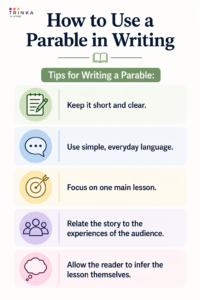
Tips for Writing a Parable:
- Keep it short and clear.
- Use simple, everyday language.
- Focus on one main lesson.
- Relate the story to the experiences of the audience.
- Allow the reader to infer the lesson themselves.
Example:
A student consistently studies a little each day and sees gradual progress in their understanding of the subject.
On the other hand, another student neglects their studies, resulting in them struggling later. This parable highlights the significance of consistent effort and hard work.
What are the Common Mistakes to Avoid:
Even in simple stories like parables, certain pitfalls can diminish their impact.
- Avoid long, convoluted narratives.
- Limit the number of characters.
- Refrain from explicitly explaining the moral.
- Steer clear of overly complex vocabulary.
A compelling parable is characterized by its simplicity and directness.
Why Parable Matters:
The significance of parables lies in their ability to make complex ideas accessible and understandable. They impart wisdom subtly, allowing readers to arrive at the lesson organically. A good parable:
- Simplifies learning.
- Is memorable for extended periods.
- Connects with the reader’s real-life experiences.
- Promotes reflective thought.
This is why parables have become a staple in teaching, storytelling, and cross-cultural communication.
Quick Recap on Parables:
A parable is a brief narrative with a moral lesson.
- It employs simple characters and scenarios.
- The focus is on one primary concept.
- It uses storytelling to enhance comprehension.
In the ever-evolving realm of writing, various tools are emerging to assist writers in their craft, such as the soon-to-be-released Trinka Grammar Checker, designed to refine grammar, improve clarity, and enhance sentence construction. This tool will make composing clear and effective parables much more achievable, thus strengthening their connection with the reader.
Enhance Your Writing with Trinka’s Grammar Checker
Trinka’s Grammar Checker is designed to help writers produce clear, polished, and publication-ready content with ease. Whether you’re drafting academic papers, professional documents, or blog posts, Trinka ensures your writing is precise, consistent, and impactful, making it a trusted companion for anyone aiming to communicate effectively in English.
Frequently Asked Questions
What is a parable in simple words?▼
A parable is a short story with a lesson.
It teaches something important.
What is the purpose of a parable?▼
A parable is used to teach a moral or idea.
It makes learning easy and clear.
What is an example of a parable?▼
A story about helping others is a parable.
It teaches kindness.
What is the difference between parable and fable?▼
A parable uses human characters.
A fable uses animals.
Can a parable be used in modern writing?▼
Yes, a parable is still used today.
It helps explain ideas in a simple way.
How do I write a good parable?▼
Keep it short.
Use simple words.
Focus on one lesson.
Make the message clear.

-
Go beyond grammar & spelling
Get holistic language improvements - Write with Trinka