


How Professors Can Tell What Students Actually Wrote

Professors can no longer look at a finished paper and know if a student actually wrote it.
A well-structured essay with perfect citations might look great. But the final PDF doesn’t tell you if a student spent hours researching or just used an AI tool to write it in two minutes.
Trinka’s DocuMark gives faculty clear proof of how a paper was made, helping them make fair decisions while giving honest students a record that protects their hard work.
Why the Finished Document Isn’t Enough
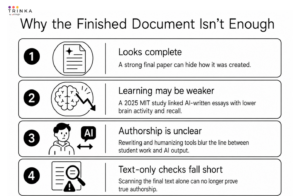
Traditional college assignments always assumed that writing a good argument required real mental effort and reflection. Today, that assumption is completely broken.
A 2025 MIT Media Lab study found that students who used ChatGPT to write essays showed lower brain activity, weaker memory recall, and felt less ownership over their work, even when their final papers looked polished.
The final product made it look like learning happened, but the brain data showed otherwise.
As AI models get smarter and students use rewriting or “humanizing” software, a final essay simply cannot prove true authorship anymore.
Tools that only scan the finished text are losing the ability to tell the difference between real student effort and AI generation.
AI Detection Tools: Where They Fall Short
AI detectors work by looking for patterns in text, like predictable words and uniform sentence lengths.
Because machine text is highly predictable, they use these patterns to guess the probability that a paper was written by AI.
Research in the International Journal for Educational Integrity tested 14 common detectors and found their accuracy ranged from a low 33% to an 81% maximum.
When students use paraphrasing tools and quick manual edits to “humanize” AI text, the final draft easily slips right past even the most expensive corporate detectors.
Bias is another major issue. Stanford researchers found that over 61% of essays written by non-native English speakers were wrongly flagged as AI-generated, while native speakers’ work was classified accurately.
These tools often mistake normal language differences for AI patterns, making them both unreliable and unfair.
Manual Review: What Experienced Instructors Look For
Experienced professors often compare a student’s current paper against their past work.
They look for sudden changes in vocabulary, style, or how complex the arguments are. They also check citations to make sure they match the course materials.
While these methods help flag red flags, they rely entirely on human intuition, not hard evidence.
In large classes, checking every paper by hand takes too much time and is hard to scale.
Process Documentation: Capturing How Work Was Created
The most transformative approach captures the writing process itself. DocuMark captures revision sequences, thinking pauses, copy-paste events, and AI content interactions with external tools in real time.
Unlike detection tools, which analyze only the final product, process documentation provides a verifiable record of human authorship.
The “Academic Integrity” framework demonstrates that these records reveal stable writing behaviors, allowing instructors to distinguish genuine effort from AI-generated content, even when the final text shows no detectable AI signature.
This approach creates evidence rather than probability estimates, enabling misconduct discussions to focus on documented behavior rather than suspicion.
DocuMark provide structured process-based validation, offering a complete record from first keystroke to final submission.
Sources and references
- Weber-Wulff, D., et al. (2023). Testing of detection tools for AI-generated text. International Journal for Educational Integrity, 19(1), 26. https://link.springer.com/article/10.1007/s40979-023-00122-7
- Popular AI. (2026, March). Turnitin false positives in 2025 and 2026: Why AI detectors can’t be proof. https://www.popularai.org/p/these-turnitin-false-positives-in
- Liang, W., et al. (2023). GPT detectors are biased against non-native English writers. https://doi.org/10.1016/j.patter.2023.100779
- Kofinas, A., et al. (2025). The impact of generative AI on academic integrity of authentic assessments within a higher education context. British Journal of Educational Technology, 56, 2522–2549. https://doi.org/10.1111/bjet.13585
- Lund, B. D., Lee, T. H., Mannuru, N. R., & Arutla, N. (2025). AI and academic integrity: Exploring student perceptions and implications for higher education. Journal of Academic Ethics. https://doi.org/10.1007/s10805-025-09613-3
- (2026, January). Exploring academic integrity: Generative AI tools used in academic writing among university students. https://bccampus.ca/2026/01/15/exploring-academic-integrity-generative-ai-tools-used-in-academic-writing-among-university-students/
- Cao, H., & Zahid, S. (2025). Automated viva voce using generative AI for student coursework authentication. Proceedings of ETAIC 2025. https://dl.acm.org/doi/10.1145/3766557.3766564
- Zhang, M., et al. (2025). Applications and modeling of keystroke logs in writing assessments. Educational Measurement: Issues and Practice. https://onlinelibrary.wiley.com/doi/abs/10.1111/emip.12668
Enhance Your Writing with Trinka’s Grammar Checker
Trinka’s Grammar Checker is designed to help writers produce clear, polished, and publication-ready content with ease. Whether you’re drafting academic papers, professional documents, or blog posts, Trinka ensures your writing is precise, consistent, and impactful, making it a trusted companion for anyone aiming to communicate effectively in English.
Frequently Asked Questions
Are AI detection tools enough for misconduct findings?▼
No. Detection scores are probabilistic and should never serve as standalone evidence. Bias against non-native English writers makes sole reliance risky.
What is the most scalable verification method for large courses?▼
Process documentation is scalable and automatic. Oral verification works well for targeted, high-stakes tasks. Detection tools are easy to scale but unreliable. A combination of process documentation and selective oral checks covers most scenarios.
Does process documentation change student behavior?▼
Yes. Knowing their writing is recorded encourages students to engage with the material themselves rather than outsource work, shifting AI use toward support rather than full authorship replacement.
How should instructors handle disputes over process data?▼
Process data informs a holistic review. Variations in typing patterns may reflect disabilities, devices, or environment. Documentation opens the conversation; professional judgment closes it.

-
Go beyond grammar & spelling
Get holistic language improvements - Write with Trinka