


Best Academic Integrity Tools for Faculty and Universities

Generative AI has changed how students approach academic work. From generating ideas to drafting assignments, AI tools are becoming part of the modern learning environment. While these technologies create new opportunities, they also bring challenges for universities trying to maintain academic integrity.
Traditional plagiarism detection alone is no longer enough. Faculty need greater visibility into how assignments are created, not just the final submission. A stronger academic integrity approach focuses on understanding the learning process and providing evidence that supports fair and informed decisions.
Why Academic Integrity Needs a New Approach
The rise of generative AI has changed the academic integrity landscape. Students are increasingly using AI tools for brainstorming, improving writing, summarizing information, and supporting assignment development. According to the 2026 HEPI Student Generative AI Survey, 95% of students use AI in some form, while 94% use generative AI to support assessed work. This widespread adoption means universities need to rethink how they evaluate student work and define responsible AI use.
Traditional plagiarism detection and AI detection tools alone cannot provide the complete picture. Faculty need to understand not only what was submitted, but also how the work was created. A recent survey found that 73% of faculty have encountered AI-related academic integrity issues, highlighting the growing need for approaches that provide deeper insight beyond a final submission or a single detection score.
Faculty today face several challenges:
AI-generated assignments
Faculty may find it difficult to determine whether an assignment represents a student’s own understanding or was primarily created using AI tools. A polished final submission alone may not provide enough context about how the work was developed.
False positives from AI detectors
AI detection tools have become a popular response to concerns around AI-generated writing. However, these tools are not always reliable. They may incorrectly flag human-written work, creating uncertainty and potentially affecting student trust.
Difficulty proving misconduct
When questions arise about authorship, faculty often lack evidence beyond the final submission. Without insight into the writing process, it can be challenging to make fair and informed decisions.
Increased workload for faculty
Reviewing assignments has always required significant time and effort. With the added complexity of AI use, faculty need solutions that help them evaluate student work more efficiently without increasing administrative burden.
This is why universities are moving toward a broader academic integrity strategy—one focused on transparency, evidence, and supporting responsible AI use.
Best Academic Integrity Tools for Universities
Modern academic integrity requires more than a single detection method. Universities are increasingly adopting solutions that combine content analysis with deeper insights into how academic work is created.
1. DocuMark: Understanding the Complete Writing Process
DocuMark helps universities move beyond evaluating only the final submission by providing visibility into the student writing journey.
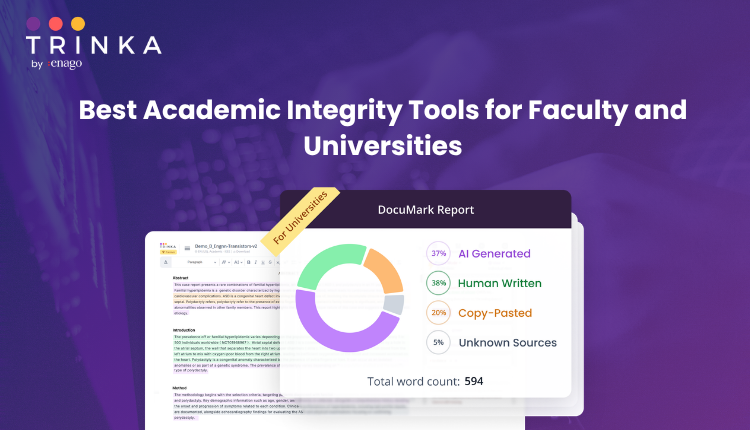
Instead of relying only on detection scores, DocuMark provides faculty with evidence of how an assignment developed over time, including writing composition history and changes made throughout the process.
Key capabilities include:
- Text similarity matching to identify potential overlap with existing sources
- AI writing indicators to provide additional context around AI-assisted writing
- Writing composition history to show how the document evolved from draft to final submission
By combining these insights within a single workflow, DocuMark enables faculty to make more informed decisions based on evidence rather than relying on a single indicator.
The goal is not to automatically label work as misconduct, but to help educators understand student effort, provide meaningful feedback, and support authentic learning.
2. Trinka AI Content Detector: Benchmark-Leading AI Detection Accuracy
AI detectors can play a supporting role in academic integrity strategies when used carefully and alongside other evidence.
The Trinka AI Content Detector has demonstrated strong performance on independent AI detection benchmarks. In the RAID (Reliable AI Detection) Benchmark, Trinka AI Content Detector achieved the #1 ranking among evaluated AI content detectors, demonstrating high accuracy in identifying AI-generated content while reducing uncertainty around AI detection results.
However, AI detection results should be considered one part of a broader evaluation process. A responsible approach combines detection insights with faculty judgment, institutional policies, and evidence of the writing process.
Why Process-Based Evidence Is Becoming Essential
As AI-generated content becomes more sophisticated, universities are recognizing that the final document alone does not always tell the complete story.
A student’s writing process provides valuable context:
- How did the idea develop?
- Were drafts created progressively?
- Did the student revise and improve their work?
- Does the final submission reflect their understanding?
This shift represents a move away from asking only, “Was AI used?” toward a more meaningful question: “How was this work created?”
Process-based evidence allows faculty to evaluate learning, not just identify potential risks. It supports fair conversations with students and helps institutions create a culture where responsible AI use is encouraged rather than hidden.
How Universities Can Build a Balanced Integrity Strategy
A strong academic integrity framework requires multiple approaches working together. Technology alone cannot solve the challenges created by AI; universities need policies, education, and tools that support responsible adoption.
1. Establish Clear AI Policies
Students and faculty need clear expectations around acceptable AI use. Policies should explain when AI tools can support learning, when disclosure is required, and what practices may violate academic standards.
Universities can refer to resources such as the Trinka AI University AI Policy Repository to explore examples of institutional AI guidelines.
2. Provide Faculty Guidance
Faculty need practical guidance on evaluating AI-assisted work, interpreting AI detection results, and having constructive conversations with students about AI use.
Training helps educators move from uncertainty toward confident decision-making.
3. Build Student AI Literacy
AI is becoming part of the future of education and work. Instead of focusing only on preventing AI use, universities should teach students how to use AI responsibly.
AI literacy helps students understand appropriate usage, ethical considerations, and the importance of maintaining ownership of their work.
4. Use Process Verification Alongside Existing Tools
Academic integrity decisions should be based on multiple sources of evidence. Combining plagiarism checks, AI indicators, writing history, and faculty expertise creates a more balanced and fair evaluation approach.
Conclusion
The future of academic integrity is not about catching students. It is about understanding learning.
As AI continues to reshape education, universities need approaches that help faculty evaluate work with greater confidence while supporting students in developing genuine skills.
The most effective academic integrity strategies will combine clear policies, AI literacy, faculty support, and technology that provides meaningful evidence of the learning process.
By focusing on transparency and authentic learning, universities can create an environment where technology supports education rather than undermines it.
Enhance Your Writing with Trinka’s Grammar Checker
Trinka’s Grammar Checker is designed to help writers produce clear, polished, and publication-ready content with ease. Whether you’re drafting academic papers, professional documents, or blog posts, Trinka ensures your writing is precise, consistent, and impactful, making it a trusted companion for anyone aiming to communicate effectively in English.

-
Go beyond grammar & spelling
Get holistic language improvements - Write with Trinka