


How Can Faculty Verify Student Authorship Without Guesswork?

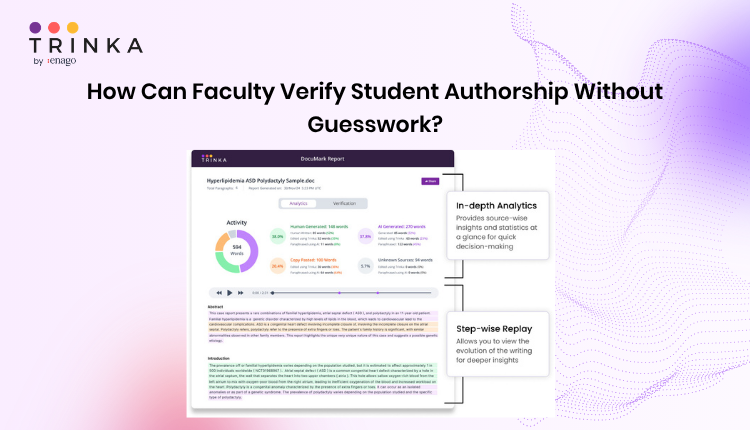
Student authorship is about knowing whether a student has made the intellectual contribution expected of them in their work. The challenge is that faculty cannot always understand how a student worked by looking at the final submission alone. Two students may submit similar essays, while the thinking, research, and effort behind them are very different. This makes it difficult for faculty to verify student authorship from the final work alone.
Faculty need to understand how the student developed, researched, wrote, and revised the work. DocuMark helps make this process visible, giving faculty more context to review student authorship.
How Can Faculty Gain More Context on Student Authorship?
Faculty use student assignments to assess what students have learned and how well they can apply it. They therefore need to know that the work reflects the student’s own thinking and efforts. As AI use grows, this can become harder to assess.
The final document tells only part of the story.
A completed assignment shows the final work, but not always what the student actually learned or contributed. A 2025 study of 28 higher-education staff found that educators were concerned about not being able to tell how much of a student’s work was their own when generative AI is involved. For faculty, seeing that contribution matters because student work is used to assess their understanding and effort.
AI detection alone cannot explain the writing process.
A detection result may flag a submission for review, but it cannot show how the student created the work or what they contributed. A 2026 study tested four AI detection tools on 160 academic documents with known authorship conditions. The tools produced different results across human-written, AI-written, and hybrid texts, showing why a detection score alone may not be enough to understand student authorship.
DocuMark addresses this gap by documenting the student’s writing process, including revisions, writing activity, copy-paste events, and AI interactions, giving faculty more context to review student authorship.
AI policies need to define the expected contribution.
Students need clear guidance on when AI can be used and what contribution is expected from them. The Trinka AI Policy Hub is a repository of 750+ university AI policies that helps institutions explore, compare, and create clearer AI guidelines.
What Can Faculty Do to Understand Student Contribution?
To assess student work fairly and understand what students have learned, faculty need to look beyond the final submission. Seeing how the work develops gives students a way to take responsibility for their work and gives faculty more information to assess learning, rather than relying only on an AI detector score to make authorship decisions.
Making the Writing Process Visible
Another way to gain this context is by looking at how the assignment was created. Writing activity, revisions, copy-paste events, and AI interactions can help faculty understand how the work developed and what role the student played in creating it.
DocuMark makes this process visible by capturing the development of student work, from writing and revisions to copy-paste activity and AI interactions. Faculty can review this information alongside the final submission to better understand the student’s contribution.
Process information is not an automatic verdict on authorship. It is another source of context that faculty can consider alongside the assignment requirements, institutional AI policy, and the student’s explanation. This keeps the final decision with the faculty member while giving them more information to make it.
Conclusion
In today’s AI-enabled learning environment, knowing how a student arrived at their final work matters. Faculty need to know that an assignment reflects the student’s own thinking and understanding because these are the skills they are trying to assess, including critical thinking, knowledge retention, and the ability to apply what they have learned.
DocuMark supports this need by making the development of student work visible. By capturing writing activity, revisions, copy-paste events, and AI interactions, it gives faculty more context to understand the student’s contribution and how the work came together. This shifts authorship verification from making assumptions about a final submission to understanding the work behind it.
Enhance Your Writing with Trinka’s Grammar Checker
Trinka’s Grammar Checker is designed to help writers produce clear, polished, and publication-ready content with ease. Whether you’re drafting academic papers, professional documents, or blog posts, Trinka ensures your writing is precise, consistent, and impactful, making it a trusted companion for anyone aiming to communicate effectively in English.

-
Go beyond grammar & spelling
Get holistic language improvements - Write with Trinka