


How Faculty Can See How Students Created Their Assignments: A Better Way to Verify Learning

Generative AI has changed how students create assignments, making it harder for faculty to understand whether a final submission reflects genuine learning. Reviewing only the finished document no longer provides enough context to assess student effort, originality, or writing development.
Faculty need visibility into how an assignment was created, not just what was submitted. By understanding the writing process, educators can make more informed academic decisions while supporting authentic learning.
How Faculty Can See How Students Created Their Assignments
- Review the Writing Journey, Not Just the Final Draft
Reviewing how ideas developed, when revisions were made, and how the document evolved provides stronger evidence of student learning than a final submission alone.
Nearly 90% of Harvard faculty reported receiving coursework they believed was AI generated, yet only 12% formally reported it because proving AI misuse remains difficult.
- Look Beyond AI Detection Scores
AI detection can provide useful signals, but it should not be the only basis for academic decisions. As Jennifer Frederick, Executive Director of Yale’s Poorvu Center for Teaching and Learning, states:
“Evidence also shows that ‘humanizing’ programs are very successful at reducing or eliminating the percentage of AI usage that is successfully detected in generative AI-produced writing.” (Source: Inside Higher Ed)
Instead of asking whether AI was used, faculty should evaluate how the assignment was created.
- Use Process-Based Evidence
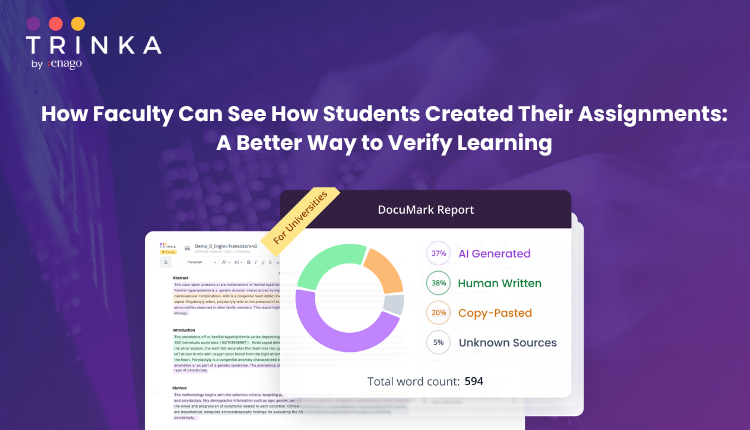
Modern academic integrity tools such as DocuMark help faculty understand the complete writing process by combining:
- Writing composition history
- AI writing indicators
- Text similarity matching
- Copy-pasted content insights
This provides evidence of how student work developed instead of relying on a single detection score.
- Integrate Verification Into Existing Workflows
Verifying student work should not add to faculty workload. Solutions that integrate with learning management systems such as Moodle and Blackboard allow instructors to review writing history alongside submitted assignments without changing their existing workflow.
- Make Academic Integrity Conversations Evidence-Based
Process-based evidence helps faculty have fair, transparent conversations with students. Instead of relying on assumptions, instructors can review writing history, revisions, and originality signals to better understand how an assignment was completed.
Takeaway: Make the Learning Process Visible With DocuMark
Academic integrity is no longer just about reviewing the final submission. It is about understanding the learning journey behind it.
DocuMark helps faculty verify student work by making the writing process visible through writing history, AI writing indicators, and text similarity insights. This gives educators the evidence they need to assess learning with greater confidence while supporting fair and transparent academic evaluation.
Enhance Your Writing with Trinka’s Grammar Checker
Trinka’s Grammar Checker is designed to help writers produce clear, polished, and publication-ready content with ease. Whether you’re drafting academic papers, professional documents, or blog posts, Trinka ensures your writing is precise, consistent, and impactful, making it a trusted companion for anyone aiming to communicate effectively in English.

-
Go beyond grammar & spelling
Get holistic language improvements - Write with Trinka