
Than vs. Then / There vs. Their vs. They’re / Its vs. It’s

This article explains what each word means, why these confusions matter in academic and technical writing, and how to correct them using practical decision rules and before and after examples.
Why these mix-ups matter in manuscripts and technical documents
In academic writing, readers expect precision. When you confuse than and then, or its and it’s, you risk more than a grammar issue. You change meaning in comparisons, timelines, and cause and effect statements. Reviewers often treat repeated surface errors as a sign your manuscript needs heavier language editing.
These errors appear often for multilingual writers because English contains many homophones, and because contractions, like they’re and it’s, appear in informal writing but are usually minimized in formal academic prose.
Than vs. then. Comparison vs. sequence, and sometimes inference
What “than” means, use it for comparisons
Use than when you compare two quantities, conditions, or outcomes.
You will see than often in Results and Discussion sections, especially when you report differences, superiority, or statistical comparisons.
Examples, academic contexts.
- The intervention group showed a greater reduction in HbA1c than the control group.
- We observed higher signal intensity than previously reported.
What “then” means, use it for time, sequence, or “in that case”
Use then when you describe time order, procedural steps, or a conditional result, meaning in that case.
Examples, methods and logic.
- The samples were centrifuged at 10,000g. Then the supernatant was transferred to new tubes.
- If the assumptions are violated, then the model may overestimate the effect.
Common mistakes and corrected versions, before and after
- Before, incorrect. The treated group had lower mortality then the untreated group.
- After, correct. The treated group had lower mortality than the untreated group.
- Before, incorrect. First, we calibrated the sensor. Than we ran validation tests.
- After, correct. First, we calibrated the sensor. Then we ran validation tests.
A quick decision rule you can apply while revising
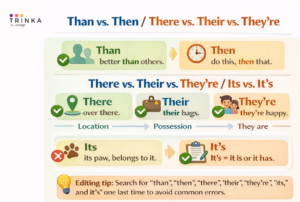
If the sentence contains a comparison, often signaled by words like more, less, higher, lower, greater, or rather, choose than. If the sentence describes order, time, a next step, or a conditional outcome, choose then.
There vs. their vs. they’re. Place or existence vs. possession vs. contraction
“There”, place or existence
Use there to refer to a location, over there, or to introduce a statement about existence, there is and there are. Academic writing often uses the existence pattern in introductions and literature reviews.
Examples.
- There are three main limitations in the current dataset.
- The samples were stored there to prevent temperature fluctuations.
“Their”, possession
Use their when something belongs to them, such as a group of people, participants, authors, or organizations.
Examples.
- Participants reported their sleep duration weekly.
- The authors present their findings in Table 2.
“They’re”, contraction of “they are”
Use they’re only when you can replace it with they are. Contractions are often avoided in formal manuscripts, so you may revise to they are anyway.
Example.
- They’re more likely to respond after follow-up reminders.
- Formal alternative. They are more likely to respond after follow-up reminders.
Common mistakes and corrected versions, before and after
- Before, incorrect. The reviewers noted that their are inconsistencies in Figure 3.
- After, correct. The reviewers noted that there are inconsistencies in Figure 3.
- Before, incorrect. The participants completed there consent forms.
- After, correct. The participants completed their consent forms.
- Before, incorrect. The authors state their unable to share raw data.
- After, correct. The authors state they’re unable to share raw data.
- Formal alternative. The authors state they are unable to share raw data.
Writing centers often highlight this set because each word has a distinct grammatical role, adverb or expletive, possessive determiner, and contraction. Confusing them leads to sentences that read as careless or ambiguous.
Its vs. it’s. Possession vs. contraction, the apostrophe trap
“It’s”, contraction, it is or it has
Use it’s only when you mean it is. In some contexts, it’s also stands for it has.
Examples.
- It’s important to distinguish correlation from causation. It is important to distinguish correlation from causation.
- It’s been reported that the catalyst degrades after 10 cycles. It has been reported that the catalyst degrades after 10 cycles.
“Its”, possessive, belonging to itUse its when something belongs to it, such as a device, a system, an organization, a method, or an animal. In scientific writing, its appears often.
Examples.
- The algorithm updates its parameters iteratively.
- The device was evaluated for its thermal stability.
Common mistakes and corrected versions, before and after
- Before, incorrect. Each instrument was calibrated before it’s first use.
- After, correct. Each instrument was calibrated before its first use.
- Before, incorrect. The model improved its clear that regularization reduced variance.
- After, correct. The model improved. It’s clear that regularization reduced variance.
Many technical writing guides stress this rule because it feels backward. Most possessives use apostrophes, but possessive pronouns, his, her, their, and its, do not.
When these errors appear most often, and how to catch them efficiently
- In Results and Discussion, than and then errors often occur near comparative language, such as higher, lower, more, and less.
- In Introductions, there and their errors often occur in there are statements and when referring to authors or participants.
- Across all sections, its and it’s errors often occur in sentences describing a system’s properties, performance, or limitations.
To catch them during revision, apply a focused grammar check pass.
- Search your document for then. Confirm each instance is about time, sequence, or conditional inference, not comparison.
- Search for there. Verify it indicates place or existence, not possession.
- Search for it’s. Expand it to it is or it has. If expansion fails, revise to its.
For long manuscripts, a discipline-aware grammar checker helps you flag real-word confusions in context, not only spelling errors. Trinka Grammar Checker focuses on academic and technical writing and supports grammar accuracy and style consistency during late-stage polishing.
Conclusion
You prevent most than and then, there and their and they’re, and its and it’s errors when you edit for meaning, not sound.
- Comparisons require than. Sequences and conditional outcomes use then.
- Location and existence uses there. Possession uses their. They are uses they’re, or write they are in formal sections.
- Possession uses its. Only it is and it has takes it’s.
Apply a targeted search pass before submission. Use a final language-editing workflow that checks real-word confusions in context, supported by tools like Trinka AI Grammar Checker for deeper accuracy. With consistent practice, these high-impact corrections become routine, and your writing reads more precise, professional, and publication-ready.

-
Go beyond grammar & spelling
Get holistic language improvements - Write with Trinka