


The Right Word in the Wrong Context: How to Catch Word Usage Errors

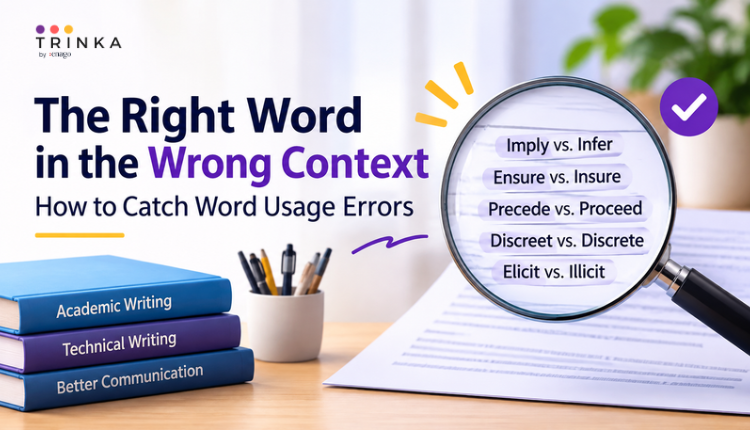
A sentence can be grammatically correct and still communicate the wrong idea. This often happens when a writer uses a word that looks or sounds right but does not fit the intended meaning. For example, confusing ensure with insure or elicit with illicit can change what a sentence communicates.
These mistakes are easy to overlook because spell-checkers may not flag them. Both words are correctly spelled, but only one may be appropriate in the given context. This makes word usage an important part of proofreading, especially in academic and professional writing, where precision matters.
Understanding commonly confused words and checking how they function in a sentence can help prevent these errors. Trinka’s free grammar checker makes it easier to identify incorrect word choices and improve sentence clarity.
What Are Word Usage Errors?
Word usage errors happen when a correctly spelled word is used in a way that does not match its meaning or grammatical role in a sentence.
For example:
Incorrect: Please insure that all participants have signed the consent forms.
Correct: Please ensure that all participants have signed the consent forms.
Both insure and ensure are correctly spelled words, but they have different meanings. Since the sentence refers to making certain that something happens, ensure is the right choice.
Unlike spelling mistakes, these errors may not be obvious because the word itself is not misspelled. Readers may still understand the intended meaning, but incorrect usage can make writing less precise and less professional.
Commonly Confused Words and How to Use Them Correctly
Some English words are frequently confused because they sound similar, have related meanings, or are used in similar situations. Here are five pairs worth checking while proofreading.
Imply vs. Infer
These words are connected to suggesting and understanding information, but they describe different actions.
- Imply: To suggest something without stating it directly.
- Infer: To reach a conclusion based on available information.
Incorrect: The findings infer that the treatment was effective.
Correct: The findings imply that the treatment was effective.
The findings suggest something, so imply is the correct word. A reader would infer the conclusion from those findings.
Ensure vs. Insure
Both words relate to making something certain, but they are used in different contexts.
- Ensure: To make certain that something happens.
- Insure: To provide financial protection against loss or damage.
Incorrect: Please insure that all references are included in the manuscript.
Correct: Please ensure that all references are included in the manuscript.
The sentence refers to making sure the references are included, so ensure is appropriate.
Precede vs. Proceed
These words can be confused because they have similar spellings, but their meanings are quite different.
- Precede: To come before something.
- Proceed: To continue or move forward.
Incorrect: The literature review should proceed the methodology section.
Correct: The literature review should precede the methodology section.
The literature review comes before the methodology section, so precede is the right choice.
Discreet vs. Discrete
Although these words sound exactly alike, they have different meanings.
- Discreet: Careful and tactful, especially to avoid attracting attention.
- Discrete: Separate or distinct.
Incorrect: The study examined three discreet categories of responses.
Correct: The study examined three discrete categories of responses.
The sentence refers to three separate categories, making discrete the correct word.
Elicit vs. Illicit
These words are pronounced alike but have very different meanings.
- Elicit: To draw out a response, reaction, or information.
- Illicit: Illegal or not permitted.
Incorrect: The interview questions were designed to illicit detailed responses.
Correct: The interview questions were designed to elicit detailed responses.
Since the questions are intended to draw out information, elicit is the correct choice.
Why Do Spell-Checkers Miss These Errors?
A spell-checker usually identifies words that are misspelled or do not appear in its recognised vocabulary. However, it may not flag a word that is correctly spelled but used incorrectly.
For example, both discreet and discrete are valid English words. A basic spell-check may accept either one, even if the sentence requires only one of them.
Identifying such errors requires looking at the surrounding words, sentence structure, and intended meaning. This is why context matters when checking word usage.
A grammar checker that considers sentence context can offer more useful suggestions than a tool that checks spelling alone. However, writers should still review suggestions carefully, particularly when using specialised terms or words with multiple meanings.
How Can You Avoid Word Usage Errors?
You do not need to memorise every commonly confused word to improve your writing. A few proofreading habits can help you catch many of these mistakes.
Check the meaning, not just the spelling. If two words look or sound similar, confirm that the one you have used conveys the intended meaning.
Read the complete sentence. A word may appear correct on its own but sound out of place when read with the rest of the sentence.
Use a dictionary when unsure. Checking definitions and example sentences can help you understand how a word is used.
Review grammar suggestions. A context-aware grammar checker can help identify possible word choice issues that a basic spell-check may overlook.
Proofread once more before submitting. Give particular attention to words that are frequently confused, especially in important documents.
How Trinka Grammar Checker Helps Improve Word Usage
Checking grammar involves more than finding spelling mistakes. Writers also need to make sure that the words they choose fit the meaning and structure of their sentences.
Trinka Grammar Checker helps writers identify grammar and language issues and improve sentence clarity. Its suggestions can support the editing process by drawing attention to possible errors that may otherwise go unnoticed.
Writers can also use Trinka’s paraphrasing feature to revise sentences that sound awkward or unclear. With eight paraphrasing styles, including Academic, Formal, Simple, and Concise, they can choose an approach based on their writing needs.
Trinka is available through its web editor, MS Word add-in, and Windows desktop application, making it accessible across different writing workflows.
As with any writing tool, suggestions should be reviewed in context. This is particularly important when a word has a specialised meaning or is part of a technical expression.
Final Thoughts
Using the right word is just as important as spelling it correctly. Words such as imply and infer or discreet and discrete can easily be mixed up, even by experienced writers. These errors may not always be caught by basic spell-checkers, which makes context-based proofreading important.
Building a habit of checking word meanings, reading sentences carefully, and using a grammar checker can help make writing clearer and more accurate.
Improve your writing with Trinka’s free Grammar Checker.
Enhance Your Writing with Trinka’s Grammar Checker
Trinka’s Grammar Checker is designed to help writers produce clear, polished, and publication-ready content with ease. Whether you’re drafting academic papers, professional documents, or blog posts, Trinka ensures your writing is precise, consistent, and impactful, making it a trusted companion for anyone aiming to communicate effectively in English.
Frequently Asked Questions
Why do I use the wrong word even when I know its spelling?▼
Similar-looking or similar-sounding words can be confused because their meanings or uses are different.
Can a spell-checker detect incorrect word usage?▼
Not always. It may accept a correctly spelled word even when it does not fit the sentence.
What is the difference between a spelling mistake and a word usage error?▼
A spelling mistake involves an incorrectly written word, while a usage error involves using the wrong word in context.
How can I check whether I have used the right word?▼
Check the word’s meaning, read the complete sentence, and use a context-aware grammar checker to review possible errors.

-
Go beyond grammar & spelling
Get holistic language improvements - Write with Trinka