


Translating Your Manuscript With AI: A Privacy Checklist

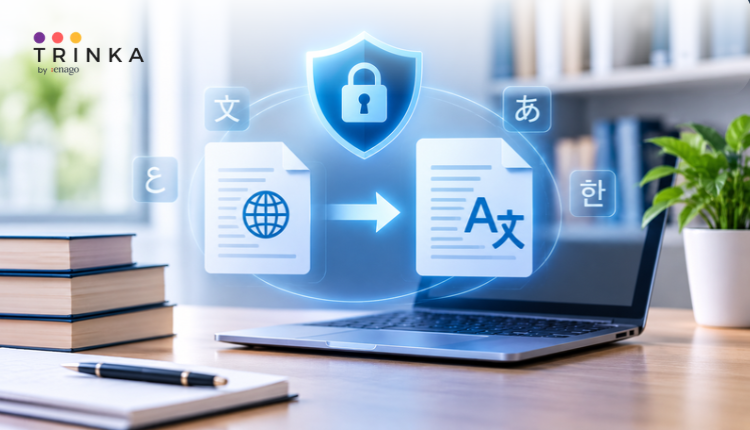
Many strong papers begin in a researcher’s first language. Translating them into English is often the step between good work and a journal submission.
It is also a step that sends your whole manuscript to a tool, usually before anyone else has seen it.
Why Translation Deserves a Privacy Check
A grammar check usually works on a section at a time. A file translation uploads the entire document, including your methods, your results, and conclusions you have not yet published.
That makes the tool’s data handling worth a few minutes of your time. Terms differ between tools, and some consumer services may keep or reuse submitted text, so it is worth checking rather than assuming.
The Checklist
Before you upload a manuscript to any translation tool, find out:
- Is the file stored, and for how long? Also find out whether you can delete it.
- Is it used to train models? Look for a clear statement, not silence.
- Who can see it? Check whether staff or contractors may review content.
- Does it keep your formatting? Tables, figures, headings, and equations should survive the translation.
- Does it handle your language and script? Non-Latin scripts such as Arabic, Chinese, Japanese, and Korean need explicit support.
- Does it handle your field’s terminology? General tools can mistranslate specialist terms.
- Is it written down? A clear privacy policy or agreement is stronger than a marketing line.
Translating Is Not the Last Step
A machine translation is a starting point. You remain responsible for the accuracy of what you submit, so a careful workflow helps:
- Keep your original. Hold on to the source-language version as your reference.
- Check the terminology. Read key terms, numbers, and units against the original.
- Edit the language. A grammar and consistency pass on the English text catches what the translation left rough.
- Record your tool use. Note which tool you used and when, in case a journal asks.
Journals and institutions have policies on AI-assisted translation and editing, and they vary. Check the target journal’s instructions, and disclose where they ask you to.
Where Trinka’s Confidential Data Plan Fits
Trinka’s file translation converts documents from more than 30 languages into English or Spanish, keeps the original formatting, and supports non-Latin scripts including Arabic, Chinese, Japanese, and Korean. It is available on Premium Plus and on the Confidential Data Plan.
Per Trinka, translations are processed under its privacy and security policies, and no data is shared or used for AI training. As with any tool, confirm the retention terms for stored files on your plan.
Because translation sits within the same plan as grammar checking, consistency checks, proofreading, citation checks, and plagiarism checks, a researcher can move from translation to the final polish without handing a draft to several different services.
Conclusion
Translation is where a first-language manuscript becomes a submission, and it is a step that touches your whole unpublished paper. Run the checklist, review the result yourself, and choose a tool with clear, written data terms.
Enhance Your Writing with Trinka’s Grammar Checker
Trinka’s Grammar Checker is designed to help writers produce clear, polished, and publication-ready content with ease. Whether you’re drafting academic papers, professional documents, or blog posts, Trinka ensures your writing is precise, consistent, and impactful, making it a trusted companion for anyone aiming to communicate effectively in English.
Frequently Asked Questions
Is it safe to translate an unpublished manuscript with an AI tool?▼
It depends on the tool’s terms. Check storage, training use, and who can see the file before you upload your whole paper, and look for the answers in writing.
Which languages does Trinka's file translation support?▼
More than 30 languages, translated into English or Spanish, including non-Latin scripts such as Arabic, Chinese, Japanese, and Korean.
Will translation keep my formatting?▼
Trinka states that the translated file retains the original formatting, but always check tables, figures, and equations yourself after translation.
Do I need to disclose AI translation to a journal?▼
Policies vary by journal, so read the instructions for authors and disclose wherever they ask you to, even if the tool only translated your own words.

-
Go beyond grammar & spelling
Get holistic language improvements - Write with Trinka