


What Instructors Should Prepare for as Student AI Use Increases

As more students use AI for assignments, faculty are facing a massive challenge that goes way beyond just catching AI misuse.
The real question isn’t whether students are using AI, most already do. The real issue is that universities haven’t given faculty the right rules, tools, or assignment designs to handle it.
AI Use Has Outpaced Policy Clarity
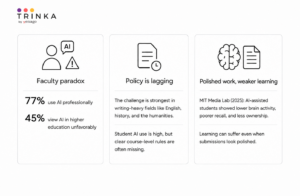
According to a study conducted in February 2026, among more than 3,000 American academic members, 45% of them have an unfavorable opinion of AI in higher education, while 77% of them said they use it professionally, there is no conflict here.
Faculty are aware of AI’s advantages for efficiency, but many are also concerned about how it may affect the assignments they have to grade.
The difficulty is particularly severe in fields that need a lot of writing.
The usage of AI by students is high in subjects like English, history, and the humanities, and there is worry about how it may affect critical thinking and original thought.
Students who used ChatGPT for assignments had lower brain activity, poorer memory recall, and less ownership of their work, according to research from MIT Media Lab (June 2025).
Learning outcomes suffer even though submissions looked polished.
Additionally, EDUCAUSE discovered that students who did not utilized AI to support their thinking remembered 40% more information than those who depended only on AI.
Traditional Assessment Was Not Designed for AI
For a long time, assignments worked on a simple rule: writing a good assignment takes real mental effort.
But now that AI can write an assignments or code in seconds, a finished assignments doesn’t prove a student learned anything.
Experts say faculty need to stop grading just the final assignments and start looking at the process of how it was made.
Unfortunately, most universities don’t have the tools to make this easy.
While faculty want to protect honesty and prepare students for real careers, they are blocked by a lack of training and worries about fairness. They know what needs to change, but they don’t have the support to do it.
Proving AI Misuse is Getting Harder
When a faculty suspects a student used AI and the student denies it, there is rarely any hard evidence. The situation usually turns into an unreliable computer score against a faculty’s gut feeling.
AI detectors are simply not accurate enough.
Stanford researchers found that over 61% of assignments written by international, non-native English speakers were wrongly flagged as AI work. This creates a major fairness problem for schools.
Students mix AI drafts with paraphrasing software and their own quick edits, wiping away the patterns that detectors look for.
Faculty are left relying on flawed tools, intuition, or just letting the issue go entirely.
What Faculty Need from Institutions
A better way is to track the actual writing session, the keystrokes, edits, pauses, and copy-pastes.
This gives faculty clear proof while letting honest students show exactly how hard they worked.
Trinka’s DocuMark make this writing journey fully visible. Instead of just trying to detect AI use by students, it guides them to review and verify their work and be transparent about how they used these tools.
You get visibility into their process, and students learn to take ownership of what they submit, protecting students’ authorship and building trust between faculty and students.
Sources and References
-
- College Board. (2026, February). New College Board research: Faculty express near-universal concern that student AI use undermines original writing and critical thinking. https://newsroom.collegeboard.org/new-college-board-research-faculty-express-near-universal-concern-student-ai-use-undermines
- MIT Media Lab. (2025, June). Your brain on ChatGPT. https://risepoint.com/insights/thinking-with-ai-what-a-viral-mit-study-reveals-about-ai-and-the-learning-brain/
- Gamby, T., Kil, D., Koblic, R., et al. (2025). The AI tsunami is here: Reinventing education for the age of AI. EDUCAUSE Review. https://er.educause.edu/articles/2025/9/the-ai-tsunami-is-here-reinventing-education-for-the-age-of-ai
- Kostanek, M., & Li, J. (2025). Redesigning assessments for AI-enhanced learning: A framework for educators in the generative AI era. Education Sciences, 15(2), 174. https://www.mdpi.com/2227-7102/15/2/174
- Liang, W., Yuksekgonul, M., et al. (2023). GPT detectors are biased against non-native English writers. Patterns. https://doi.org/10.1016/j.patter.2023.100779
Enhance Your Writing with Trinka’s Grammar Checker
Trinka’s Grammar Checker is designed to help writers produce clear, polished, and publication-ready content with ease. Whether you’re drafting academic papers, professional documents, or blog posts, Trinka ensures your writing is precise, consistent, and impactful, making it a trusted companion for anyone aiming to communicate effectively in English.
Frequently Asked Questions
How should instructors handle suspected AI misuse with unreliable detection tools?▼
Detection scores should be treated as signals, not verdicts. Process-level evidence such as writing session records allows more defensible decisions.
Do instructors need to redesign every assignment?▼
Not all assignments carry equal risk. High-stakes tasks, dissertations, capstones, central assignments, are priority candidates for process documentation and in-class writing components.
What does responsible AI use in writing look like?▼
Students should disclose AI involvement and retain intellectual ownership of their work. Paired with session records, institutions can enforce policies transparently and fairly.

-
Go beyond grammar & spelling
Get holistic language improvements - Write with Trinka