


Why Medical Teams Need GDPR-Compliant Writing Solutions

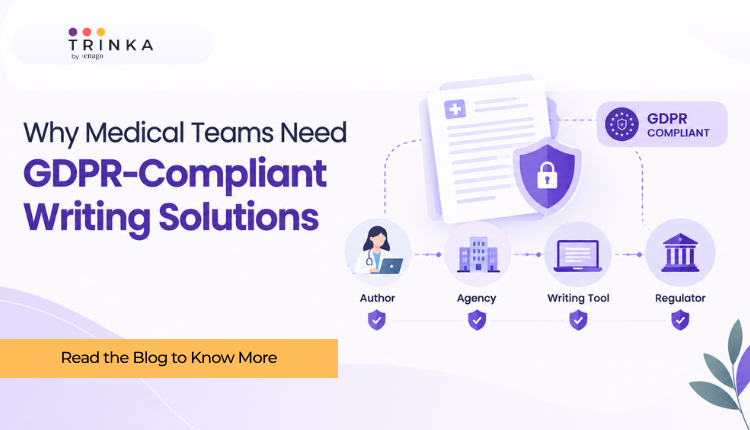
Medical teams rarely write everything in-house. Manuscripts, regulatory submissions, and clinical communications routinely pass through medical communications agencies, contract research organizations, and freelance medical writers before they’re finished.
That matters for GDPR compliance in a way that’s easy to overlook. GDPR doesn’t just apply to the pharma company or hospital that owns the data. It applies to every agency, writer, and tool that touches it along the way.
Why Health Data Gets Special Treatment Under GDPR
GDPR treats health information as special category data under Article 9, a stricter classification than ordinary personal data. Processing it generally requires explicit consent or another specific legal basis, not just a general data processing justification.
This matters directly for medical writing, because a manuscript, case report, or regulatory document often contains exactly this kind of information, even in draft form. A document doesn’t need to be “finished” or “published” for GDPR’s special category rules to apply. The moment it contains identifiable patient information, those stricter protections are already in effect.
The Pseudonymization vs. Anonymization Confusion
These two terms get used interchangeably in practice, and the difference actually changes which GDPR rules apply.
- Anonymized data has been processed so no individual can be re-identified, by anyone, under any circumstances. Properly anonymized data falls outside GDPR’s scope entirely.
- Pseudonymized data has identifying details replaced or masked, but re-identification is still possible with additional information held elsewhere. Pseudonymized data is still personal data under GDPR, and still subject to its full requirements.
A lot of clinical documentation that teams assume is “anonymized” is actually pseudonymized. That distinction decides whether GDPR still applies to a given document, and it’s worth getting right before assuming a draft is safe to share broadly.
Cross-Border Transfer Risk
Medical writing work often crosses borders. An EU-based trial might use a writing agency based outside the EEA, or a cloud-based writing tool might process documents on servers located in another jurisdiction entirely.
GDPR places specific restrictions on transferring personal data, including health data, outside the EEA. This applies whether the transfer happens through an outsourced writing vendor or through the servers a software tool runs on. A medical writing solution that doesn’t disclose where it processes data creates a transfer risk that’s easy to miss until a data protection officer asks about it directly.
The Erasure-vs-Retention Tension
GDPR gives individuals a right to request erasure of their personal data. Clinical trials and regulatory submissions, on the other hand, often carry legal requirements to retain documentation for years, sometimes well beyond when a trial concludes.
These two obligations can pull in opposite directions, and resolving the tension usually depends on the specific legal basis for processing and the retention requirements of the relevant regulatory framework. It’s a conversation worth having with legal or compliance counsel early, rather than assuming either requirement automatically overrides the other.
Why This Extends to Vendor and Tool Selection
A Data Protection Impact Assessment isn’t just an internal exercise for the organization that owns the data. If an agency, freelance writer, or software tool is going to touch health-related content, that same scrutiny should extend to them.
In practice, this means asking the same questions of an external medical writing vendor or an AI writing tool that you’d ask of your own internal process:
- What is the legal basis for processing this data?
- Where is the data processed and stored, and does that location meet GDPR’s transfer requirements?
- How long is data retained, and does that match your organization’s own retention policy?
- Is there a signed data processing agreement in place, naming these terms explicitly?
A vendor or tool that can’t answer these clearly is a gap in your own GDPR compliance, not just theirs.
Where Trinka’s Confidential Data Plan Fits
Trinka’s Confidential Data Plan was built with this kind of scrutiny in mind. Submitted content isn’t stored beyond the session and isn’t used to train any model, and the plan carries GDPR alignment alongside HIPAA, SOC 2, and ISO 27001. That design reduces several of the questions above, around retention and data use, though it doesn’t replace the legal analysis a team still needs to do around consent, legal basis, and cross-border transfer for their specific situation.
Conclusion
GDPR compliance in medical writing isn’t just a certification to list on a vendor page. It’s a set of specific requirements around consent, data classification, transfer, and retention that apply to every agency, writer, and tool a medical team brings in. Choosing a writing solution built around these requirements, rather than one that treats GDPR as a checkbox, is part of getting this right.
Key Takeaways
- GDPR compliance in medical writing extends to every agency, writer, and tool touching the data, not just the data owner.
- Health data is special category data under Article 9, with stricter requirements than ordinary personal data.
- Pseudonymized data is still personal data under GDPR; only properly anonymized data falls outside its scope.
- Vendor and tool selection should include the same GDPR scrutiny applied to internal processes.
Enhance Your Writing with Trinka’s Grammar Checker
Trinka’s Grammar Checker is designed to help writers produce clear, polished, and publication-ready content with ease. Whether you’re drafting academic papers, professional documents, or blog posts, Trinka ensures your writing is precise, consistent, and impactful, making it a trusted companion for anyone aiming to communicate effectively in English.
Frequently Asked Questions
Does GDPR apply to a medical writing agency, or only to the pharma company?▼
It applies to anyone processing the personal data, including agencies, freelance writers, and software vendors involved.
What's the difference between pseudonymized and anonymized data under GDPR?▼
Anonymized data can’t be re-identified under any circumstances and falls outside GDPR’s scope. Pseudonymized data still can be re-identified and remains subject to GDPR.
Can an AI writing tool create a cross-border transfer risk?▼
Yes, if it processes or stores data on servers outside the EEA, this falls under GDPR’s transfer restrictions.
Does GDPR's right to erasure override clinical trial retention requirements?▼
Not automatically. The two can conflict, and resolving it depends on the legal basis for processing and the applicable regulatory retention rules.

-
Go beyond grammar & spelling
Get holistic language improvements - Write with Trinka