


Why Pharma Is Rethinking AI Writing Tools in 2026

A protocol draft, a manuscript in progress, a regulatory submission half-written. Not long ago, each one sat in a single Word document, edited by hand and checked by a colleague before it moved forward. In 2026, a growing share of that work runs through an AI writing tool first. That shift has pushed pharma organizations to ask a question many skipped in earlier years: where does the text actually go once it leaves the screen.
Why This Question Suddenly Matters
Regulatory scrutiny of AI use in life sciences has grown sharper this year. Industry trend reports now list AI governance and data integrity among the issues every pharma and biotech team is expected to have a real answer for, not just a policy document sitting in a drawer.
Compliance teams that once treated AI writing tools as a productivity convenience are now treating them as a data-handling decision, closer in weight to choosing a cloud storage vendor than picking a grammar checker.
Two Forces Behind the Shift
Shadow AI use has grown. A team can have a strict AI policy on paper and still have researchers pasting unpublished trial data into a free consumer chatbot, simply because no compliant alternative felt as easy to use.
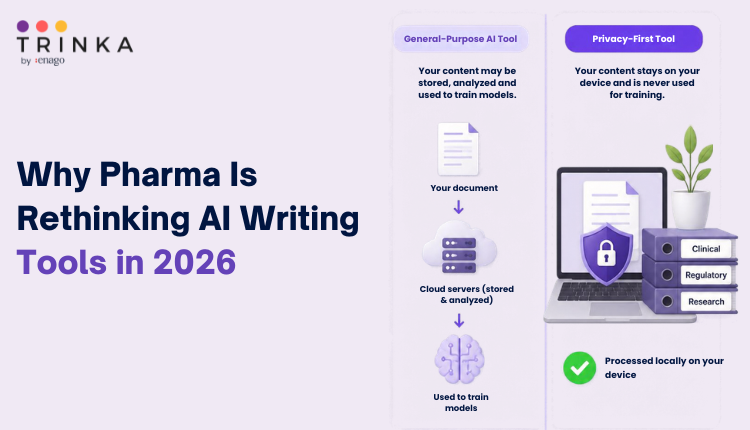
Most tools weren’t built for regulated work. General-purpose AI writing tools were designed for broad markets, not pharma or healthcare. Their default terms often allow submitted content to improve the underlying model unless a user manually opts out, a detail that is hard to defend to a data protection officer reviewing a clinical manuscript.
A Different Category of Tool
That combination has created room for AI writing tools built around a simpler premise: customer content is never stored beyond the session and never used to train any model. This is not a feature added later. It changes what a vendor can say in a security questionnaire and what a regulatory affairs lead can approve without escalating.
Trinka’s Confidential Data Plan follows this model, with grammar, terminology, and clarity support tuned to medical and regulatory writing, backed by HIPAA, SOC 2, GDPR, and ISO 27001 alignment.
A shorter list of questions now decides most pilots:
– Does the vendor store submitted content after the session ends?
– Is that content used, in any form, to train models used by other customers?
– Can the vendor produce a data processing agreement naming these terms explicitly?
Teams that ask these upfront tend to find out quickly which tools were built for their sector and which were adapted for it later.
Conclusion
As AI writing becomes standard practice in clinical and regulatory work, the tools that pass procurement review will likely be the ones built around data privacy from the start, not the ones that added a compliance page once enterprise buyers started asking harder questions.
Key Takeaways
– AI writing tools in pharma have moved from a convenience decision to a data-handling one.
– Shadow AI use grows when no compliant alternative exists.
– Privacy-first tools are architected differently, not retrofitted with privacy features.
– Three direct vendor questions cover most of what a compliance review needs.
Enhance Your Writing with Trinka’s Grammar Checker
Trinka’s Grammar Checker is designed to help writers produce clear, polished, and publication-ready content with ease. Whether you’re drafting academic papers, professional documents, or blog posts, Trinka ensures your writing is precise, consistent, and impactful, making it a trusted companion for anyone aiming to communicate effectively in English.
Frequently Asked Questions
Why are pharma companies reconsidering AI writing tools in 2026?▼
Regulatory pressure and shadow AI use have turned data handling into a compliance question.
What is shadow AI in clinical writing?▼
Staff using unapproved AI tools because no vetted, compliant option was available to them.
Do AI writing tools use my content to train their models?▼
Many do by default unless you opt out; check the vendor’s terms directly.
What should compliance ask before approving a tool?▼
Whether content is stored, whether it trains models, and whether this is written into a signed agreement.

-
Go beyond grammar & spelling
Get holistic language improvements - Write with Trinka