


Why Sensitive-Data Industries Need an Offline Grammar Checker

Many industries handle information that isn’t meant for anyone else to see. Forensic case files. Legal discovery documents. Unpublished drug trial data. Classified defence reports. Add to that list patent filings before publication, financial due diligence records, government intelligence briefs, and academic research still under embargo.
Each of these carries the same underlying problem. The moment that text touches a tool that sends it somewhere else, even for something as simple as a grammar check, the confidentiality of that document is no longer fully in the writer’s hands.
Why These Teams Can’t Rely on Standard Tools
Most AI writing tools and grammar checkers process text on remote servers. That’s how they work, and for general writing it’s rarely a concern.
For the industries above, it’s a different calculation entirely. A forensic report sent to a cloud server creates a record outside the chain of custody. A pharma manuscript pasted into a public AI tool may sit on servers the company has no visibility into. A defence document, even briefly transmitted, can violate the handling rules it was written under.
So these teams often default to the safest option available: doing it manually. No automated grammar check, no AI-assisted editing, just a colleague reading line by line.
The Cost of Going Manual
That workaround solves the privacy problem, but it creates a new one.
– Manual proofreading takes longer, especially on long technical or legal documents.
– Errors still slip through, since human review has its own limits at scale.
– Teams end up choosing between speed and confidentiality, when neither should be optional.
– Writers who need consistent terminology across hundreds of pages have no automated way to check it.
This is the quiet cost of high-security environments. The safest choice is often the slowest one, and over time that adds up across an entire department.
What an Offline Grammar Checker Changes
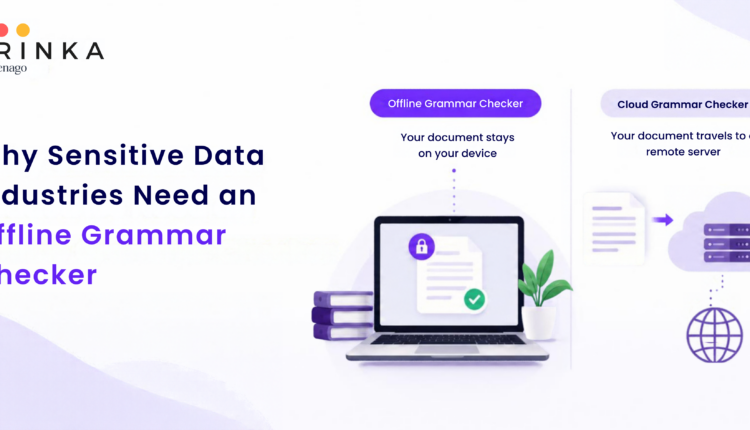
An offline grammar checker runs the check locally, without sending text to any server. The document never leaves the device it was written on.That single design choice removes the tradeoff. Writers get grammar, clarity, and terminology support without creating a new copy of sensitive content anywhere outside their own environment. There’s no upload, no server log, and no question about where the data went, because it never went anywhere.
This is what data sovereignty actually means in practice: not a policy statement, but a tool architecture where the sensitive document simply stays where it started.
Where This Fits for Regulated Writing Teams
Trinka’s Offline Grammar Checker was built for exactly this kind of writing, medical and regulatory documents that carry the same confidentiality requirements as legal or defence material. It checks grammar and terminology without an internet connection, so a protocol draft, a manuscript, or a regulatory submission gets the same editing support a cloud tool provides, without the exposure a cloud tool creates.
Conclusion
Industries that handle sensitive material shouldn’t have to choose between writing quality and confidentiality. An offline grammar checker isn’t a smaller version of a cloud tool. It’s a different answer to a problem cloud tools were never built to solve.
Key Takeaways
– Several industries handle documents too sensitive to risk on cloud-based tools.
– Manual review as a workaround slows teams down and doesn’t eliminate errors.
– An offline grammar checker keeps documents on-device while still supporting writing quality.
– Data sovereignty is a matter of tool architecture, not just policy.
Enhance Your Writing with Trinka’s Grammar Checker
Trinka’s Grammar Checker is designed to help writers produce clear, polished, and publication-ready content with ease. Whether you’re drafting academic papers, professional documents, or blog posts, Trinka ensures your writing is precise, consistent, and impactful, making it a trusted companion for anyone aiming to communicate effectively in English.
Frequently Asked Questions
Which industries benefit most from an offline grammar checker?▼
Forensic, legal, pharma, defence, and any team handling unpublished or classified material.
How is an offline tool different from a regular grammar checker?▼
It processes text locally, so nothing is uploaded or transmitted anywhere.
Does going offline mean losing writing quality features?▼
No, core grammar, clarity, and terminology checks still run, just without an internet connection.
What does "complete data sovereignty" actually mean here?▼
The document never leaves the device, so there’s no external copy, log, or transmission to account for.

-
Go beyond grammar & spelling
Get holistic language improvements - Write with Trinka