
Can a Grammar Checker Make AI Content Sound More Human?

You spend 30 seconds generating content with AI.
You spend the next 30 minutes trying to make it sound like a person wrote it.
The facts are there. The grammar looks fine. Yet something still feels off. The sentences sound predictable, the wording feels repetitive, and the content lacks the natural flow readers expect.
So what exactly is missing?
– The answer isn’t always grammar. In many cases, AI-generated content is technically correct but still lacks the readability and sentence variety that make writing feel natural. That’s why many writers don’t publish AI-generated drafts as they are. Instead, they review and refine them before sharing them with their audience.
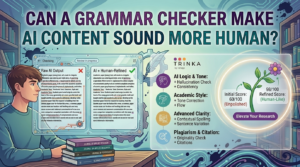
Why Does AI Content Feel Different from Human Writing?
Human writing isn’t perfect, and that’s part of what makes it engaging.
People naturally vary sentence length, change their tone, and emphasize ideas differently throughout a piece of content. AI, on the other hand, often follows patterns. It tends to use similar transitions, sentence structures, and phrasing repeatedly.
Readers may not consciously notice these patterns, but they often recognize when content feels mechanical or overly structured.
Is Grammar Really the Problem?
– Not always.
A piece of AI-generated content can be grammatically correct and still feel unnatural. The issue is often readability rather than correctness.
Consider these examples:
- The implementation of the strategy resulted in significant improvements across various operational functions.
- The strategy improved several key areas of the business.
Both sentences are correct, but one is noticeably easier to read.
This is why editing AI-generated content often involves improving clarity rather than simply fixing mistakes.
How Can a Grammar Checker Help?
A modern grammar checker does much more than identify grammar and spelling errors.
It can help improve sentence structure, punctuation, readability, and word choice. These small refinements can make content feel smoother and easier to follow.
When writers review AI-generated drafts with Trinka Grammar Checker, they’re often looking beyond grammar mistakes. They’re looking for opportunities to make the content clearer, more concise, and more natural for readers.
Can a Grammar Checker Reduce Repetitive AI Writing?
– Yes, to an extent.
One of the most common characteristics of AI-generated content is repetition. Similar sentence patterns and repeated wording can make an article feel less engaging, even when the information is useful.
A grammar checker can help identify these areas and suggest improvements that create better flow throughout the content.
Why Does Readability Matter So Much?
Readers rarely stop reading because of a single grammar mistake.
They stop reading when content feels difficult, repetitive, or tiring to follow.
Improving readability helps readers absorb information more easily. When ideas flow naturally from one sentence to the next, content feels more conversational and more human.
Can a Grammar Checker Replace Human Editing?
– No.
Human editors bring context, experience, creativity, and audience understanding that no tool can fully replicate.
The strongest workflow is often a combination of AI drafting, grammar checking, and human review. AI helps create the first draft, a grammar checker helps refine the language, and the writer adds the final judgment and personality.
So, Can a Grammar Checker Make AI Content Sound More Human?
A grammar checker won’t turn AI-generated content into a personal story or unique opinion piece. However, it can significantly improve readability, sentence flow, word choice, and clarity.
Those improvements make content feel less mechanical and more natural to readers.
That’s why many writers use Trinka Grammar Checker as a final review step before publishing AI-generated content.
Ready to Improve Your AI-Generated Content?
Before publishing AI-generated text, review it with Trinka Grammar Checker to improve grammar, readability, sentence structure, and overall writing quality. A few minutes of editing can make the difference between content that sounds automated and content that truly connects with readers.

-
Go beyond grammar & spelling
Get holistic language improvements - Write with Trinka