

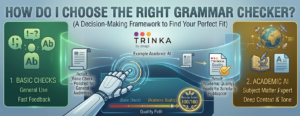
Choosing the right grammar checker depends entirely on your specific writing goals, your target audience, and the level of stylistic analysis your document requires. While basic tools focus heavily on spelling and punctuation corrections, advanced writing assistants evaluate context, tone, readability, and structural flow to ensure clear communication.
What Should a Grammar Checker Actually Help with?
A comprehensive grammar checker should assist with readability, sentence structure, and vocabulary enhancement, going far beyond basic spelling and punctuation fixes. Its primary objective is to optimize the overall flow of your writing and eliminate structural friction.
An advanced writing assistant systematically identifies:
- Passive voice misuse: Highlighting phrases that weaken your narrative authority.
- Repetitive vocabulary: Suggesting contextual synonyms to elevate engagement.
- Structural density: Breaking down complex, convoluted clauses into scannable sentences.
Is Accuracy the Most Important Factor in a Grammar Tool?
While grammatical accuracy is foundational, contextual accuracy is the most critical factor in selecting a tool. A checker must understand the specific syntax of your industry or medium to avoid making counterproductive suggestions.
For example, look at this structurally sound but poorly optimized phrase:
“The implementation of the proposed methodology facilitated enhanced productivity.”
A standard, non-contextual spell-checker will mark this as 100% correct. However, a context-aware tool recognizes the wordiness and prompts a high-clarity alternative:
“The proposed method boosted productivity.”
Do You Need a Different Grammar Checker for Academic Writing?
Yes, academic and scientific writing requires a specialized grammar checker because standard algorithms are trained on casual internet text and struggle with complex research prose. Peer-reviewed journals demand formal language, precise domain-specific terminology, and strict adherence to style guides.
For instance, general-audience tools often flag passive voice as an error, whereas scientific papers frequently require passive phrasing in methodology sections. This specialized need is why researchers utilize tools like Trinka Grammar Checker, which is explicitly trained on millions of peer-reviewed papers to fix language quality without altering technical meaning.
Can an AI Grammar Checker Truly Understand Context?
Modern AI grammar checkers use advanced Natural Language Processing (NLP) to analyze entire paragraphs rather than evaluating words in isolation. This allows the system to provide semantic corrections based on the tone and intent of the overall document.
Context-aware AI helps writers by:
- Differentiating homophones that match the technical field (e.g., discrete discreet variables).
- Maintaining tone consistency, ensuring a business proposal doesn’t slip into casual, conversational phrasing.
- Explaining the “why” behind a correction so the writer can treat the platform as a learning tool to build better writing habits over time.
Which Grammar Checker Should You Choose?
To choose the right tool, match the software’s core capabilities to your final output goals:
- For daily tasks (emails, basic blogs, social media): Free browser extensions or built-in processor tools are perfectly sufficient.
- For high-stakes documents (journal articles, research papers, legal briefs): A dedicated, context-aware platform like Trinka is required to safeguard technical clarity and academic integrity.

-
Go beyond grammar & spelling
Get holistic language improvements - Write with Trinka