

Whether you are writing a college assignment, a thesis, or a research paper, every stage of writing presents opportunities for grammar mistakes, unclear sentences, and inconsistencies. Waiting until the final review to correct these issues often means spending more time editing and increases the chance of overlooking important errors.
This guide explains how to use a Grammar Checker from planning your ideas to completing the final proofread. It walks through each stage of writing with practical tips, examples, and checklists so you can improve clarity, consistency, and overall writing quality.
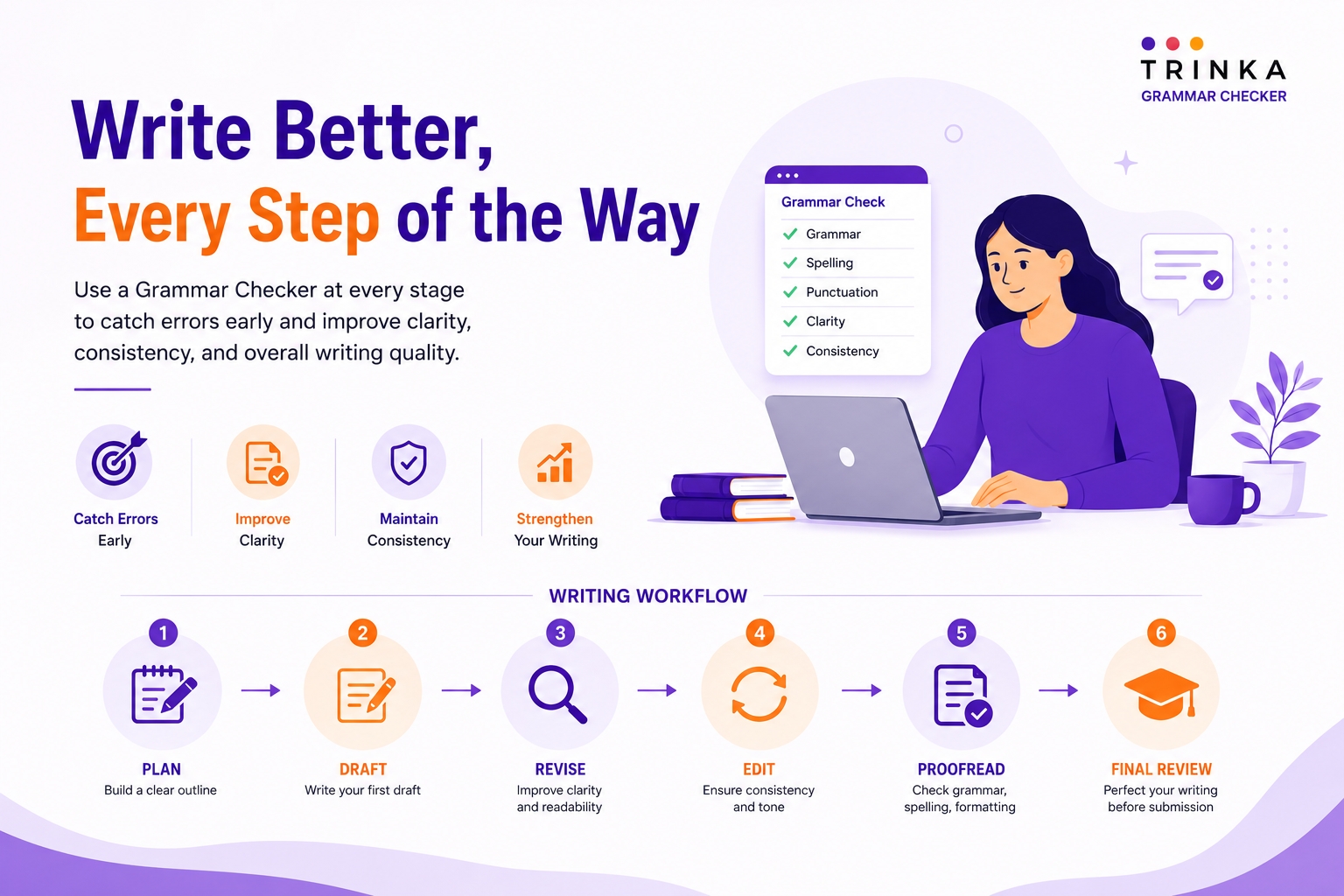
Writing Workflow
| Stage | What to Check | Goal |
| Planning | Headings, spelling, terminology | Build a clean outline |
| First Draft | Grammar, punctuation | Keep writing |
| Revision | Clarity, readability | Improve understanding |
| Editing | Consistency, tone | Create a cohesive document |
| Final Review | Grammar, spelling, formatting | Prepare for submission |
Stage 1. Start with a Clear Outline
Create an outline before drafting. Use the grammar checker to correct spelling, improve headings, standardize terminology, and fix obvious grammar mistakes. Do not spend time refining style at this stage. Example: ‘Benefit of grammar checker’ → ‘Benefits of Using a Grammar Checker’.
Stage 2. Write Your First Draft
Complete one section before running the grammar checker. Fix grammar, punctuation, and repeated words, but ignore style suggestions until revision. Example: ‘The experiment demonstrate…’ → ‘The experiment demonstrates…’
Stage 3. Improve Clarity During Revision
Simplify long sentences, remove unnecessary words, reduce repetition, and improve readability. Review both student assignments and research writing with clarity in mind.
Stage 4. Check Consistency
Review capitalization, terminology, abbreviations, numbering, and British or American English usage. Keep the same style throughout the document.
Stage 5. Refine Tone
Replace informal or vague wording with precise academic language. Example: ‘The results are pretty good.’ → ‘The results demonstrate strong performance.’
Stage 6. Final Review
Run one final grammar check, then read the document yourself to catch awkward wording and transitions before submission.
Common Mistakes to Avoid
- Waiting until the end
- Editing every sentence while drafting
- Accepting every suggestion automatically
- Ignoring discipline specific language
- Mixing British and American English
- Forgetting to review after feedback
- Relying only on automation
Pro Tips
- Write first and edit later.
- Review one section at a time.
- Read your work aloud after the grammar check.
- Use a grammar checker before peer review.
- Combine automated suggestions with your own judgment.
Final Thoughts
Using a grammar checker throughout the writing process helps you catch errors early, improve clarity, and maintain consistency from your outline to your final submission. Whether you are preparing an assignment, thesis, dissertation, or research paper, this workflow helps you produce stronger writing with less editing. Explore Trinka Grammar Checker for advanced support with grammar, clarity, tone, and consistency.

-
Go beyond grammar & spelling
Get holistic language improvements - Write with Trinka