

Many writers are told to avoid passive voice because active voice is clearer and easier to read. That advice is useful, but it is not always correct. Passive voice has an important place in academic, scientific, and professional writing where the focus should be on the action rather than the person performing it.
This guide explains the difference between active and passive voice, when to use each, and how students, researchers, professionals, and content creators can choose the right style for different writing situations.
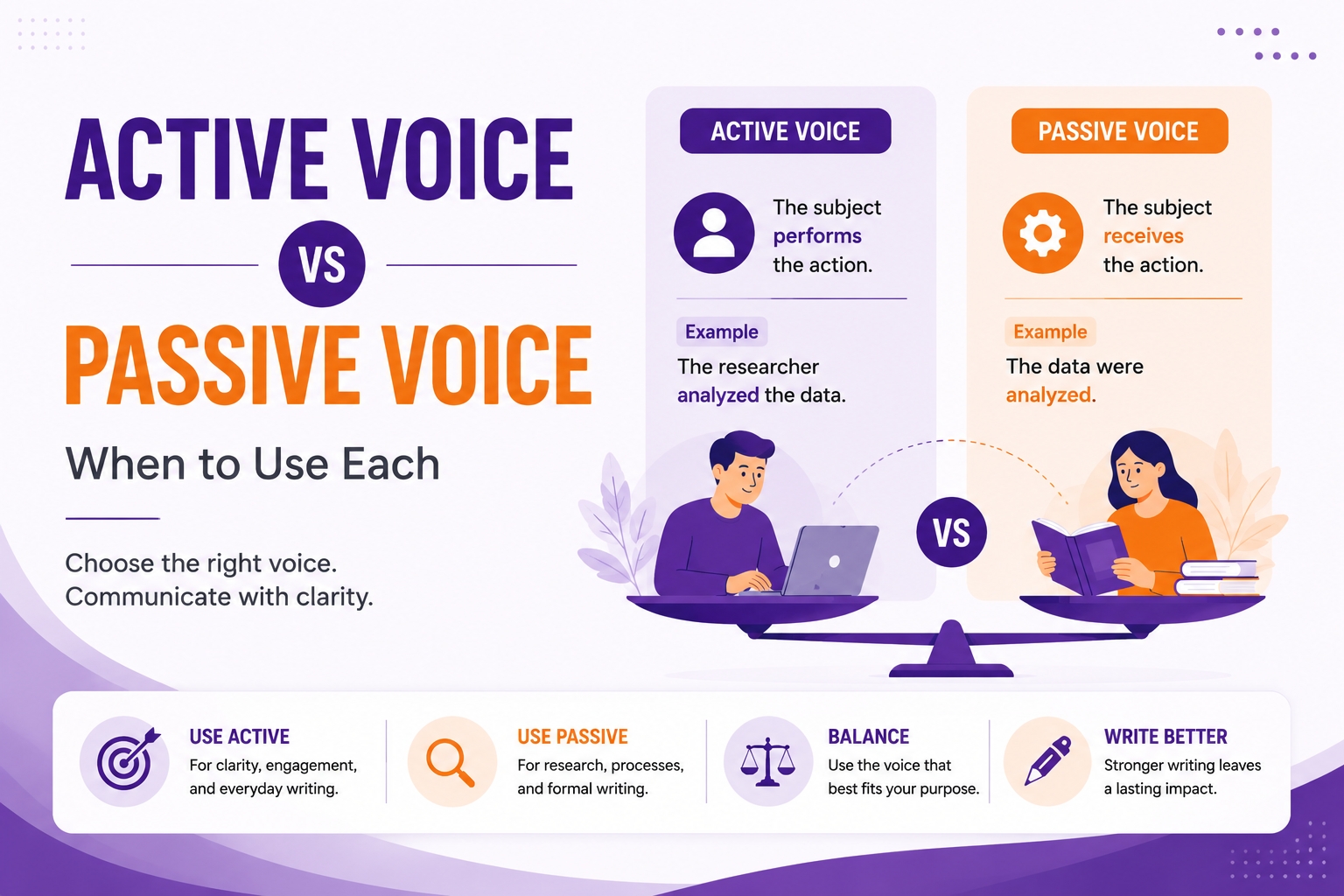
Active Voice vs Passive Voice at a Glance
| Feature | Active Voice | Passive Voice |
| Focus | Person performing the action | Action or result |
| Tone | Direct and engaging | Objective and neutral |
| Best For | Blogs, essays, emails | Research papers, reports |
| Readability | High | Moderate |
What Is Active Voice?
Active voice means the subject performs the action. Example: ‘The researcher analyzed the data.’ It is ideal for essays, business communication, blogs, and most everyday writing because it is clear and concise.
What Is Passive Voice?
Passive voice means the subject receives the action. Example: ‘The data were analyzed.’ It is useful when the action, process, or result is more important than the person performing it.
Which Voice Should You Use?
| Audience | Active Voice | Passive Voice | Recommendation |
| Students | Essays, assignments | Lab reports | Mostly active |
| Researchers | Discussion, conclusions | Methods, experiments | Use both |
| Professionals | Emails, proposals | Policies, compliance | Mostly active |
| Content Creators | Blogs, web copy | Occasional emphasis | Mostly active |
When to Use Active Voice
- You want readers to know who performed an action.
- You are writing essays, blogs, or website content.
- You are sending business emails or reports.
- You want shorter, more engaging sentences.
When to Use Passive Voice
- The action matters more than the person.
- The actor is unknown or unimportant.
- You are describing research methods or laboratory procedures.
- You want a formal or objective tone.
Active vs Passive in Academic Writing
| Section | Recommended Voice |
| Introduction | Active |
| Literature Review | Active |
| Methodology | Passive |
| Results | Either |
| Discussion | Active |
| Conclusion | Active |
Quick Decision Guide
| Goal | Use |
| Improve readability | Active |
| Describe a process | Passive |
| Show responsibility | Active |
| Highlight results | Passive |
Common Mistakes
- Thinking passive voice is always wrong.
- Overusing passive constructions.
- Using passive voice to hide responsibility.
- Switching voice without a purpose.
How a Grammar Checker Helps
A grammar checker can identify unnecessary passive constructions, suggest clearer alternatives, improve sentence flow, and maintain consistency.
Active and passive voice are both valuable. Active voice is usually the best choice for clear, engaging writing, while passive voice is useful when emphasizing actions, processes, or results. Choose the voice that best supports your purpose instead of following a single rule.

-
Go beyond grammar & spelling
Get holistic language improvements - Write with Trinka