


What Is a Writing Report and Why Should Academic Writers Use One?

Many students and researchers revise a draft, run a grammar check, and still feel unsure about one critical question: Is this manuscript submission ready? A writing report fills this gap. It turns scattered feedback into a structured, evidence-based summary of what works, what risks rejection, and what to fix next.
This article explains what a writing report is, what it includes, why it matters in academic writing, when to use it, how to read it, and how to apply it to revise fast. It also highlights how tools like the Trinka.ai free grammar checker can help ensure your writing is polished and ready for submission. This helps when you balance journal rules, supervisor feedback, and tight deadlines.
What a writing report is (and what it is not)
A writing report is a structured evaluation of a document’s writing quality. It pulls measurable and reviewable signals into one place. These signals often include grammar accuracy, readability, tone, style consistency, and document statistics. You use the report to make targeted revisions.
A writing report is not the same as:
- Peer review comments, which focus on the research contribution, methods, and novelty.
- A plagiarism or similarity report, which focuses on text overlap with existing sources.
- A grading rubric, which measures alignment with course outcomes and instructor expectations.
A writing report works like a diagnostic summary for language and presentation. It helps you move from “I edited the draft” to “I can explain why the draft meets academic writing standards.”
What a writing report typically includes
Platforms use different labels. Strong writing reports still cover the same core areas.
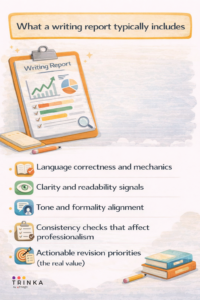
Language correctness and mechanics
This section highlights sentence-level issues that affect credibility and comprehension. It flags grammar, punctuation, spelling, articles, prepositions, subject verb agreement, and phrasing problems common in academic English.
It also helps you catch errors you often miss during self-editing. Examples include inconsistent tense in Methods or missing determiners in technical definitions.
Clarity and readability signals
Academic writing needs formal language. It also needs clear flow. A writing report often flags long sentences, dense noun strings, unclear pronoun references, and wordiness.
Example pattern. You repeat “This shows” without stating what shows what. Readers then guess the link. You should state the link.
Tone and formality alignment
Many academic drafts fail because the language sounds conversational, emotional, or vague. A writing report may highlight tone mismatches, informal phrases, and promotional claims that journals often dislike.
This helps when multiple authors write different sections and your tone shifts across the manuscript.
Consistency checks that affect professionalism
Consistency issues rarely cause desk rejection on their own. They shape quality signals for editors and reviewers. A report can help you catch:
- Mixed American and British spelling in the same document
- Inconsistent capitalization of key terms
- Shifts in terminology, for example “deep neural network” vs. “DNN” without defining the abbreviation
- Formatting issues that slow review
These issues distract reviewers. They also make your writing look less controlled.
Actionable revision priorities (the real value)
The best writing reports do more than list issues. They rank what to fix first. You stop fixing errors at random. You focus on high-impact categories, for example recurring clarity issues in Results.
This prioritization matters because your revision time is limited. Issues also carry different risk levels for submission.
Why academic writers should use a writing report
A writing report improves the quality of your revision decisions. It also improves speed.
It reduces revision blindness
After multiple drafts, you stop noticing your own errors. A writing report gives you an outside lens. It highlights patterns you miss, such as repeated sentence frames, vague verbs like “shows,” “indicates,” “affects,” and inconsistent tense.
It supports publication readiness
Journals expect clean and consistent language. Reviewers want to focus on the research, not decode sentences. A writing report helps you remove avoidable friction before submission. This reduces reviewer comments about unclear writing.
It helps non-native English writers revise with confidence
If English is not your first language, you often know what you want to say. You still feel uncertain about academic phrasing. A report makes revision concrete. It points to categories like articles, prepositions, hedging, and conciseness. It replaces vague advice like “improve readability.”
It creates an auditable trail of improvement
You often need to show progress between drafts. This happens with supervisors, writing centers, and institutional support programs. A writing report gives you a repeatable way to compare drafts. You can show how revisions improved clarity and correctness.
When to use a writing report in your workflow
You get the most value when you run a writing report at decision points, not only at the end.
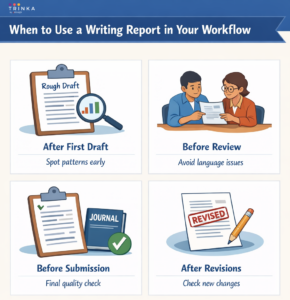
Use a writing report:
- After your first complete draft to spot patterns early, before they spread across sections.
- Before supervisor or co-author review to avoid sharing drafts with preventable language issues.
- Before journal submission as a final quality gate for consistency, clarity, and correctness.
- After major revisions, such as new Results or a rewritten Discussion, because new text creates new error patterns.
If you run a report once, run it right before submission. If you run it twice, run it once after the first full draft and once before submission.
How to interpret a writing report without over-editing
Many writers treat every flag as required. Academic writing needs judgment.
Focus on patterns, not isolated flags
One awkward sentence rarely harms a paper. Repeated patterns reduce clarity across the manuscript. Use the report to find what you repeat. Fix the source of the pattern.
Protect technical meaning
Automated checks can miss domain intent. If a suggestion changes a definition, statistics, or clinical meaning, keep your intent. Revise the sentence yourself for clarity.
Align revisions to section purpose
Your Abstract, Methods, and Discussion serve different goals. Use the report, then filter suggestions based on each section.
- Methods prioritize precision and reproducibility.
- Results prioritize clarity and signal-to-noise ratio.
- Discussion prioritizes argument structure and careful claims.
Practical before-and-after examples (how a report drives revision)
Below are common academic issues a writing report flags, plus revisions that improve clarity and formality.
Example 1: Wordiness and unclear subject
Before: It is important to note that the results clearly show that there is a significant improvement in performance.
After: The results show a significant performance improvement.
Why this works: the revision removes filler and keeps the claim direct.
Example 2: Informal tone in academic writing
Before: A lot of studies talk about how this method is pretty good.
After: Several studies report that this method performs well under comparable conditions.
Why this works: the revision replaces informal language with precise academic phrasing.
Example 3: Ambiguous pronoun reference
Before: This suggests that it improves the outcome.
After: This finding suggests that the proposed model improves classification accuracy.
Why this works: the revision states what “it” refers to and what “outcome” means.
Common mistakes writers make with writing reports
Treating the report as a substitute for revision strategy
A report highlights language issues. It does not fix argument logic, missing citations, or study design. Use it to improve presentation.
Revising sentence-by-sentence without checking global consistency
Many writers accept suggestions in isolation. This creates new inconsistencies, such as mixing “we” and passive voice across sections. After edits, re-check key sections for consistent tone and terminology.
Ignoring style guide and journal expectations
A writing report improves general readability. You still need journal requirements for abbreviations, units, reporting standards, and reference style. Use the report as one layer in your submission checklist.
How to use a writing report to revise efficiently (a step-by-step method)
- Run the report on a complete draft, not a single section, to capture patterns across the manuscript.
- Scan category summaries first. Identify the top two or three issue types in your draft, for example conciseness, article use, tone.
- Fix high-frequency, high-impact issues before rare issues.
- Re-read revised paragraphs for meaning to protect technical accuracy and correct hedging.
- Run the report again after major edits to confirm improvements and catch new inconsistencies.
This method stops wasted time on sentences you later delete or rewrite.
Where Trinka fits in a writing-report workflow
If you want a report tailored to academic and technical writing, Trinka Grammar Checker helps by flagging grammar, punctuation, and academic style issues for formal writing. Trinka also supports consistency-focused improvements and formal phrasing refinement.
Conclusion: Use writing reports to revise with clarity and control
A writing report gives you a structured snapshot of writing quality. It helps you revise faster, with consistent results, and with fewer blind spots. For academic writers, it shifts revision from guesswork to priorities. You focus on correctness, clarity, tone, and consistency before you submit to a supervisor, committee, or journal.
To apply this now, run a writing report on your latest full draft. Identify your top two recurring issues. Revise one section at a time based on those priorities. This step often improves readability more than hours of sentence-level edits. Additionally, using a tool like the Trinka.ai free grammar checker can help you catch nuanced language and style issues, ensuring your writing is polished before submission.
Enhance Your Writing with Trinka’s Grammar Checker
Trinka’s Grammar Checker is designed to help writers produce clear, polished, and publication-ready content with ease. Whether you’re drafting academic papers, professional documents, or blog posts, Trinka ensures your writing is precise, consistent, and impactful, making it a trusted companion for anyone aiming to communicate effectively in English.

-
Go beyond grammar & spelling
Get holistic language improvements - Write with Trinka