


AI Tools for Academic Integrity: What Works and What Doesn’t

Institutions have invested heavily in AI detection software, redesigned assignments, and launched AI literacy programs, with mixed results. Some of these strategies add real value to the classroom. Others create new challenges.
This article takes an honest look at the current landscape: what actually works, what completely falls short, and what provides a truly reliable way to prove student authorship.
Detection Tools Alone Are Not Enough
AI detection software, including Turnitin, GPTZero, and Copyleaks, has become the most widely used response to AI misuse.
These tools were meant to do for AI-generated text what plagiarism checkers did for copied content. In reality, they fall short.
A 2023 study in the International Journal for Educational Integrity tested 14 popular detectors, finding accuracy rates from 33% to 81%.
Even Turnitin’s team acknowledges that AI-generated content is allowed intentionally to limit false positives.
Independent testing in 2025 found Turnitin’s detection rate for modified AI content ranged from 20% to 63%, depending on how much the text was edited.
Bias compounds the problem. Stanford researchers found that over 61% of essays by non-native English speakers were misclassified as AI-generated, creating biases for international students.
Detection tools alone are unreliable and unfair when used as the basis of compliance investigation.
Authentic Assessment Isn’t a Complete Solution
When detection tools proved unreliable, institutions pivoted to authentic assessment.
Assignments that draw on personal experience, local knowledge, or iterative engagement are harder for AI to produce convincingly. Requiring drafts, revisions, or application of course-specific materials can reduce misuse.
However, AI has caught up. A 2025 study in the British Journal of Educational Technology found that generative AI can produce work that passes even authentic assessment scrutiny.
Faculty judgments produced false positives and false negatives at significant rates. While authentic assessment remains pedagogically valuable, it cannot serve as a standalone integrity enforcement mechanism.
AI Literacy: Education Is Clearer Than Prohibition
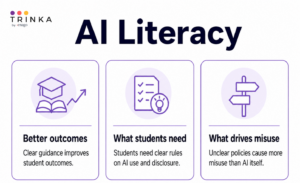
Institutions combining AI literacy programs with clear, course-level policies see better outcomes.
A 2026 study found students need structured guidance on ethical AI use, tool appropriateness, and disclosure expectations.
Policy ambiguity, not AI itself, drives misuse. Education that explains why AI rules exist, including learning and career implications, produces more durable integrity outcomes than prohibition alone.
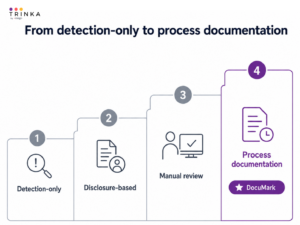
Process-Based Documentation: The Strongest Evidence
The absolute best way to protect academic integrity is through process documentation. Instead of scanning a finished document after it is done, this method records the writing session as it happens.
Tracking keystrokes, edits, copy-pastes, typing pauses, and AI interactions builds a clear, verifiable history of how the assignments were put together.
Research in Educational Measurement: Issues and Practice (2025) show that typing patterns (keystroke logs) reveal a unique behavioral footprint for every writer. This makes it incredibly easy to separate real human effort from a block of text copied out of an AI generator, even if the final text looks entirely human.
For instructors, this shifts the entire conversation away from stressful guesswork and subjective intuition. A student either has an automatic session record that supports their work, or they do not.
Tools like Trinka’s DocuMark handle this entire lifecycle automatically from the very first keystroke to final submission. Instead of just trying to detect AI use by students, it guides them to review and verify their work and be transparent about how they used these tools.
You get visibility into their process, and they learn to take ownership of what they submit, replacing unreliable percentages with real, verifiable evidence.
Turning Policy into Daily Practice
To make these efforts stick, universities must bridge the gap between their handbook rules, and the tools professors use every single day. Trinka’s University AI Policy Repository is a completely free, searchable database that tracks exactly how over 100 leading universities handle AI governance, risk tiers, and disclosure structures. Instead of starting from scratch, administrators can use this repository to compare policy frameworks side-by-side, adopt proven terminology, and easily update their own academic integrity codes to match modern standards.
By combining clear, standardized policy models with the verified writing data from tools like DocuMark, schools can finally move away from high-stress AI policing and get back to focusing on transparent, accountable learning. A well-documented process not only protects integrity but also makes students’ authorship visible and credible.
Sources and references
- Weber-Wulff, D., Anohina-Naumeca, A., Bjelobaba, S., et al. (2023). Testing of detection tools for AI-generated text. International Journal for Educational Integrity, 19(1), Article 26. https://link.springer.com/article/10.1007/s40979-023-00122-7
- Popular AI. (2026, March). Turnitin false positives in 2025 and 2026: Why AI detectors can’t be proof. https://www.popularai.org/p/these-turnitin-false-positives-in
- Liang, W., Yuksekgonul, M., Mao, Y., Wu, E., & Zou, J. (2023). GPT detectors are biased against non-native English writers. https://doi.org/10.1016/j.patter.2023.100779
- Kofinas, A., et al. (2025). The impact of generative AI on academic integrity of authentic assessments within a higher education context. British Journal of Educational Technology, 56, 2522–2549. https://doi.org/10.1111/bjet.13585
- Lund, B. D., Lee, T. H., Mannuru, N. R., & Arutla, N. (2025). AI and academic integrity: Exploring student perceptions and implications for higher education. Journal of Academic Ethics. https://doi.org/10.1007/s10805-025-09613-3
- (2026, January). Exploring academic integrity: Generative AI tools used in academic writing among university students. https://bccampus.ca/2026/01/15/exploring-academic-integrity-generative-ai-tools-used-in-academic-writing-among-university-students/
- Cao, H., & Zahid, S. (2025). Automated viva voce using generative AI for student coursework authentication. Proceedings of ETAIC 2025. https://dl.acm.org/doi/10.1145/3766557.3766564
- Zhang, M., et al. (2025). Applications and modeling of keystroke logs in writing assessments. Educational Measurement: Issues and Practice. https://onlinelibrary.wiley.com/doi/abs/10.1111/emip.12668
Enhance Your Writing with Trinka’s Grammar Checker
Trinka’s Grammar Checker is designed to help writers produce clear, polished, and publication-ready content with ease. Whether you’re drafting academic papers, professional documents, or blog posts, Trinka ensures your writing is precise, consistent, and impactful, making it a trusted companion for anyone aiming to communicate effectively in English.
Frequently Asked Questions
Should institutions stop using detection tools entirely?▼
Not necessarily. Detection can serve as a signal to flag submissions for human review but should not be treated as evidence in isolation. Combined with process documentation and judgment, detection still has a role.
Is authentic assessment wasted if AI can pass it?▼
No. Authentic assessment serves learning goals and encourages engagement. Its value lies in pedagogy, not enforcement alone.
Why is process documentation adoption slow?▼
Structural barriers, LMS integration, procurement, faculty training, and governance, slow adoption. Many institutions are still redesigning assessments or updating policies. Process documentation requires deliberate commitment.
Can students game process documentation like detection tools?▼
It is much harder. Process tools capture real-time behavior during authenticated sessions. Fabricating a convincing session with realistic keystroke timing and edits is not practically feasible.

-
Go beyond grammar & spelling
Get holistic language improvements - Write with Trinka