
Is Using a Grammar Checker Cheating? What Universities Say

Why the question is harder now than it used to be
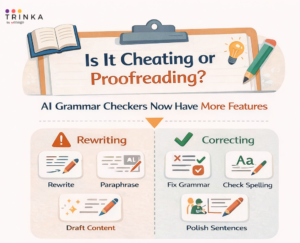
A decade ago, a grammar check tool focused on spelling and punctuation. Many students used Microsoft Word style suggestions. Today, many tools combine multiple features in one place. You might see grammar correction, style rewrites, paraphrasing, summarizing, citation generation, and draft generation.
Universities rarely object to error correction. They object when a tool does the work your instructor expects from you. This includes generating ideas, writing original sentences, or rewriting your argument in a way that changes authorship.
This shift explains why the same AI grammar checker might be allowed in one course, restricted in another, and prohibited during an exam.
What universities usually mean by “cheating” in writing
Academic integrity policies focus on behavior, not the tool. The issue is misrepresenting who produced the work. Another issue is getting unauthorized help that creates an unfair advantage.
When universities describe misconduct in writing, they often focus on outcomes like:
- Submitting text, you did not write as if you wrote it
- Hiding or failing to disclose unauthorized assistance
- Outsourcing analysis, synthesis, or wording that the assignment assesses
A grammar checker becomes cheating when it stops acting like proofreading support and starts acting like a ghostwriter.
What universities say, a consistent pattern across policies
University rules vary by institution and course. Recent examples show a common line. Minor mechanical corrections often count as acceptable proofreading. Content generation and substantial rewriting do not.
Example: “Use AI to improve grammar” can be allowed if the course policy says so
Penn State academic integrity resources include sample syllabus language for generative AI. One policy option allows students to use AI tools to improve their use of grammar. It prohibits other uses such as creating content for coursework. The same document notes the policy applies to generative AI tools including Grammarly, Copilot, and other artificially intelligent tools.
Source: Penn State sample syllabus language PDF, March 2024: https://integrity.psu.edu/sites/default/files/2024-03/syllabus_language_for_gen_AI_policies.pdf (integrity.psu.edu)
Takeaway. Your course syllabus matters more than general internet advice. If your instructor allows grammar level help, follow the boundary. If they restrict drafting and rewriting, follow that rule.
Example: “Minor grammar corrections” are usually acceptable, rewrites and paraphrasing are not
Geneva College provides specific guidance. It states that using a writing assistance tool for minor grammar corrections, such as spelling and punctuation, is usually acceptable for editing and proofreading assignments. It gives examples including Grammarly’s Grammar Checker and Microsoft Word’s Editor. It also states that tools that rewrite sentences or paragraphs, summarize or paraphrase ideas, or generate content are not acceptable under its policy.
Source: Geneva College FAQ PDF, March 12, 2025: https://www.geneva.edu/online/resources/bachelors/faq-ai-in-academic-writing-3.12.25.pdf (geneva.edu)
This fits how many universities define cheating with writing tools. Correction is support. Rewriting is substitution.
Example: Some institutions do not “ban tools,” they ban unethical outcomes
Liberty University’s Online Writing Center describes an approach many institutions use. They do not ban AI powered writing aids outright. They prohibit AI generated content presented as original work. They also prohibit AI modifications that substantially change the student’s words.
This changes the core check you should do. Focus on whether your use keeps originality and authorship clear.
Example: Writing centers emphasize instructor control, course by course rules
The University of Delaware Writing Center policy statement notes instructors set the rules for student use of LLM based tools in their own classes.
If you study across multiple courses or programs, do not treat one instructor’s permission as a general rule.
The “acceptable vs. cheating” line, proofreading vs. rewriting
Use this simple test. Did the tool correct your errors, or did it create your phrasing.
Proofreading support, often acceptable
Universities often treat these as similar to spellcheck or tutoring support. You still need to follow your course policy.
- Fixing typos, punctuation, and capitalization
- Correcting subject verb agreement
- Flagging missing articles, common for non-native English writers
- Identifying repeated words or minor clarity issues
- Highlighting inconsistent spelling, such as color versus color
Rewriting or generating, often not acceptable without permission
These uses often count as unauthorized assistance, especially when you submit output without disclosure.
- Paraphrasing a source or your draft automatically
- Rewriting sentences or paragraphs to “sound more academic”
- Summarizing a reading response
- Generating draft text, arguments, or examples
Rule for your workflow. If the tool can plausibly claim authorship of your sentences, you are in a risk zone.
How to use a grammar checker ethically, and confidently
Use these steps for coursework, theses, and manuscript drafts.
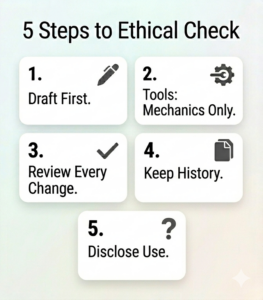
- Start with your own draft first. Write your content, argument, and structure before you run a grammar check. This protects authorship.
- Limit the tool to mechanics unless you have explicit permission. If your institution separates grammar correction from rewriting, stay on the mechanic’s side.
- Review every suggestion and accept selectively. Auto acceptance shifts meaning, tense, and hedging. This matters in research writing.
- Keep a revision trail when possible. Version history in Word or Google Docs helps show authorship and your edits.
- When in doubt, disclose or ask. Send a one sentence email. Example. “Can I use a grammar checker for punctuation and grammar fixes if I do not use rewrite or draft generation features.”
Where Trinka fits (without crossing the integrity line)
If your goal is to correct grammar and keep an academic tone without outsourcing authorship, a discipline aware grammar checker supports careful self-editing. Tools such as Trinka Grammar Checker help you spot grammar, usage, and consistency issues in long academic documents. This includes inconsistent spelling conventions and formatting drift across sections.
If you work with sensitive or unpublished research, data handling matters. Trinka’s Confidential Data Plan (CDP) targets privacy sensitive writing. It states submitted text is not permanently stored and is not used for AI training.
Align your tool use with your course or institutional policy. Avoid features that generate or rewrite substantive content unless your instructor permits them.
Conclusion: Is it cheating? Universities usually care about how you use it
Universities often treat grammar checking as acceptable when it stays in proofreading support for mechanics. Risk rises when a tool rewrites sentences, paraphrases ideas, summarizes sources, or generates draft content. Risk rises again when you submit output as your own without permission or disclosure.
Submission standard. You stay the author of your ideas and your phrasing. The tool stays an editor, not a co-writer. When policies are unclear, ask your instructor and keep a record of your process.

-
Go beyond grammar & spelling
Get holistic language improvements - Write with Trinka