


Why AI misuse is becoming harder to detect

The reason is simple that the tools students use to generate and rewrite text are improving much faster than the software designed to catch them.
Right now, standard AI detectors work by guessing the probability that a finished document was written by a machine.
But the real issue is a fundamental gap between how universities grade assignments and the new ways students create to disregard them.
The Real Story Behind AI Detectors
Over the last two years, universities have poured a lot of money into AI detection software. While the goal was to protect academic honesty, the results have been completely unpredictable.
A study in the International Journal for Educational Integrity looked at 14 popular detectors and found their accuracy rates ranged anywhere from a low 33% to an 81% maximum.
These percentages even with a tiny 4% false-positive rate can make hundreds of honest students face stressful misconduct investigations for work they wrote entirely by themselves.
At the same time, if a detector misses more than 10% of AI text, a massive amount of generated work slips through unnoticed.
The core problem isn’t just that the technology is imperfect; it’s that evaluating a final paper gives professors zero actual proof of how the student arrived at the finish line.
Students Have Moved Beyond Simple AI Copy-Pasting
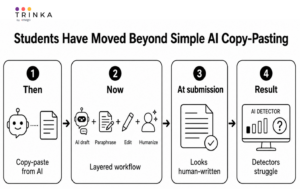
When generative AI first arrived, schools mainly worried about students copying and pasting raw text directly from a chatbot.
Today, students regularly mix AI drafting with paraphrasing tools, manual editing, and specialized “humanizing” software.
By the time they hit submit, the text no longer carries the predictable patterns that AI detectors look for.
Other academic reviews from 2024 and 2025 show that even top-tier, paid detectors struggle to spot AI origins once the text has been rephrased.
The Hidden Bias in Detection Tools
Stanford researchers discovered that over 61% of essays written by non-native English speakers were falsely flagged as AI-generated.
This built-in bias puts international and vulnerable student populations at a major disadvantage and damaging the trust between students and faculty.
Relying entirely on a computer-generated score to make major disciplinary decisions is a massive risk. These numbers are simply too unstable to be trusted blindly.
Moving From Guesswork to Real Evidence
The flaw with AI detectors isn’t just bad programming; it’s a flawed strategy. Scanning a finished PDF cannot tell you if a student genuinely engaged with the prompt, learned the material, or just outsourced their critical thinking to an algorithm.
Trinka’s DocuMark offers a practical shift in perspective. Instead of guessing after the fact, it records the actual writing process in real time.
It tracks keystrokes, edits, pauses, copy-paste actions, and AI interactions as they happen.
Instead of just trying to detect AI use by students, it guides them to review and verify their work and be transparent about how they used these tools.
You get visibility into their process, and students learn to take ownership of what they submit, protecting students’ authorship.
Aligning Strategy with Institutional Policy
To make these solutions work, universities must align their classroom tools with clear institutional guidelines. Trinka’s University AI Policy Repository provides an open database tracking how over 100 leading institutions handle AI governance, disclosure requirements, and academic integrity.
By reviewing these frameworks, administrators can see exactly how peer universities define acceptable use, moving away from unrealistic blanket bans toward structured, transparent disclosure rules.
Sources and References
- Weber-Wulff, D., Anohina-Naumeca, A., Bjelobaba, S., et al. (2023). Testing of detection tools for AI-generated text. International Journal for Educational Integrity, 19(1), Article 26. https://link.springer.com/article/10.1007/s40979-023-00122-7
- Liang, W., Yuksekgonul, M., Mao, Y., Wu, E., & Zou, J. (2023). GPT detectors are biased against non-native English writers. Patterns. https://doi.org/10.1016/j.patter.2023.100779
- (2024). 2024 EDUCAUSE action plan: AI policies and guidelines. https://www.educause.edu/research/2024/2024-educause-action-plan-ai-policies-and-guidelines
- Turnitin & Vanson Bourne. (2025). Academic community beliefs on AI misuse in institutions. https://www.turnitin.com/blog/what-are-the-new-and-emerging-trends-in-academic-misconduct
- Asselta Law. (2025). Temple University evaluation of Turnitin AI detection accuracy. https://blogs.ncl.ac.uk/sin/2025/08/05/the-unfairness-of-ai-flagged-academic-misconduct-investigations-in-uk-universities/
Enhance Your Writing with Trinka’s Grammar Checker
Trinka’s Grammar Checker is designed to help writers produce clear, polished, and publication-ready content with ease. Whether you’re drafting academic papers, professional documents, or blog posts, Trinka ensures your writing is precise, consistent, and impactful, making it a trusted companion for anyone aiming to communicate effectively in English.
Frequently Asked Questions
Why are AI detection tools getting less reliable over time? ▼
Detectors look for fixed patterns in machine text. As AI models get smarter and students use rewriting software, those patterns vanish, making traditional detectors highly inaccurate.
Do universities have to adopt process tracking all at once?▼
No. Departments or individual professors can easily run small pilot programs in their specific courses before the university decides on a wider rollout.
Who can use DocuMark?▼
DocuMark is designed for instructors and administrators seeking to reduce academic integrity violations and faculty stress. It helps teachers shift from AI policing to learning outcomes while providing administrators clear data to reinforce AI policies.
What platforms does DocuMark work on?▼
DocuMark works on Trinka Cloud, MS Word, and Google Docs. It can also be easily integrated into the institute’s existing LMS systems.

-
Go beyond grammar & spelling
Get holistic language improvements - Write with Trinka