Teaching & Learning
- Whether assistance is authorized may depend on instructor, departmental, and/or university policy
- For coursework submitted for credit, students must produce original work without unauthorized assistance
- AI-generated material cannot be presented as the student's own work, and any use of AI-generated source material must be properly cited
The principle of academic honesty is understood to include the writing of papers, reports, quizzes, presentations, projects and examinations, as well as the creation of art, design, performance, or compositional (music and coding) work. Students are expected to participate fully in their academic studies by contributing their own ideas and understanding to each assignment. All material submitted for credit must be original work created for a specific assignment without any unauthorized assistance.
All art, design, performance and compositional work, and all written work, must be the original work of the student and a result of their independent effort. Any work previously created by the student for another project and/or purpose may not be reused and claimed as original work unless authorized by the instructor. This includes misrepresenting work/material either created by someone else or AI-generated as one’s own, or buying or selling written or visual work to be turned in for a class.
Any quotations, paraphrases, or direct appropriation of imagery or ideas from source material, including that generated by AI, must be properly cited according to university, departmental, and/or instructor policy.
- AI use in exams and other assessments is prohibited unless the instructor has specifically authorized it
- The policy treats unauthorized AI-generated answers or materials during test-taking as cheating, and students must follow instructor test-taking instructions
The principle of academic honesty is understood to include the writing of papers, reports, quizzes, presentations, projects and examinations, as well as the creation of art, design, performance, or compositional (music and coding) work.
Cheating is defined as accepting or giving aid to another during a written exam or for a written report unless authorized by the instructor, or accepting or giving aid to another for an individual studio project unless authorized by the instructor.
Cheating also includes dependence on sources, other than those specifically authorized by the instructor; possession of tests or other materials before such materials have been distributed by the instructor, unless prior permission is granted; unauthorized use of AI-generated answers or materials; failing to abide by the instructions of the instructor with respect to test-taking procedures;
- Instructor authorization can create exceptions
- Programming and coding work is covered by the university's academic honesty rules
- Students must submit original coding work without unauthorized assistance, and AI-generated coding output cannot be misrepresented as the student's own work
The principle of academic honesty is understood to include the writing of papers, reports, quizzes, presentations, projects and examinations, as well as the creation of art, design, performance, or compositional (music and coding) work. Students are expected to participate fully in their academic studies by contributing their own ideas and understanding to each assignment. All material submitted for credit must be original work created for a specific assignment without any unauthorized assistance.
All art, design, performance and compositional work, and all written work, must be the original work of the student and a result of their independent effort.
This includes misrepresenting work/material either created by someone else or AI-generated as one’s own, or buying or selling written or visual work to be turned in for a class.
Research
Academic Integrity
- Collaborative work used in whole or in part must also be acknowledged and attributed to all co-creators
- When students use AI-generated source material, they must properly cite it according to university, departmental, and/or instructor policy
Any quotations, paraphrases, or direct appropriation of imagery or ideas from source material, including that generated by AI, must be properly cited according to university, departmental, and/or instructor policy. All work created in collaboration used in whole (or in part) must be acknowledged as such, and correctly attributed to all co-creators.
- The sources do not define any AI detection tools
- The university states that AI-related academic honesty violations are handled individually and may lead to suspension or dismissal
- Plagiarism involving AI can result in a zero on the assignment, reporting to the Department Director and Executive Office, an F for the course, a transcript notation, and for multiple violations, suspension or permanent dismissal
Academy of Art University addresses violations of this academic honesty policy on an individual basis. Academic honesty violations may be grounds for suspension or dismissal.
Any student who plagiarizes will receive a zero for that assignment or project, with no opportunity to do the assignment again. All plagiarism offenses will be reported to the Department Director and to the Executive Office. Multiple instances of plagiarism in a single class will result in a final course grade of F, and a notation will be indicated on the student’s transcript.
Plagiarism is a violation of Academy of Art University’s Academic Honesty Policy. Multiple plagiarism violations will be grounds for suspension or permanent dismissal from Academy of Art University. This policy as written in the Student and Academic Policies constitutes an official warning to each student.
Institutional & Administrative
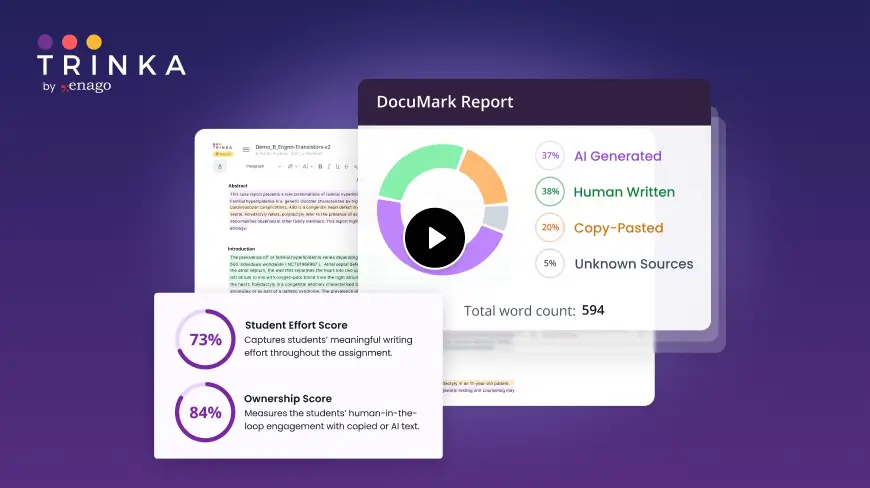
DocuMark: Responsible AI Use for Academic Integrity
Knowing your institution's AI policy is step one. DocuMark helps enforce it fairly by empowering universities to manage AI-generated content, prevent cheating, and support student writing through responsible AI use.
Common Questions About Academy of Art University's AI Policies
Academy of Art University has defined AI policies in 5 of 12 categories, with an overall coverage score of 42%.
When students use AI-generated source material, they must properly cite it according to university, departmental, and/or instructor policy. Collaborative work used in whole or in part must also be acknowledged and attributed to all co-creators.
The university states that AI-related academic honesty violations are handled individually and may lead to suspension or dismissal. Plagiarism involving AI can result in a zero on the assignment, reporting to the Department Director and Executive Office, an F for the course, a transcript notation, and for multiple violations, suspension or permanent dismissal. The sources do not define any AI detection tools.
No explicit data protection or approved AI platform policy is currently defined in the available policy sources.